CastleAsparn an der Zaya

Asparn Castle

Asparn Castle

Museum

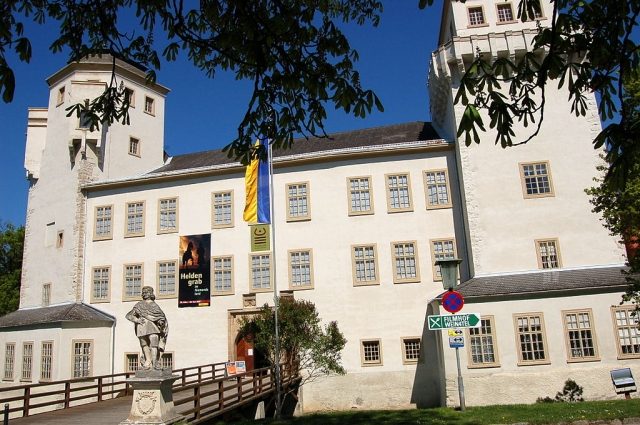
Asparn Castle is located in the market town of Asparn an der Zaya in the Weinviertel region of Lower Austria. Since 1970, it has housed the Museum of Prehistory.

Hademar von Sonnberg built a castle in the second half of the 13th century on the remains of a fortress already mentioned in 1121. The Sonnbergs held the castle until 1348, then the Tursen von Rauheneck-Asparn. In 1397, Asparn became a princely fief for the Lords of Walsee, who had the castle rebuilt from 1421. The two massive corner towers, one with two oriels and the other with a battlement, date from this period. In 1443, Asparn passed to Ulrich von Eyczing and in 1463 fell to Emperor Frederick III. In the 16th century, the mortgaged lordship of Asparn was held by various families, including the Gall von Loosdorf.

In 1610, Count Seyfried Christoph von Breuner acquired the lordship as his own property and expanded the castle into his main residence. The two sandstone figures in front of the castle gate also originate from him. In 1645, the Swedes devastated the castle; the restoration work in 1651 gave the castle its present appearance.

In 1820, the north wing of the building was demolished due to dilapidation. In 1945, the Russian occupation caused extensive damage, especially to the interior.

Asparn Castle remained in the possession of the Breuner family. Like the second important Breuner castle in Lower Austria, Grafenegg, it passed to the Metternich-Sandor family after the extinction of the family, to whom Asparn still belongs today.

In 1949, the Weinlandmuseum (Wine Country Museum) was established in the castle. In 1967, the Province of Lower Austria rented the building to open the Lower Austrian State Museum of Prehistory here after extensive renovation.

In 2010, the Province of Lower Austria bought it and intends to invest further. Exhibits from the Traismauer Museum are to be moved here. In 2013, a part of the provincial exhibition is planned here together with Poysdorf.

Prehistory Museum+

The museum was founded as an outpost of the Lower Austrian State Museum. In 23 rooms, with approximately 3000 exhibits, the history of the pre-literate prehistoric era in Lower Austria is shown within the context of overall European events. The prehistoric finds from Lower Austria present the beginnings of human history with objects from the Stone Age up to the time around the birth of Christ.

In 2002, the museum was completely redesigned.

A focus of the permanent exhibition is the presentation of human dwelling forms. The castle park was used for the creation of an associated open-air museum with reconstructions of prehistoric buildings.

Since the museum's founding, Asparn has been a leader in experimental archaeology. Demonstrations of historical craft techniques, special seminars and workshops, as well as prehistoric themed events such as the Celtic Festival, Stone Age Festival, or the Long Night of Celtic Fire, bring the museum to life.

The director of the museum is the provincial archaeologist for prehistory, early history, and medieval archaeology, Ernst Lauermann.

Take Mobile History with you

You are reading this text for free. Premium adds what matters on the road: descriptions read aloud, sites found through your camera, whole regions taken offline.

  • Every description, including the ~17,700 Premium sites
  • Audio guide: have descriptions read to you on location
  • AR finder: see sites through your camera, with distance and bearing
  • Unlimited saved sites

14 days free, then from €2.99 a month. Cancel anytime.

Source: Wikipedia · Licence: CC BY-SA 4.0 · Image: https://commons.wikimedia.org/wiki/File:Asparn_Zaya_Schloss.JPG

This description draws on the facts documented in the linked Wikipedia article; Wikipedia content is licensed under CC BY-SA 4.0. Wording and editing: Mobile History.

Location: 48.5890, 16.4914