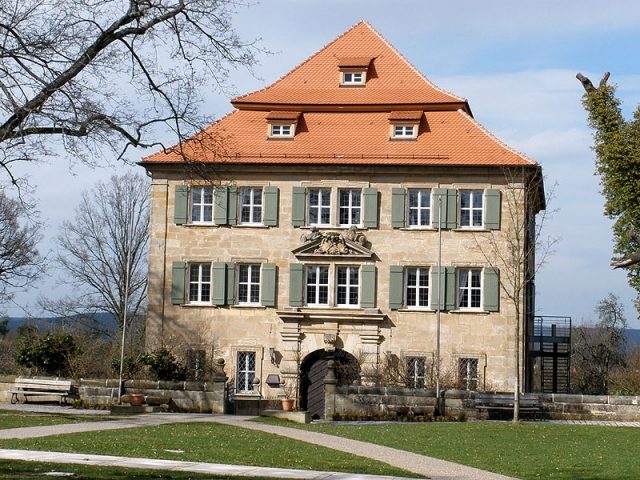
CastleAtzelsberg

Atzelsberg Castle

Atzelsberg Castle

Restaurant

The ownership of a "Hof zu Atzelsberg" can first be precisely attributed by name to a Leupold from the noble Strobel family in 1394. Originally, it was probably a free-owned property of this wealthy ministerial family, perhaps dating back to the 13th or even 12th century. From the early 15th century, Atzelsberg was granted as a margravial-Brandenburg knight's fief in exchange for services, and from the early 17th century, it was granted as a free hereditary leasehold in exchange for payment; the dues went to the Uttenreuth administration office.

Documentary evidence from the 15th century of a "Sitz" Atzelsberg (1432), a fortified dwelling ("castrum", 1435) or a "Sloß" (1441) indicates – perhaps much older – predecessor buildings of the current castle. The manor house of the Knights Strobel and their successors, destroyed by Nuremberg mercenaries in a feud with the Margrave in 1450, was rebuilt, but suffered destruction again in the Second Margrave War (1553). A description from 1616 speaks of a burned-down castle ruin with a tower. The manor soon after apparently served as a residence in a large two-story house.

During the Thirty Years' War, Atzelsberg was plundered and burned down (1631/1632). The rapidly changing owners of the 17th century struggled painstakingly and often in vain to rebuild or maintain the Atzelsberg estate and could hardly think of re-erecting the castle.

The turning point of 1705 by Johann Conradt von Seutter

This only changed when the wealthy Nuremberg merchant Johann Conradt von Seutter, capable and willing to make large investments, acquired the Atzelsberg estate in January 1705 and renewed and expanded the agricultural buildings. Even before he was elevated to the imperial nobility by the German Emperor, he was probably interested in a residence in the style of a noble seat. In 1705, he also had the baroque castle built in its present form as a three-story, almost square ashlar building with a once-set hipped roof. The master masons were the Moßer brothers, the carpenter Andreas Patter, all three perhaps from Cadolzburg.

In 1714, the new lord of the castle succeeded, thanks to special payments to the treasury of Margrave Georg Wilhelm of Brandenburg-Bayreuth, in converting his estate from his superior ownership into a freely inheritable private estate. With the transfer of lower jurisdiction to Baron von Seutter, Atzelsberg also became a knight's estate again.

In the hands of the von Wahler and Schrodt families (1763-1960)

After the death of his widow Helena Freifrau von Seutter (1748), the estate and castle passed to the Bayreuth Imperial Baron Conrad Friedrich von Hagen, who had little interest in it and sold it 15 years later.

In 1763, another wealthy, already ennobled Nuremberg merchant became the owner of Atzelsberg. Johann Andreas von Wahler found 12 households with 50 people on the estate at that time. In 1790, one year before his death, he had the stone bridge built over the moat.

In a remarkable continuity of ownership, the estate and castle remained in the hands of the von Wahler families (until 1849) and later the family of his son-in-law Franz Schrodt, whose descendants managed the castle estate until 1960 and then sold it to the city of Erlangen.

"From Knight's Seat to Castle for Citizens" (Inge Meidinger-Geise)

Already in 1834, the last von Wahler renounced his patrimonial jurisdiction. With the completion of peasant liberation in the revolutionary year 1848, the knight's estate became a castle estate, and the Atzelsberg estate subjects became personally independent estate tenants.

When the city of Erlangen, under Mayor Dr. Heinrich Lades, acquired the castle, located in the district territory, and an area of 1.2 million square meters from the Schrodt heirs' community in 1961, it now even came into the direct possession of the citizenry.

Because the city of Erlangen no longer wanted to bear the urgently needed investments for the preservation of the building and the safety of its visitors itself, Erlangen parted with its showcase property again in 2004.

Since September 2005, every visitor to Atzelsberg can now see for themselves the restoration of the castle to its old splendor by the Johann Schorr family company.

Take Mobile History with you

You are reading this text for free. Premium adds what matters on the road: descriptions read aloud, sites found through your camera, whole regions taken offline.

  • Every description, including the ~17,700 Premium sites
  • Audio guide: have descriptions read to you on location
  • AR finder: see sites through your camera, with distance and bearing
  • Unlimited saved sites

14 days free, then from €2.99 a month. Cancel anytime.

Source: Wikipedia · Licence: CC BY-SA 4.0

This description draws on the facts documented in the linked Wikipedia article; Wikipedia content is licensed under CC BY-SA 4.0. Wording and editing: Mobile History.

Location: 49.6267, 11.0418