To be privately owned
Bach Castle

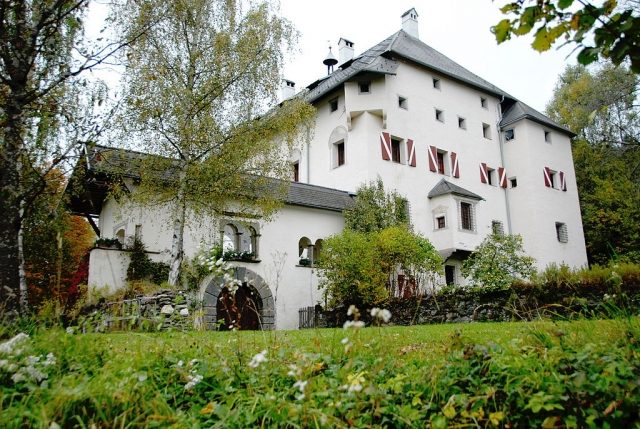
Bach Castle is a Renaissance building in the municipality of Sankt Urban in Carinthia. It is located on a hillside north of Lake Sankt Urban near the hamlet of Bach.
The castle in its current form was built in the 16th century. The predecessor building, a medieval ministerial tower, was first mentioned in documents in 1192 as the seat of a ministerialis (Wigant de Bach) and in 1433 as "turm ze Pach" (tower at Pach) owned by the Mordax family. After 1569, Hannibal Eghk von Hungersbach was the owner. Christoph Freiherr von Egkh had the old castle converted into the present Renaissance castle in 1596. The arcaded walkway between the castle and the farm building was added in 1609 under Carl Freiherr von Egkh. The latter had to leave the country in 1614 as a Protestant. Subsequently, the noble residence had various owners. In 1739, a castle chapel was consecrated, which, along with the farm buildings, fell victim to a fire in 1890. An interior restoration took place between 1997 and 1999. During this time, the bricked-up arcades of the eastern loggia were opened and frescoes in the second upper floor were uncovered.
The building is privately owned and not open to the public. Rooms are rented for conferences and other events.
Description+
Bach Castle is a mighty, irregular building complex consisting of towers, oriels, and arcades, covered with a high, shingle-covered hip roof. At the northeastern and southwestern corners, there is a projecting square tower, and at the other two corners on the top floor, there is an oriel on corbels. In the middle of the north side, a short wing with coupled windows is attached. The current facades date from the 16th century. The round-arched, profiled main gate in the south of the building is made of red sandstone. Twin windows are installed on the second and third floors of the north and south sides.
A cross-vaulted corridor runs through the ground floor. On the second and third floors, a hall extends through the entire length of the building. The ceilings of the upper floors are coffered ceilings. They are decorated with so-called "Fladerpapieren", a rare decoration for the Renaissance period of the 16th century, consisting of glued-on woodcuts with wood grain framed by ornamental bands.
Take Mobile History with you
You are reading this text for free. Premium adds what matters on the road: descriptions read aloud, sites found through your camera, whole regions taken offline.
- Every description, including the ~17,700 Premium sites
- Audio guide: have descriptions read to you on location
- AR finder: see sites through your camera, with distance and bearing
- Unlimited saved sites
14 days free, then from €2.99 a month. Cancel anytime.
Source: Wikipedia · Licence: CC BY-SA 4.0 · Image: http://commons.wikimedia.org/wiki/File:Sankt_Urban_Schloss_Bach_09.jpg
This description draws on the facts documented in the linked Wikipedia article; Wikipedia content is licensed under CC BY-SA 4.0. Wording and editing: Mobile History.
Location: 46.7493, 14.1606