Museum
Restaurant
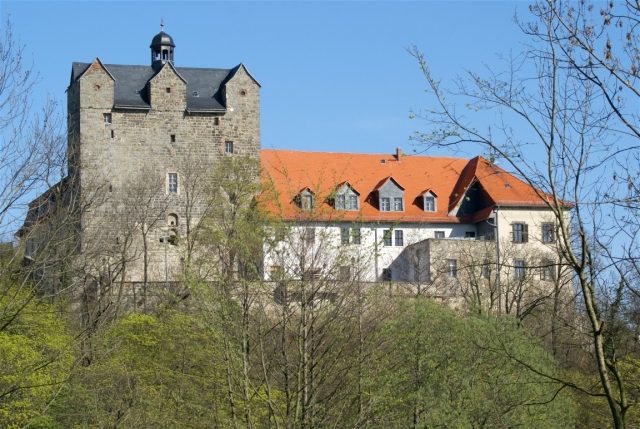
Ballenstedt Castle

Ballenstedt Castle is located in the west of the city on a northern spur of the Harz Mountains. Thanks to its exposed location, it majestically towers over all other buildings of the former residential city of the Princes of Anhalt-Bernburg. The first confirmed mention of Ballenstedt in a document by King Henry IV dates back to 1173. But even before that, Count Esiko of Ballenstedt and Aschersleben, who is considered the progenitor of the Ascanians (derived from Aschersleben), is said to have founded an Augustinian monastery on the site of the present castle in the first quarter of the 11th century, which is said to have been consecrated in 1046 in the presence of King Henry III and was converted into a Benedictine monastery in 1123 by Albert the Bear and his father Otto the Rich. At that time, the castle and monastery existed within the same walls. The history of the present castle begins with the secularization in 1525, after the monastery had been stormed by rebellious peasants. The remaining buildings served as a summer residence for the Princes of Anhalt-Bernburg from the 16th to the 18th century. In the first half of the 18th century, it was expanded into the three-winged Baroque castle complex that still exists today. Parts of the Romanesque period were integrated into this new building, including the massive tower of the former monastery church. The present castle church, built in 1748, also rests on medieval foundations. This is one reason why the castle is an important stop on the Romanesque Road today.
In 1765, Ballenstedt with its representative castle was elevated to a residence by the Princes of Anhalt-Bernburg. In accordance with its new status, the city received an impressive theater building in the immediate vicinity of the castle complex. This castle theater was completed in 1788 and soon became the workplace of important contemporary artists and musicians. Also at this time, an extensive castle park was laid out, the northern part of which was redesigned around 1860 by Peter Joseph Lenné into the charming Renaissance-style landscape garden that exists today.
After the First World War, Ballenstedt Castle served as the residence of the princely family until their expulsion and expropriation in 1945 by the Communists. The large building was subsequently used for several decades until 1990 as an engineering school for forestry.
Today, you will find a restaurant, a museum, and various exhibitions in the rooms of the castle. The castle church is also popular as a venue for civil and church weddings. Another attraction is the tomb of "Albert the Bear" in the tower chapel of the castle.
Take Mobile History with you
You are reading this text for free. Premium adds what matters on the road: descriptions read aloud, sites found through your camera, whole regions taken offline.
- Every description, including the ~17,700 Premium sites
- Audio guide: have descriptions read to you on location
- AR finder: see sites through your camera, with distance and bearing
- Unlimited saved sites
14 days free, then from €2.99 a month. Cancel anytime.
Source: Wikipedia · Licence: CC BY-SA 4.0 · Image: Roland Neubert, Halle (Saale)
This description draws on the facts documented in the linked Wikipedia article; Wikipedia content is licensed under CC BY-SA 4.0. Wording and editing: Mobile History.
Location: 51.7186, 11.2185