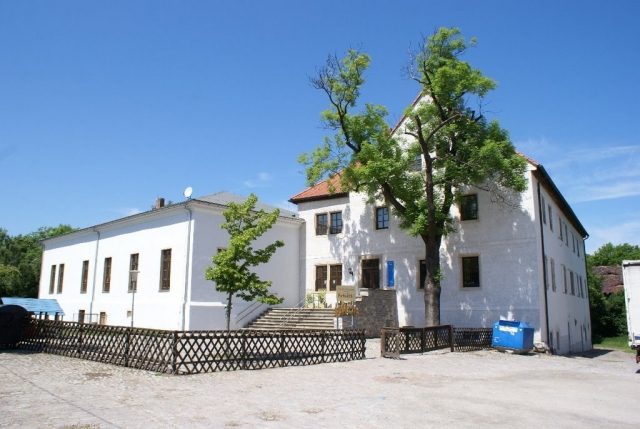
To be privately owned
Beesenlaublingen Castle

The Historic Building: A Journey Through Time+
From Renaissance Castle to Modern Landmark+
The castle was built in the 2nd half of the 16th century.
Originally conceived as a magnificent Renaissance castle, the building has undergone numerous transformations throughout its history. Each era has left its mark, making the castle a unique witness to architectural and cultural change.
The Renaissance Period: Origins and First Flourishing
The construction of the castle began around 1560 under the patronage of Duke Albrecht V. of Bavaria. The initial design reflected the typical features of Renaissance architecture: symmetrical facades, ornate portals, and spacious courtyards. The castle served not only as a residence but also as a representative seat of power.
- Construction start: approx. 1560
- Architectural style: Renaissance
- Original function: Ducal residence and administrative seat
Baroque Expansion: Grandeur and Splendor
In the 17th century, under Duke Ferdinand Maria, the castle experienced a significant Baroque expansion. New wings were added, and the interiors were lavishly decorated with frescoes, stucco, and valuable tapestries. The castle became a center of courtly life and hosted numerous festivities and cultural events.
A particularly impressive addition from this period is the "Great Hall," known for its breathtaking ceiling paintings and opulent chandeliers. This hall was used for banquets and receptions and still impresses visitors today with its splendor.
The 19th Century: Changes and New Uses
The 19th century brought further changes. After the secularization, the castle changed hands several times and was used for various purposes, including as a military hospital and a school. Despite these functional changes, efforts were made to preserve the historical substance of the building.
During this period, some parts of the castle were adapted to the prevailing tastes of historicism, which is reflected in certain interior design elements and facade details.
The 20th Century to Today: Preservation and Public Access
In the 20th century, the importance of the castle as a cultural monument was increasingly recognized. Extensive restoration work began to preserve the building for future generations. Today, the castle is open to the public and houses a museum that vividly presents its eventful history.
Regular exhibitions, concerts, and guided tours attract numerous visitors from all over the world. The castle has thus become a vibrant cultural center and a popular destination for history and art lovers.
Architectural Features and Highlights+
The castle impresses with a variety of architectural styles that reflect its long history. From the robust Renaissance foundations to the playful Baroque decorations and later additions, every detail tells a story.
The Courtyard: A Journey Through Time
The inner courtyard is a central element of the complex and offers a fascinating overview of the different construction phases. Here, Renaissance arcades meet Baroque window frames, creating a unique architectural ensemble.
The Chapel: A Place of Contemplation
The castle chapel, consecrated in 1680, is a jewel of Baroque sacred art. Its richly decorated altar, the impressive frescoes, and the detailed wood carvings invite contemplation and admiration.
The Castle Garden: An Oasis of Peace
Surrounding the castle is a spacious garden that was originally laid out in the Baroque style. Today, it combines historical elements with modern landscape design and offers an oasis of peace and relaxation. Sculptures, fountains, and carefully maintained flower beds invite you to stroll and linger.
The Castle as a Cultural Center+
Today, the castle is more than just a historical building; it is a lively cultural center that offers a diverse program for all ages.
- Museum with permanent and special exhibitions
- Concerts and cultural events
- Educational programs for schools and groups
- Venue for private events and conferences
The castle thus plays an important role in the cultural life of the region and contributes significantly to the preservation and communication of historical heritage.
Take Mobile History with you
You are reading this text for free. Premium adds what matters on the road: descriptions read aloud, sites found through your camera, whole regions taken offline.
- Every description, including the ~17,700 Premium sites
- Audio guide: have descriptions read to you on location
- AR finder: see sites through your camera, with distance and bearing
- Unlimited saved sites
14 days free, then from €2.99 a month. Cancel anytime.
Location: 51.7145, 11.6958