CastleHörselberg-Hainich-Behringen

Behringen Castle
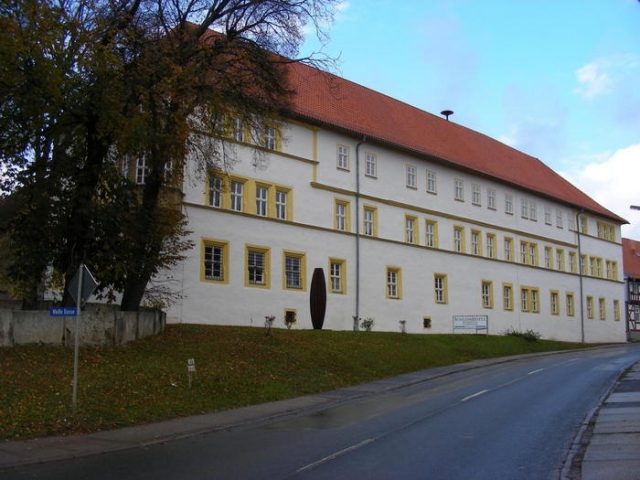
Behringen Castle

Hotel

Behringen Castle in Behringen am Hainich in Thuringia dates predominantly from the Renaissance and Baroque periods. It was built from the 16th century onwards by the noble family von Wangenheim, in whose possession it remained until its expropriation in 1945.

There was probably a predecessor building in the southeastern area of the current castle. Under Friedrich the Middle von Wangenheim, the construction of the current castle began in the mid-16th century during the early Renaissance. Parts of the south wing, the bay window, the un-demolished lower parts of the stair tower, and the lower area of the southern part of the east wing date from this period. Although an inscription on the bay window states that construction began as early as 1517, 1547 was later assumed. A year before, Friedrich the Middle had taken over Großbehringen. The castle was inhabited by Friedrich and his family from at least 1567.

After a fire in 1621, extensive interior renovations were carried out under Balthasar von Wangenheim. The half-timbered structure in the middle part of the east wing also dates from the 17th century. During the Thirty Years' War, the castle burned again in 1631 and was plundered in 1632. After that, it was uninhabited for a time. During the Baroque period, major construction measures took place, especially in the interior of the castle. During this time, from 1743 to 1792, Ernst Wilhelm von Wangenheim lived in the castle and probably initiated the extensions. He also had the large castle park laid out. The stair tower was raised to its towering height in the 17th or 18th century. Before 1874, the old north wing had been demolished and replaced by a new one. The half-timbered upper floors of the north and west wings date from the early 20th century. Othmar von Wangenheim, who owned the castle and estate from 1928, also carried out renovations and extensions.

In the German War, on June 27, 1866, Prussian troops from Minden and Hamburg were defeated by the army of the Kingdom of Hanover in the Battle of Langensalza, which nevertheless capitulated two days later to the superior Prussian army. Behringen Castle housed King George V of Hanover and his general staff on June 24 and 25, 1866, and negotiations with the Prussian General Alvensleben also took place here. Military historians today consider the day of negotiations in Behringen to be the reason for the later defeat of the Hanoverians. This delay gave the more distant Prussian units time and opportunity to thwart the further advance of the Hanoverians to the south.

Behringen Castle was expropriated without compensation in 1946 and became state property. From 1949, it housed a psychiatric and nursing home. This involved considerable alterations. The tower dome and octagon were demolished, and the west wing was gutted and rebuilt in the late 1980s. An intermediate building was erected on the north side of the south wing, and an extensive annex for technical facilities was added on the north side of the castle courtyard. After 2000, the castle was extensively restored and freed from the additions. In 2007, the Behringen Castle Hotel was presented to the Prime Minister of Thuringia as a "barrier-free European youth castle" by Grenzenlos GmbH.

The former inspector's house, located to the east of the castle, was restored and began its new function as a local history museum and community library in 2000.

The 18th-century castle park (338 ares) is partially preserved. Its 200-year-old Weymouth pine is well-known. Other rare tree species were lost, and new plantings have been made. A 6 km long sculpture hiking trail starts in the park and leads to Hütscherode; it was laid out with modern sculptures after 1996. The Rennstieg des Hainich, which leads over 32 km to Eigenrieden, also begins in Behringen Castle Park.

Othmar von Wangenheim's daughter, Baroness Elisabeth von Wangenheim-Winterstein, lived in the castle with her husband, Grand Duke Karl August of Saxe-Weimar and Eisenach, in 1944/45. Heavily pregnant, she fled to West Germany in June 1945, shortly before the arrival of the Red Army. Even after reunification, the last lady of the castle did not want to visit Behringen again, to keep it in her memory as it was in her childhood and youth. Elisabeth died in 2010 as Hereditary Grand Duchess of Saxe-Weimar and Eisenach in Munich and was buried at Wartburg Castle.

Take Mobile History with you

You are reading this text for free. Premium adds what matters on the road: descriptions read aloud, sites found through your camera, whole regions taken offline.

  • Every description, including the ~17,700 Premium sites
  • Audio guide: have descriptions read to you on location
  • AR finder: see sites through your camera, with distance and bearing
  • Unlimited saved sites

14 days free, then from €2.99 a month. Cancel anytime.

Source: Wikipedia · Licence: CC BY-SA 4.0 · Image: http://www.wehrbauten.de/thread.php?threadid=615

This description draws on the facts documented in the linked Wikipedia article; Wikipedia content is licensed under CC BY-SA 4.0. Wording and editing: Mobile History.

Location: 51.0226, 10.5140