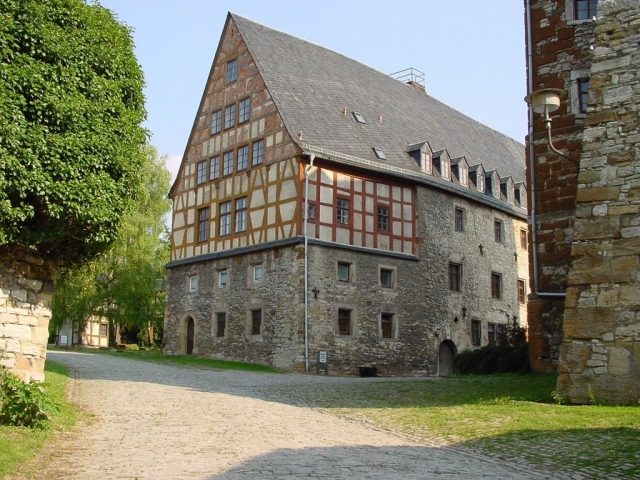
CastleBeichlingen

Beichlingen Castle

Beichlingen Castle

To be privately owned

Beichlingen Castle is located in the village of Beichlingen, about 9 km north of Kölleda in Thuringia.

Beginnings until 1945

North and south of the current castle, extensive prehistoric or early historical ramparts are preserved, which extend significantly beyond the later medieval castle. Beichlingen Castle was probably built by King Henry I to protect an important pass road to the Unstrut Valley. It was likely originally imperial property. Beichlingen was first mentioned in 1014 as a castle in a document by Bishop Thietmar of Merseburg. During an armed conflict between King Henry IV and Margrave Dedo II, the castle was conquered and destroyed. In the following years, the castle was rebuilt and around 1080 was the residence of Countess Kunigunde of Weimar-Orlamünde. After the assassination of her second husband Kuno von Northeim, Count of Beichlingen, in 1103 and the death of her third husband, Count Wiprecht von Groitzsch in 1124, Kunigunde managed with great difficulty to maintain possession until her death in 1140. From 1141, a Count Friedrich von Beichlingen was named as lord of Beichlingen and founder of the Beichlingen noble family. From 1330, the economic decline of the Beichlingen noble family began. In 1519, Count Adam von Beichlingen finally had to sell the castle and most of the county to Hans von Werthern from Wiehe (Thuringia). Soon after, Dietrich von Werthern, son of Hans von Werthern, took up residence at Beichlingen Castle. Dietrich's son, Wolfgang von Werthern, together with his brothers, had the dilapidated castle complex rebuilt.

Subsequent generations of the Werthern family continued to expand and remodel the castle. From 1588, Johann von Werthern commissioned renowned regional artists to decorate the castle. Around 1650, Friedrich von Werthern invested considerable financial resources to repair the damage to the castle left by the Thirty Years' War. In the following decades and centuries, the castle was increasingly transformed into a palace by the von Werthern family, in accordance with the taste of the time. From 1901 to 1904, a fundamental redesign of the interiors took place. The von Werthern-Beichlingen family produced many important personalities in state service and highly decorated officers. A number of members of the noble family were confirmed by emperors in the office of "Imperial Hereditary Chamber Door-Keeper of the Holy Roman Empire of the German Nation". These were responsible for ensuring that the respective imperial election in Frankfurt took place in secret.

1945 until now

The castle complex was not damaged during the Second World War. From 1944, refugees were quartered in the castle buildings. In 1945, Beichlingen initially belonged to the US occupation zone. The castle was used by members of the US Army as a commandant's office. After its handover to the Red Army and integration into the Soviet occupation zone, Beichlingen Castle and its dominion were expropriated without compensation as part of the so-called land reform. The comital family - the count had fallen in France in 1940 - had left the castle before the Red Army arrived. Subsequently, the castle was partially plundered. From 1946 to 1951, a teacher training college was initially housed in the castle. From 1952 to 1955, the GDR used the castle as a training center for kindergarten teachers. From 1955 to 1962, the school of the Association of Mutual Peasant Aid was located in the castle. This was followed by its use as a technical college for veterinary technicians from 1962 to 1969. In 1969, this technical college was converted into the Engineering School for Veterinary Medicine. From 1970, numerous buildings of the farmyard were converted or demolished for this school and replaced by new buildings, which fundamentally changed the appearance of the farmyard: "Massive structural interventions". "Today and certainly for some time to come, the great damage and losses to the historically grown building fabric caused by the inappropriate use of the castle complex remain." After German reunification, the end came for the engineering school, which was closed in 1992. Already in 1991, a support association for the rescue and preservation of Beichlingen Castle had been founded. Since 2001, the castle has been back in private ownership, but the support association can continue its work.

Current Castle+

The castle complex consists of the "Lehnshaus" (Feudal House) with the "Kalte Tor" (Cold Gate) as a passage, the "Hohe Haus" (High House) as the oldest part of the building from the 13th century with valuable Renaissance rooms, the "Neue Schloss" (New Castle) with beautiful Renaissance portals and windows, the castle chapel, and a boarding school building from the GDR era. The castle church, built of quarry stone, was extended in the 17th century by a north wing and is connected to the castle by a rare "Kirchengang" (church passage), a covered half-timbered bridge. Inside, late Renaissance stucco work and baroque furnishings with a valuable stucco ceiling have been preserved. The Hohe Haus has rich furnishings with unspoiled original painting on the wooden walls and ceilings, as well as stucco frames on the portals depicting biblical motifs. This is the description from 2007 by the German Foundation for Monument Protection, which, among other things, supported the restoration of the castle chapel, the castle church, and the Old Distillery.

Personalities+
  • Count Georg von Werthern (1700–1768) was a politician in the service of the Elector of Saxony/King of Poland and the Duke of Saxe-Weimar, "Imperial Hereditary Chamber Door-Keeper".
  • Count Johann Georg Heinrich von Werthern (1735–1790) was Prussian Minister of War in the last years of Frederick II, the Great.
  • Count Georg von Werthern (1816–1895) was a Prussian diplomat, as such Ambassador of Prussia to the Kingdom of Bavaria. He was a "pioneer of the national idea" and rendered great services to the inclusion of Bavaria in the German Empire. His tomb is located on the Weißen Berg near Beichlingen Castle.
  • Count Thilo von Werthern-Beichlingen (1914–1986), officer, Knight's Cross recipient in 1941, was (since his brother Ottobald fell in 1942) the last owner of Beichlingen Castle and Estate. His wife Walpurgis von Werthern, née Princess zu Stolberg-Wernigerode, managed the family property until the expropriation in 1945.
  • Elisabeth Countess von Werthern, née Countess von Wedel, (1916–2009) was the wife of one of the last owners of Beichlingen Castle. Her husband Wolfgang fell in the French campaign in 1940, and the young mother became a widow. In 1944, she moved to the neighboring castle of Großneuhausen, which was designated for such a case. After her flight from there before the Red Army in 1945 with a convoy, she became an outstanding personality in the early Federal Republic of Germany. For over 33 years, she was the first managing director of the German Parliamentary Society in Bonn from 1951 to 1984, of which she then became an honorary member. The Countess was a recipient of the Federal Cross of Merit 1st Class. Elisabeth ("Betta") Countess Werthern passed away at the age of 92 on January 24, 2009, in Freiburg and was buried on April 4, 2009, after a ceremony in the Beichlingen Castle Chapel, in the family cemetery there.

Take Mobile History with you

You are reading this text for free. Premium adds what matters on the road: descriptions read aloud, sites found through your camera, whole regions taken offline.

  • Every description, including the ~17,700 Premium sites
  • Audio guide: have descriptions read to you on location
  • AR finder: see sites through your camera, with distance and bearing
  • Unlimited saved sites

14 days free, then from €2.99 a month. Cancel anytime.

Source: Wikipedia · Licence: CC BY-SA 4.0 · Image: Roland Neubert, Halle (Saale)

This description draws on the facts documented in the linked Wikipedia article; Wikipedia content is licensed under CC BY-SA 4.0. Wording and editing: Mobile History.

Location: 51.2350, 11.2603