CastleKrakow am See-Bellin

Bellin Castle
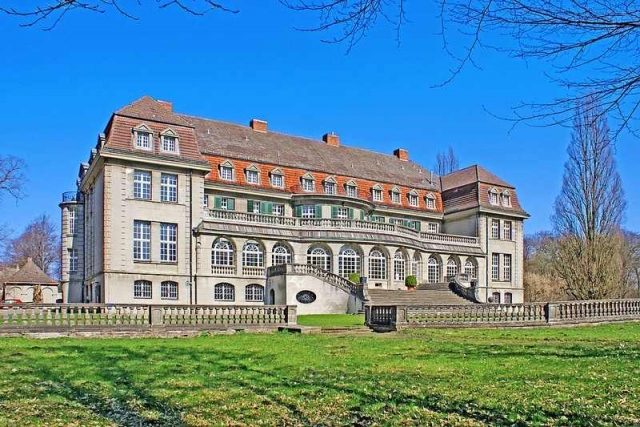
Bellin Castle

Hotel

The Neo-Baroque hunting lodge Bellin, built in 1912, is the centerpiece of a spacious estate in Bellin, Mecklenburg-Vorpommern, and is now used as a hotel and for events.

The castle, built in 1912 by the Hamburg entrepreneur and merchant Henry Brarens Sloman, replaced the classical manor house of a large agricultural enterprise in Bellin. In May 1910, Sloman had bought this approximately 1050-hectare estate for 1,475,000 Reichsmark from Gerhard Freiherr von Marschall, who himself had only acquired it in 1900 from Friedrich Gotthard von Pentz. The manor house demolished by Sloman had been built at the beginning of the 19th century by Christian Friedrich von der Osten-Sacken in place of an older moated castle. The still existing "Goldfish Pond" in the castle park is probably a section of the moated castle's unfilled moat.

Sloman had designated the estate as his retirement home; after his death in 1931, he was buried in a mausoleum he had built in Bellin. From 1935, the eldest son, Enrique Sloman, took over the management of the property. When a magnificent red deer trophy from Bellin's own hunt was displayed at a hunting ring exhibition in 1940, Reichsmaster Hunter Hermann Göring became aware of the game-rich property and offered the Sloman family in vain to buy the estate from them. In 1941, mountain infantry were quartered there, who were on their way to deployment in Norway. In 1944 and 1945, students from Rostock were accommodated in the castle to protect them from bombing raids.

At the end of the war in 1945, Russian troops initially occupied the building. The interior was plundered and the mausoleum desecrated. In 1950, the "Wilhelm Häcker" administration college was established in the castle, where around 90 students were trained. In 1951, the castle's roof truss burned down for unknown reasons. From 1963 to 1979, the castle housed an outpost of the Schwerin District Party School.

Namibian Refugee Children

On December 18, 1979, eighty Namibian children of kindergarten age arrived in Bellin via Berlin-Schönefeld. The castle had been temporarily converted into a children's home at the instigation of Margot Honecker.

After South African troops attacked the SWAPO headquarters in Cassinga on May 4, 1978, SWAPO President Sam Nujoma approached the Central Committee of the SED with the request to take in partial and full orphans as well as refugee children to bring them to safety from the South African occupation force. The GDR leadership supported the project in the hope that Namibia would become a communist state in the future and envisioned the training of the children as future cadres of this state.

As part of the program, around 430 Namibian children came to the GDR by 1986. A total of 298 of them were accommodated in Bellin. After completing primary school, they were transferred from Bellin to Staßfurt for further schooling. The education of the Bellin castle children was provided by Namibian and German teachers as well as a Namibian instructor. In addition to German school lessons, the children received little training in Oshivambo, Namibian dance, and singing. There were roll calls and military drills, and they also learned how to handle rifles. Margot Honecker and Kovambo Theopoldine Nujoma visited frequently.

The stay was initially planned to be temporary, as a SWAPO victory was expected soon. Shortly before German reunification, the children, aged between 8 and 17, were hastily flown back to Namibia by the de Maizière government on August 26, 1990. Due to years of estrangement from their Namibian roots and their limited language skills, the integration of the young people in their homeland was difficult. Some of them later returned to Germany.

One of the Bellin orphanage children, Lucia Engombe, published her experiences in the book "Child No. 95. My German-African Odyssey," which was released by Ullstein Taschenbuchverlag in 2005. The story of another child, Oshosheni Hiveluah (today a film producer in Windhoek), was featured in a special edition of Geo magazine in 2008. In spring 2007, the low-budget film "Wenn uns zwei Berge trennen" (If Two Mountains Separate Us) by Marion Nagel and Martin Reinbold was made on the subject.

The accommodation of the refugee children in the castle until shortly before reunification ensured that the building was always maintained and heated, thus preserving its structural integrity.

After the Wende

In autumn 1990, the Dutch Queen Beatrix visited the castle with her husband Claus. A meeting with German Federal President Richard von Weizsäcker took place there.

After having leased the agricultural land and facilities of the former LPG in the early 1990s, the former Hamburg private banker Friedrich-Wilhelm Sloman, a grandson of the builder, also bought back the castle from the special assets of the Treuhandanstalt in 1996. The Hamburg architectural firm Ehrensberger & Oertz began converting the building into an apartment hotel in autumn 1999. The hotel opened in January 2000 and is now a popular venue, especially for wedding celebrations.

Architecture+

Bellin Castle is considered the most important work of the regionally active architect Paul Korff. It was built according to the client's specifications in a restrained Neo-Baroque style with classical influences from the Gründerzeit. Construction began in 1911 and was completed in 1912. The plastered building has two floors above a basement and a mansard hip roof. On the courtyard side, the castle features a mighty central risalit with a triangular gable and a balcony supported by four columns. On the garden side, an imposing grand staircase was built. The originally roof-glazed winter garden received a concrete ceiling during the renovation work in 1999 (as well as a balustrade, whose balusters are modeled after those of the grand staircase), which now serves as a terrace for the rooms on the first floor. The largely glazed room below, with access to the grand staircase, is 35 meters long and is now used as a dining room.

Ensemble+

The original Baroque ensemble structure of the inner manor courtyard from the 18th century is almost completely preserved. The inner area, formerly used partly as a courtyard of honor and partly as a farmyard, extends approximately 160 meters south from the gatehouse to the present castle, which was built directly behind the classical manor house before its demolition in 1912. The new construction of the castle extended the courtyard of honor by about 20 meters, and the adjoining park was reduced by about 30 meters. The two small, symmetrically opposing, originally probably three-winged, plastered cavalier houses, set in front of the courtyard side, date from the Baroque period of construction. An original triangular gable with the year 1746 is preserved in the house located east of the courtyard of honor. The cavalier house located to the west is in poor structural condition.

The two large farm buildings with hip roofs on the long sides of the courtyard, originally set back about 20 meters and adjoining towards the gatehouse, were extended and renovated by Henry B. Sloman. The eastern farm building is no longer preserved today; it was replaced in the post-war period by two smaller buildings (closer to the courtyard). In the adjoining western cattle yard area, Sloman also renovated stable buildings. Furthermore, he built a machine center and a machine hall on the estate. The large green areas in the middle of the courtyard are now bordered by lime trees planted by Sloman.

Gatehouse

The impressive gatehouse of Bellin is an originally probably plastered brick building with a mansard roof and a dome-crowned lantern tower from the mid-18th century. It is one of the few preserved Baroque manor gatehouses in Mecklenburg-Vorpommern, although it has been redesigned several times. The central risalit on the street side contains a gate passage and two flanking side entrances only on the street side. The gable contains a sandstone coat of arms of the Sala family. The lantern base contains a clock on both the street and courtyard sides. The weather vane bears the years 1910 and 1982.

Park

The Baroque park, laid out around 1750 to the south of the former manor house, was transformed into a landscape park in the 19th century. With the construction of the castle, which extended into the former park in 1912, it received a Neo-Baroque design. An encompassing rose garden no longer exists today. The heavily wooded park on the sides extended – bounded to the north by the large park pond or the "Goldfish Pond" – to the fields made accessible for agriculture by Sloman through drainage in the south of the estate. The park grounds are now surrounded by a stone wall. The tree and shrub population of the park includes English oaks, common beeches, tulip magnolias, giant arborvitae, Japanese cedars, and pyramidal oaks. A small pavilion, presumably from the Baroque era, stands by the park pond. The park pond is enclosed by walls and stairs. Sloman had the park pond ensemble designed in imitation of the water staircase of the Kleine Alster at Hamburg's Rathausmarkt.

Use as a Hotel+

The building, now known as "Jagdschloss Bellin," offers guests apartments up to 180 square meters in size with a total of 42 beds. Apart from a breakfast that can be ordered, no classic hotel service is offered; guests must cater for themselves in the apartments equipped with kitchens or eat in the surrounding area. Of the 3,600 square meters of interior usable space, approximately 2,000 are made accessible for hotel use. The park accessible to guests covers about 10 hectares. The castle can be rented entirely for celebrations.

In 2003, during the production of the NDR Polizeiruf 110 episode "Verloren" (Lost), the hotel was temporarily used as the residence for Chief Inspector Tobias Törner (played by Henry Hübchen), who, according to the script, had been temporarily transferred from Berlin to his new duty station in Schwerin. In spring 2010, NFP Neue Film Produktion filmed a documentary wedding short film here under the direction of Anja Schütze.

Take Mobile History with you

You are reading this text for free. Premium adds what matters on the road: descriptions read aloud, sites found through your camera, whole regions taken offline.

  • Every description, including the ~17,700 Premium sites
  • Audio guide: have descriptions read to you on location
  • AR finder: see sites through your camera, with distance and bearing
  • Unlimited saved sites

14 days free, then from €2.99 a month. Cancel anytime.

Source: Wikipedia · Licence: CC BY-SA 4.0 · Image: http://www.werner-conrad.de/jagdschloss-bellin.html

This description draws on the facts documented in the linked Wikipedia article; Wikipedia content is licensed under CC BY-SA 4.0. Wording and editing: Mobile History.

Location: 53.7079, 12.1893