Museum
Berchtesgaden Castle

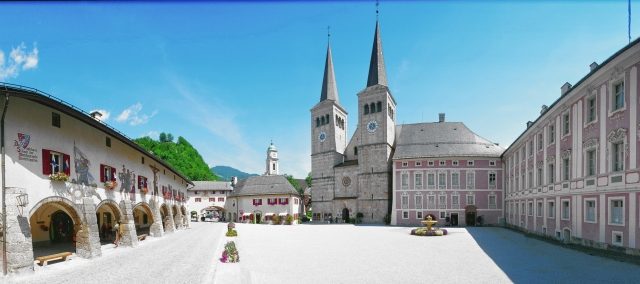
Berchtesgaden Royal Palace is a former Augustinian collegiate church building in Berchtesgaden, whose origins date back to around 1102 and which, after several renovations, also served as the residence of the Berchtesgaden Prince-Provostry. From 1810 it was owned by the Bavarian Royal House and is now the property of the Wittelsbach Compensation Fund.
The Beginnings
Countess Irmingard von Sulzbach vowed to found an Augustinian collegiate church. A year after her death, its construction began in 1102 and was continuously continued in 1112 (according to other sources 1116) by the first provost Eberwin. Starting with up to seven canons (the first from Rottenbuch in Allgäu), Eberwin initiated clearings and gradually expanded the monastery. Thus, under his aegis, a construction phase or "emergency building" of the collegiate church of St. Peter and John the Baptist, which belongs to the present palace ensemble, was consecrated by the Archbishop Konrad of Salzburg in 1122. This was followed after his death in the second half of the 12th century by a more massive construction as a three-aisled Romanesque pillar basilica and presumably also the first towers, of which, however, there is neither a description nor an illustration.
In the following centuries, the adjacent monastery buildings were also continuously expanded. On the east side of the Romanesque cloister, built around 1180, a two-aisled Gothic hall was built. This was followed by Renaissance halls on the south side around 1500. In 1725, the Baroque south wing was built. Since the canons never had enough money to demolish everything at once and erect an entirely new building, the structures have been preserved to this day.
As the seat of the respective collegiate and prince-provosts, these buildings also served as the secular residence of the territorial rulers of an imperial immediate state, which existed as Berchtesgadener Land or Prince-Provostry of Berchtesgaden until its mediatization in the course of secularization in 1803.
Hunting Lodge of the Bavarian Kings
After the secularization in 1803 and the associated end of provost rule, the Berchtesgaden region was first incorporated into the newly founded Electorate of Salzburg, from 1805 into the Austrian Empire, and for a short time in 1809 into Napoleon's France. In 1810, it finally became part of the Kingdom of Bavaria.
In 1818, the oldest part of the palace was furnished as a summer residence for King Maximilian I, while the first and second floors and the archive building were leased to the district court until 1828. In addition to Maximilian I, his successors, the Bavarian kings Ludwig I and Maximilian II, who also had the Royal Villa built in Berchtesgaden, and especially Prince Regent Luitpold and his son King Ludwig III, frequently stayed in the former monastery.
After losing his claim to the throne in 1918 during the November Revolution, Crown Prince Rupprecht of Bavaria and his family moved into the palace in Berchtesgaden. Their stay lasted from 1922 to 1933, and three of his children were born there.
Currently, the palace is occasionally still used by Rupprecht's grandson Franz, Duke of Bavaria, as a secondary residence.
Use by the Traunstein District Court
In 1952, the Traunstein District Court conducted the nationally sensational "Küsswetter Trial" in the palace. Forester Georg Küsswetter and other foresters were accused of arson of several alpine huts and the demolition of the former Wehrmacht house under the Blaueis glacier. Küsswetter's instigation of these crimes was based not least on his hostility towards tourists, as he wanted to prevent the Alpine Club from using the Wehrmacht house as a new Blaueishütte.
Museums+
Palace Museum
Rooms
Crown Prince Rupprecht already made the palace accessible to the public. 30 of 120 rooms are still on display today.
Rupprecht furnished them with original furniture. Three richly stocked armories display hunting rifles and pistols from three centuries. Boar spears, halberds, and partisans flank high-quality armor.
Special pieces of furniture also await visitors. The so-called "Liedertisch" (song table) from 1591 is a table whose tabletop, made of Solnhofen stone, was treated with nitric acid. On the tabletop is a six-part motet by Palestrina, the Passion of Christ, an perpetual calendar, allegories of the planets, and the coat of arms of the House of Wittelsbach.
A Baroque writing cabinet from 1750 is known as the "Convict's Cabinet". Master cabinetmaker Johann Georg Wahl crafted it for Elector Karl Theodor of the Palatinate after the Elector had sentenced him to imprisonment for misuse of the Electoral Seal. The cabinet was intended to secure Wahl's pardon. It contains 72 drawers, two of which are secret drawers. It is decorated with inlays of mother-of-pearl, ivory, ebony, and colored wood.
In the palace, in the former living quarters of Crown Prince Rupprecht, is the Great Dining Hall, where valuable Nymphenburg porcelain is used as decor. One can admire a centerpiece from 1755, which is intended to depict the Nymphenburg Palace Garden. When the centerpiece was first presented, it was such an attraction that the valuable porcelain had to be protected by guards.
In addition to the furniture, many works of art and paintings can be seen in the palace, including valuable works by famous artists such as Tilman Riemenschneider, Veit Stoß, Peter Gertner, Barthel Beham, and paintings of the Munich School. In summer, when the weather is fine, the small rose garden can also be visited.
Guided Tours
The rooms can only be visited as part of a guided tour, which covers 30 rooms. These are offered year-round. Before and around Christmas, Berchtesgaden Palace offers evening tours. The glow of dimmed chandeliers and up to 800 candles creates a special atmosphere for visitors. During the tour, a few surprises also await visitors. In the pre-Christmas period, there are special Advent tours with Christmas texts and singing. Berchtesgaden Palace also offers a music tour, during which a singer performs appropriate music in various rooms, making the museum visit more lively. Pieces from Mozart to Sinatra are offered.
Roe Deer Museum
Since 2005, the Roe Deer Museum has been housed in the palace stables. Especially for hunting and nature enthusiasts, it offers an interesting insight into wildlife science.
Take Mobile History with you
You are reading this text for free. Premium adds what matters on the road: descriptions read aloud, sites found through your camera, whole regions taken offline.
- Every description, including the ~17,700 Premium sites
- Audio guide: have descriptions read to you on location
- AR finder: see sites through your camera, with distance and bearing
- Unlimited saved sites
14 days free, then from €2.99 a month. Cancel anytime.
Source: Wikipedia · Licence: CC BY-SA 4.0
This description draws on the facts documented in the linked Wikipedia article; Wikipedia content is licensed under CC BY-SA 4.0. Wording and editing: Mobile History.
Location: 47.6333, 13.0031