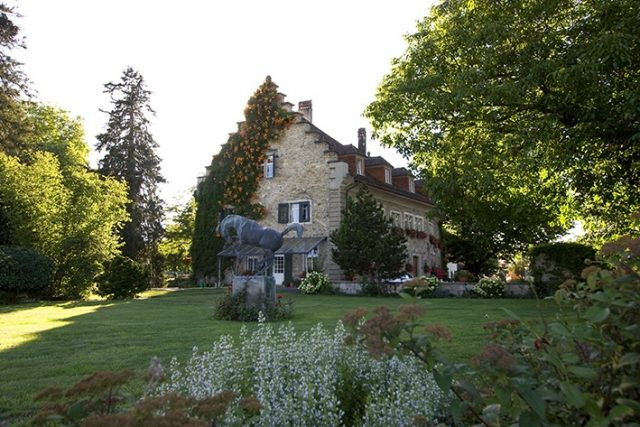
CastleBerg am Irchel

Berg Castle

Berg Castle

To be privately owned

Berg Castle only dates back to the mid-17th century. High jurisdiction came to Zurich in 1452 with the County of Kyburg. After Anna Dorothea von Meiss brought the manorial rights over Berg to Hans Heinrich Escher vom Luchs through marriage in 1642, Junker Escher built the current Berg Castle. Above the modernly copied round-arched ashlar portal proudly display the colorfully painted coats of arms of the builders: Hans Heinrich Escher vom Luchs and his wife Anna Dorothea von Meiss.

The Eschers inhabited the country estate for more than two centuries. After the upheaval of 1798, they still retained the two castles of Berg and Eigental, as well as the lands. However, Junker Hans Georg (1756-1837) could not come to terms with the new times and opposed the government, whereupon he and fourteen other opponents of the revolution were arrested by the Directory and held in Basel for six months. After the fall of Napoleon, he again believed that the time had come to restore the old conditions. However, his memorandum, which he sent to the government together with 300 like-minded companions, failed to achieve its goal. From then on, Escher, who was considered a man "of spirit and courage", "clear-thinking" and "worldly-wise", withdrew from political life and henceforth dedicated himself to the care of his estates.

The last member of the manorial family, Albertine Cäcilie, sold the estate in 1875 to Hermann Sieber from Zurich. Via Jakob Zwingli, the castle came into the possession of Major Karl Richard Ziegler in Schaffhausen in 1911. With the stay of the poet Rainer Maria Rilke in the winter of 1920/21, Berg Castle briefly entered the stage of world literature. Rilke was provided with the ground floor, including the comfortably large living room, a bedroom, and the kitchen. It was here that he also made the decision to remain loyal to Switzerland. Because a cattle plague was rampant in Berg at the time, his freedom of movement was restricted, and he wrote about it to Rudolf Junghans: "... My walking is now restricted to the park by the strict limitations of the cattle plague, in which I have set myself a path of one hundred and twenty steps in length as a track, which I measure many times back and forth: this unchangeability brings me hardly anything else than the breathed expanse and the felt space, but everything else that would begin to be an impression would also already enter into rivalry with my strictly taken concentration." As the plague subsided, Rilke began to undertake smaller excursions into the Flaachtal, and for a long time there were still farmers who remembered the friendly man with the round black felt hat.
In 1922, Major Karl Richard Ziegler sold his estate to Colonel Hans Bühler-Volkart (died 1967) from Winterthur.

Take Mobile History with you

You are reading this text for free. Premium adds what matters on the road: descriptions read aloud, sites found through your camera, whole regions taken offline.

  • Every description, including the ~17,700 Premium sites
  • Audio guide: have descriptions read to you on location
  • AR finder: see sites through your camera, with distance and bearing
  • Unlimited saved sites

14 days free, then from €2.99 a month. Cancel anytime.

Source: Wikipedia · Licence: CC BY-SA 4.0

This description draws on the facts documented in the linked Wikipedia article; Wikipedia content is licensed under CC BY-SA 4.0. Wording and editing: Mobile History.

Location: 47.5692, 8.5995