Restaurant
Hotel
Berge Castle (Gelsenkirchen)

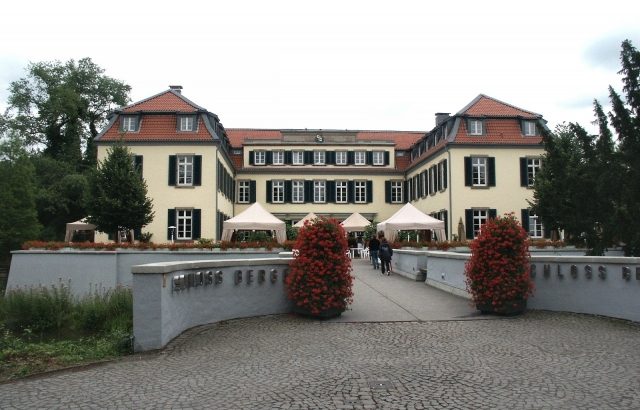
Schloss Berge, also known as Haus Berge, is located on the south side of Buer Hill in the Buer district of Gelsenkirchen, North Rhine-Westphalia. It was built as a moated castle to protect the present-day Gelsenkirchen district of Erle and was the ancestral seat of the von Berge family until 1433. Converted into a castle in the first half of the 16th century and altered again in the last quarter of the 18th century, the manor house of the complex presents itself in the Late Baroque style on the threshold of Classicism. It is now used as a hotel-restaurant.
In 1248, the noble family von Berge, from the House of Strünkede, first appeared as owners of the then castle with the knight Dietrich († 1272). However, it is presumed that the origins of the complex reach further back in time.
Built as a fortified house surrounded by moats, it was probably a multi-part complex surrounded by an approximately rectangular moat system. As an allodial estate of the family, the castle was inherited from father to son for six generations. The last representative of this lineage at Berge was Gerlach, who died childless in 1433.
His widow sold the house and the surrounding estates to the knight Heinrich von Backem from Haus Leythe. When the male line of this family died out with Jörgen von Backem, his heiress daughter Hartlieb (also Hartlief) brought Haus Berge to her husband Georg von Boenen in 1521.
Around 1530, he had the fortified complex expanded and converted into a castle. From that period dates a 10.75 x 26.25 meter section in the main wing of the manor house, whose 1.30 meter thick walls are significantly more massive than the others. Another building at the site of today's north wing completed the building stock at that time. In the following approximately 250 years, during which the von Boenen family inhabited the castle, Berge attained the dominant manorial position north of the Emscher and, consequently, corresponding social prestige. The von Boenen were even elevated to the status of Imperial Barons.
Around 1700, a cellarless extension was added to the main tract of the manor house. Furthermore, a first park was laid out to the south of the main house island. In accordance with the taste of the time, this was a geometrically designed Baroque garden in the French style.
Under Baron Ludolf Friedrich Adolf von Boenen, the family was elevated to the status of Imperial Counts in 1790. The marriage of Adolf to Wilhelmine Franziska von Westerholt-Gysenberg, the heiress daughter of that comital family, made it possible. From then on, the castle owners called themselves "Counts of Westerholt". The elevation to the rank of count also obligated them to a more elevated lifestyle, which the old 16th-century manor house no longer met. Their daughter Maria Anna Wilhelmine, a lover of Beethoven, was born there. Therefore, between 1785 and 1788, the old building was partially demolished and rebuilt in the early Classicist style with an additional tract, the south wing, under the master builder of Werden Abbey, Engelbert Kleinhansz. The park was also extended by an English landscape garden stretching to the west. After the renovation, illustrious personalities such as Emperor Napoleon and Marshal Blücher stayed at the castle as guests.
After the death of the last resident of Schloss Berge, Countess Jenny von Westerholt, a commercial enterprise was established in the castle, which the city of Buer leased from 1920.
In 1924, the city acquired the castle together with the 102-hectare site for 1.4 million Goldmark and established a public recreation area with catering and business premises there. For this purpose, the house was rebuilt and extended from 1926 to 1933, during which the neo-Gothic chapel from 1879 was demolished in 1927. The castle park was enlarged to about 73 hectares and restored to its old style. However, the statues visible in it today are only replicas of old originals. At the same time, between 1927 and 1929, the Berger See was created opposite the main entrance of the castle, which was dammed in 1930.
After the Second World War, the city of Gelsenkirchen had Schloss Berge restored in 1952/53. At the same time, a comprehensive interior renovation took place to accommodate a hotel-restaurant there afterwards. After extensive modernization in 1977 and 1978, further renovation and restoration work followed in 2003 and 2004.
The Castle Today+
The castle complex consists of the formerly undeveloped outer bailey island, the core castle island, and a garden island.
The main house still largely presents itself from the outside as it did after the redesign between 1785 and 1788. The coat of arms of the Imperial Counts of Westerholt-Gysenberg on the main wing points to its last builders. The representative three-wing building is open to the west and stands on a square island of about 40 meters side length. Its two stories are topped by a mansard roof. The high basement of the building was erected on pile grates, which received a supporting corset of reinforced concrete during the restoration work in the 1950s to counteract mining damage. Until 1784, a round tower stood at the south corner of the manor house island, of which only the foundation remains today.
Since July 1988, the entire complex has been a protected monument. Together with the hotel and restaurant housed in the castle building, the two castle gardens, as well as the Berger See and the Gelsenkirchen city forest, it now serves as a local recreation area.
Take Mobile History with you
You are reading this text for free. Premium adds what matters on the road: descriptions read aloud, sites found through your camera, whole regions taken offline.
- Every description, including the ~17,700 Premium sites
- Audio guide: have descriptions read to you on location
- AR finder: see sites through your camera, with distance and bearing
- Unlimited saved sites
14 days free, then from €2.99 a month. Cancel anytime.
Source: Wikipedia · Licence: CC BY-SA 4.0
This description draws on the facts documented in the linked Wikipedia article; Wikipedia content is licensed under CC BY-SA 4.0. Wording and editing: Mobile History.
Location: 51.5687, 7.0696