Museum
Bernburg Castle

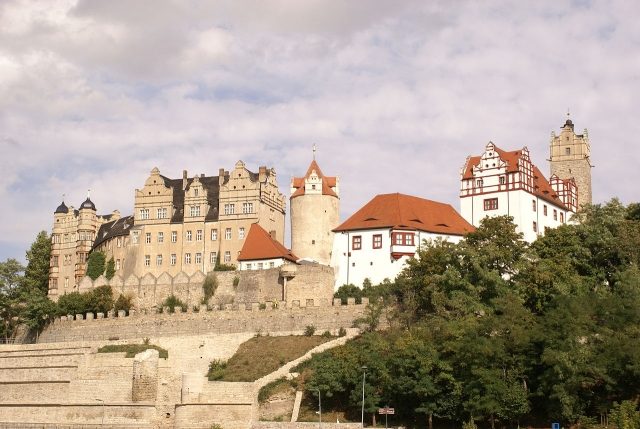
Bernburg Castle, also known as the Crown of Anhalt, rises as a Renaissance castle on a high sandstone cliff on the eastern bank of the Saale, at the site of a former ford, above the city of Bernburg in Saxony-Anhalt.
The Bernburg was probably already mentioned on June 29, 961, as a Saxon circular and refuge castle with rampart and moat in a deed of gift by Emperor Otto I as "Brandanburg". A large early medieval castle complex has since been archaeologically proven on Bernburg Castle Hill.
In 1138, it was first mentioned as Berneburch or Berneborch on the occasion of its plundering in connection with disputes between the Welfs and Hohenstaufens. At that time, it was the widow's seat of Countess Eilika, the mother of Margrave Albert the Bear.
In the second half of the 12th century, under Bernhard III (Saxony), it was rebuilt as a large Romanesque castle complex. From this period dates the mighty keep in the castle courtyard (one of the largest in Germany), which - according to local tradition - is considered the setting for the 22nd story of the Middle Low German folk book Till Eulenspiegel and is therefore called the Eulenspiegel Tower.
The Romanesque castle chapel of St. Pancras, preserved in remnants, also dates from the second half of the 12th century. The death of Bernhard III (Saxony) in Bernburg around the turn of the year 1211/12, as recorded in the Annales Stadenses, connects the history of the Anhalt region with the remains of the Bernburg castle chapel walls, because it was highly probable that the first part of the mourning ceremony for the deceased duke took place here, before his body was transferred to the Benedictine monastery of Ballenstedt, the burial place of the early Ascanians. The Bernburg castle chapel, as the site of the first public-ritual confrontation with Bernhard's death, was thus an important stage in the ceremonial course of the inheritance and the Ascanian division of inheritance. It represents, in a sense, alongside the eponymous Anhalt Castle in the Selke Valley, another authentic "birthplace" of the later Anhalt region.
From 1498, the lordship and Bernburg Castle passed to the Princes of Anhalt-Köthen, who primarily used the castle as a domain, administrative center, and residence for the regional rulers and rebuilt it accordingly (Altes Haus). The complex was not further expanded militarily.
In 1538/39, Prince Wolfgang of Anhalt (1508–1566) had a tower-like building erected in the northwest of the castle courtyard by the Halle master builder Andreas Günther, in rich, only partially preserved Renaissance forms, named after him as the Wolfgangbau (today the western part of the so-called Langhaus). A model for this was the slightly older hall building of the Electoral Saxon residential castle Hartenfels in Torgau. Thus, the Bernburg Wolfgangbau also has round oriel windows at two building corners, referred to as "Leuchten" (lights), with antique-style ornamentation, and thus functioned as a stately belvedere with a wide view into the river valley. Additionally, the oriels on the outer sides show pictorial reliefs of Protestant princes and the Holy Roman Emperor Charles V.
It is probable that construction also took place at other points in the complex at that time, as individual architectural details, e.g., door jambs, prove. In 1547, Prince Wolfgang, as one of the co-founders of the Schmalkaldic League, which was defeated by Emperor Charles V, had to leave his country; the relatives of the Dessau line only gradually regained possession of this territory.
In 1563, Prince Joachim Ernst of Anhalt (reg. 1551–1586) received the Bernburg part of the country. In 1567, he began the construction of an extensive two-story residential building for himself and his wife as an eastern extension of the Wolfgangbau. This created the so-called Langhaus as the northern end of the castle courtyard. Unlike today, the Langhaus originally had a picturesque series of dormer houses in the roof zone. For this construction task, he commissioned the Halle master builder Nickel Hoffmann.
Joachim Ernst initially resided mainly in Roßlau Castle, and perhaps the expansion of Bernburg arose from the intention to move his residence to this larger castle. However, soon after the completion of construction work in Bernburg, his last surviving brother Bernhard, who ruled in Dessau, died in 1570, and Joachim Ernst was able to unite all Anhalt lands in his hand. As a result of his move to Dessau and the extensive construction measures at the residential castle there in the 1570s, Bernburg lost importance and at most had to fulfill the functions of a secondary residence. Nevertheless, at an unknown time after 1586, the Johann-Georg-Bau was begun, but in 1606 it was still in shell construction.
The significance of the castle changed when Bernburg became the modest residence of an Anhaltine sub-line in 1606, but this new function was not reflected in elaborate alterations to the existing building fabric. With the relocation of the residence to Ballenstedt in 1765, Bernburg again lost its central importance, until it finally moved to the periphery after the extinction of the Bernburg line in 1863 and the unification with Anhalt-Dessau.
Due to these circumstances, the building fabric of the castle was only cautiously altered. Although various outbuildings were erected, the existing rooms were designed according to the respective needs, and the Langhaus was provided with extensive classical interior architecture in the first half of the 19th century, on the whole, the castle retained its old form.
In 1860, a first bear pit for a Russian brown bear was built in the former moats. Over time, several alterations were made to the bear enclosure, most recently from 1992 to 1996. Currently, two brown bears can be seen there, cared for by the Bernburg Zoo.
The Johann-Georg-Bau, which burned down in 1895, was rebuilt, and shortly thereafter extensive restoration measures began on the Langhaus, during which the substance of the oriels and other details was replaced true to form. Further extensive restorations took place in the 1920s and 1930s and were partially resumed after the Second World War.
Current Use+
The Bernburg Castle Museum is housed in the Altes Haus and Krummes Haus of the castle. The torture exhibition provides insight into the dark part of the Middle Ages. The Anhalt Mineral Collection can be viewed in the Johann-Georg-Bau. Since 2004, the German Cabaret Archive in the same building has documented the history of GDR cabaret. The buildings, now managed by the Foundation of Cathedrals and Castles in Saxony-Anhalt, also formerly housed the district court. The castle terrace offers a wide panoramic view of the Saale valley and the Harz foothills, with good visibility extending to the Brocken. The castle is a stop on the Romanesque Road.
Take Mobile History with you
You are reading this text for free. Premium adds what matters on the road: descriptions read aloud, sites found through your camera, whole regions taken offline.
- Every description, including the ~17,700 Premium sites
- Audio guide: have descriptions read to you on location
- AR finder: see sites through your camera, with distance and bearing
- Unlimited saved sites
14 days free, then from €2.99 a month. Cancel anytime.
Source: Wikipedia · Licence: CC BY-SA 4.0 · Image: https://commons.wikimedia.org/wiki/File:Bernburg_Schloss_07-09-2008_043.jpg
This description draws on the facts documented in the linked Wikipedia article; Wikipedia content is licensed under CC BY-SA 4.0. Wording and editing: Mobile History.
Location: 51.7939, 11.7344