CastleTeutschenthal-Beuchlitz

Beuchlitz Castle
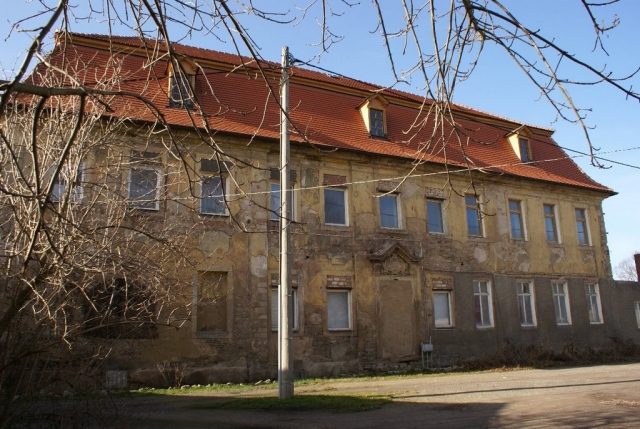
Beuchlitz Castle

To be privately owned

The Sack family, whose lineage died out in 1733, was in 1616 the undivided owner of all four large estates in the lower and upper villages of Holleben. The property was bought by the Prussian War and Domain Councillor Johann Paul Stecher. His youngest son, Johann Christoph von Stecher, took up residence at the Unterhof in Beuchlitz, where he had a baroque manor house built, surrounded by a park.

Small three-wing complex from the second quarter of the 18th century, possibly by David Schatz. Altered in the 19th century (stair tower in the courtyard of honor). The garden side is structured by eleven axes with a single-axis central and three-axis side risalits, the original central portal with a sculptural cartouche. On the north side, originally a freestanding garden pavilion (around 1725).

A shell room, which is said to have been built in the mid-18th century on behalf of Major Hans Christoph von Billerbeck (1714-1790), adjutant to King Frederick II of Prussia, was modeled after the shell hall in the New Palace in Potsdam. Billerbeck had been commissioned by the King in 1754 to marry a daughter of the Stechers in order to bring the existing fortune or part of it to Prussia. The Prussian state treasury was extremely strained. A son was born from the marriage with Rudolfine Karoline Wilhelmine von Stecher (1739-1801). In the church book/baptismal register of Beuchlitz in 1757, King Frederick II of Prussia is listed as the first godfather. In 1945, the owners were forcibly expropriated and expelled by the communists.

After the Second World War, the manor house served as accommodation for refugees from the eastern territories of Germany. The municipality had no money for renovation or restoration, and the building was left to slow decay. The stair tower on the front of the manor house was demolished at the beginning of the 21st century and fitted with a blind facade. Only the roof was renewed. The shell grotto embedded on the back of the manor house was used as storage space, among other things for coal. It remained hidden from the residents of the municipality. Only from 2005 to 2007 did friends of the architectural and art monuments of Saxony-Anhalt e. V. from Halle an der Saale begin to remove dirt. Afterwards, the grotto was made accessible to the public for the first time on September 9, 2007, on the Day of Open Monuments. A restoration largely depends on the future use of the manor house.

Take Mobile History with you

You are reading this text for free. Premium adds what matters on the road: descriptions read aloud, sites found through your camera, whole regions taken offline.

  • Every description, including the ~17,700 Premium sites
  • Audio guide: have descriptions read to you on location
  • AR finder: see sites through your camera, with distance and bearing
  • Unlimited saved sites

14 days free, then from €2.99 a month. Cancel anytime.

Source: Wikipedia · Licence: CC BY-SA 4.0 · Image: Roland Neubert, Halle (Saale)

This description draws on the facts documented in the linked Wikipedia article; Wikipedia content is licensed under CC BY-SA 4.0. Wording and editing: Mobile History.

Location: 51.4450, 11.9016