CastleLengenfeld unterm Stein

Bischofstein Castle
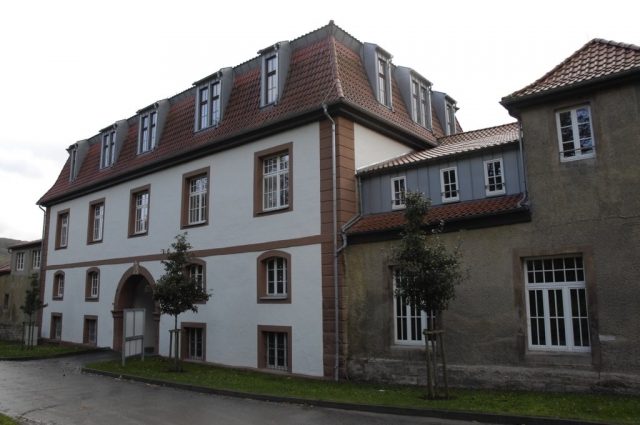
Bischofstein Castle

Home for the elderly

Bischofstein Castle is a castle above the village of Lengenfeld unterm Stein in Eichsfeld in Northwest Thuringia.

The castle was built in 1747 as a summer residence and seat of the bailiffs of the Mainz Elector Johann Friedrich Karl von Ostein (1689–1763) by the Dingelstädt master builder Johann Cristoph Heinemann (1695–1777). The stones used in the construction came from the nearby deserted town of Stein and Stein Castle, which was partially destroyed during the Thirty Years' War. At that time, the owner was the Archbishop of Mainz, whose coat of arms is located above the main entrance. In 1802, the castle became a Prussian state domain through secularization and was used as a country estate and manor from 1815 onwards. From 1907, the castle was restructured into a rural educational home and managed according to Hermann Lietz's reform pedagogical concept until after the Second World War.

In addition to the educator Gustav Marseille, the classical philologist Wilhelm Ripke (1886-1965) was also the owner and director of the boarding school as a private school since 1920. Ripke had participated in the democratic protest against the Tsar during his studies in Saint Petersburg and became a convinced opponent of National Socialism in the 1920s. There was no Hitler salute in his house, three Jewish students were not removed from the school, and the books of authors ostracized by the National Socialists remained in the library. Käthe Kollwitz, who lived at Bischofstein Castle for a time during the Second World War, was among his circle of friends. In 1934, he was banned from teaching, and in 1943, he had to leave the castle, which became an "SS Home School".

After the war, a box of graphics by Käthe Kollwitz, believed to be lost, was rediscovered in the attic of the nearby Zella Monastery. During GDR times, the castle was an FDGB recreation home.

After the reunification, the Treuhand was responsible for properties formerly in East German ownership, including Bischofstein Castle. In 1991, the building was leased by Freemasons. The Priory for Culture and Social Affairs, based in Mühlhausen, initially planned a combination of a spa, sports, and holiday home. Later, the castle was to become a meeting place for culture, education, and art for students from all over Europe. However, the implementation of the plans was always made dependent on various factors, such as funding, and repeatedly postponed. Finally, the Freemasons withdrew from the castle. In the course of the seemingly intended renovation work, however, they had destroyed more than they had renewed.

In 1994, the Free State of Thuringia proposed using the castle as a meeting place for European youth, a youth monument preservation workshop, or a bicycle workshop. However, nothing came of these plans, and the castle fell into a kind of Sleeping Beauty slumber in the following years.

In 1999, the "Internat Schloss Bischofstein" association was founded with the aim of using the castle again as a boarding school. In 2000, the association finally bought the castle from the Treuhandanstalt.

Finally, in the spring of 2003, an investor group that emerged from the association began to gradually renovate the castle so that it could be used as a boarding school. The association and the investor group consist largely of former boarding school students ("Altbischofsteiner").

Boarding School+

At the beginning of the 2003/2004 school year, the boarding school was reopened with initially six students living in the renovated north wing. The education of the boarding school students was ensured in cooperation with the Käthe-Kollwitz-Gymnasium in Lengenfeld unterm Stein, the Rodeberg secondary school, and the elementary school in Lengenfeld unterm Stein. Since 2005, the western side wing has been renovated – some classrooms for the care of boarding school students have already been completed. The boarding school operation had to be discontinued at the end of the 2006/2007 school year due to too few students and too high costs.

Since the end of 2008, a completely new concept has been pursued with the conversion into a retirement home.

Take Mobile History with you

You are reading this text for free. Premium adds what matters on the road: descriptions read aloud, sites found through your camera, whole regions taken offline.

  • Every description, including the ~17,700 Premium sites
  • Audio guide: have descriptions read to you on location
  • AR finder: see sites through your camera, with distance and bearing
  • Unlimited saved sites

14 days free, then from €2.99 a month. Cancel anytime.

Source: Wikipedia · Licence: CC BY-SA 4.0

This description draws on the facts documented in the linked Wikipedia article; Wikipedia content is licensed under CC BY-SA 4.0. Wording and editing: Mobile History.

Location: 51.2189, 10.2136