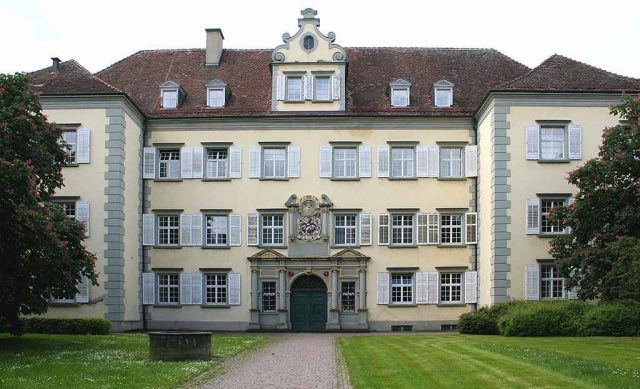
CastleKonstanz

Blarerscher Castle

Blarerscher Castle

District court

Schloss Bonndorf+

Das Schloss wird 1267 erstmals als Wohnhaus urkundlich erwähnt. 1612-20 erfolgte der Neubau unter dem Domkapitular Johann Jakob Blarer von Wartensee. 1846 wurde das Schloss erweitert und als Gerichtsgebäude (zuerst Badisches Hofgericht, heute Landgericht) genutzt.

Die Geschichte des Schlosses+

Das Schloss Bonndorf, dessen Geschichte bis ins 13. Jahrhundert zurückreicht, ist ein bemerkenswertes Beispiel für die architektonische und funktionale Entwicklung eines historischen Gebäudes. Ursprünglich als einfaches Wohnhaus im Jahr 1267 urkundlich erwähnt, erfuhr es im Laufe der Jahrhunderte bedeutende Transformationen, die seine Rolle in der lokalen Gesellschaft widerspiegeln.

Vom mittelalterlichen Wohnhaus zum repräsentativen Schloss

Die erste urkundliche Erwähnung im Jahr 1267 verortet das Schloss Bonndorf als ein Wohnhaus. Über die genaue Beschaffenheit dieses frühen Baus ist wenig bekannt, doch markiert es den Ursprung des heutigen imposanten Gebäudes. Eine entscheidende Phase in der Geschichte des Schlosses war der Neubau zwischen 1612 und 1620. Dieser erfolgte unter der Ägide des Domkapitulars Johann Jakob Blarer von Wartensee, einer Persönlichkeit, die offensichtlich den Wunsch hatte, ein repräsentativeres und zeitgemäßeres Gebäude zu errichten. Der Neubau verlieh dem Schloss jene barocke Prägung, die bis heute seine äußere Erscheinung prägt und es zu einem herausragenden Beispiel der Architektur dieser Epoche macht.

Nutzung als Gerichtsgebäude

Eine weitere signifikante Veränderung in der Nutzung des Schlosses Bonndorf ereignete sich im Jahr 1846. In diesem Jahr wurde das Schloss erweitert und einer neuen Funktion zugeführt: Es wurde zum Gerichtsgebäude umfunktioniert. Zunächst beherbergte es das Badische Hofgericht, eine wichtige Institution der Rechtsprechung im Großherzogtum Baden. Später wurde es zum Landgericht, eine Funktion, die es bis heute innehat. Diese Umnutzung unterstreicht die Anpassungsfähigkeit des Gebäudes an die sich wandelnden Bedürfnisse der Gesellschaft und seine fortwährende Bedeutung als öffentliches Gebäude.

Architektonische Merkmale und heutige Nutzung

Das Schloss Bonndorf präsentiert sich heute als ein beeindruckendes Ensemble, das die verschiedenen Bauphasen und Nutzungsänderungen widerspiegelt. Die barocken Elemente aus dem frühen 17. Jahrhundert sind ebenso erkennbar wie die Erweiterungen aus dem 19. Jahrhundert, die für die Nutzung als Gerichtsgebäude notwendig wurden. Trotz der funktionalen Anpassungen hat das Schloss seinen historischen Charakter bewahrt und dient weiterhin als wichtiger Bezugspunkt in der Stadt Bonndorf. Die Nutzung als Landgericht gewährleistet, dass das Gebäude auch in der Gegenwart eine zentrale Rolle im öffentlichen Leben spielt und somit seine lange und wechselvolle Geschichte fortschreibt.

Die Geschichte des Schlosses Bonndorf ist somit ein faszinierendes Beispiel für die Transformation eines Gebäudes von einem mittelalterlichen Wohnhaus über ein barockes Schloss bis hin zu einem modernen Gerichtsgebäude, das seine historische Identität bewahrt hat.

Bonndorf Castle+

The castle is first mentioned in a document as a dwelling in 1267. The new building was constructed between 1612 and 1620 under the cathedral canon Johann Jakob Blarer von Wartensee. In 1846, the castle was extended and used as a courthouse (first the Baden Court of Appeal, today the Regional Court).

The History of the Castle+

Bonndorf Castle, whose history dates back to the 13th century, is a remarkable example of the architectural and functional development of a historic building. Originally mentioned in a document as a simple dwelling in 1267, it underwent significant transformations over the centuries, reflecting its role in local society.

From Medieval Dwelling to Representative Castle

The first documented mention in 1267 identifies Bonndorf Castle as a dwelling. Little is known about the exact nature of this early building, but it marks the origin of today's imposing structure. A decisive phase in the castle's history was the new construction between 1612 and 1620. This took place under the aegis of the cathedral canon Johann Jakob Blarer von Wartensee, a personality who evidently wished to erect a more representative and contemporary building. The new construction gave the castle the Baroque character that still shapes its external appearance today and makes it an outstanding example of the architecture of this era.

Use as a Courthouse

Another significant change in the use of Bonndorf Castle occurred in 1846. In that year, the castle was extended and given a new function: it was converted into a courthouse. Initially, it housed the Baden Court of Appeal, an important institution of justice in the Grand Duchy of Baden. Later, it became the Regional Court, a function it still holds today. This repurposing underlines the building's adaptability to the changing needs of society and its continued importance as a public building.

Architectural Features and Current Use

Bonndorf Castle today presents itself as an impressive ensemble that reflects the various construction phases and changes in use. The Baroque elements from the early 17th century are as recognizable as the 19th-century extensions that became necessary for its use as a courthouse. Despite the functional adaptations, the castle has retained its historical character and continues to serve as an important landmark in the town of Bonndorf. Its use as a Regional Court ensures that the building continues to play a central role in public life in the present day, thus continuing its long and eventful history.

The history of Bonndorf Castle is thus a fascinating example of the transformation of a building from a medieval dwelling to a Baroque castle and then to a modern courthouse that has preserved its historical identity.

Take Mobile History with you

You are reading this text for free. Premium adds what matters on the road: descriptions read aloud, sites found through your camera, whole regions taken offline.

  • Every description, including the ~17,700 Premium sites
  • Audio guide: have descriptions read to you on location
  • AR finder: see sites through your camera, with distance and bearing
  • Unlimited saved sites

14 days free, then from €2.99 a month. Cancel anytime.

Source: Wikipedia · Licence: CC BY-SA 4.0 · Image: http://de.wikipedia.org/wiki/Datei:Konstanz-Landgericht1-Bubo_rectified.jpg

This description draws on the facts documented in the linked Wikipedia article; Wikipedia content is licensed under CC BY-SA 4.0. Wording and editing: Mobile History.

Location: 47.6647, 9.1739