To be privately owned
Bleiburg Castle

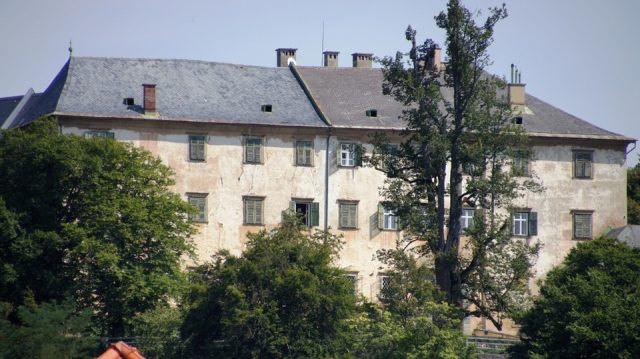
Bleiburg Castle stands elevated on a prominent hill above the town of Bleiburg.
The former castle probably originated at the beginning of the twelfth century. In 1228, "Pliburch" is mentioned as the seat of the Counts of Heunburg. After the extinction of the Heunburgers, the castle passed to the Aufensteiners in 1322. In 1378, Dukes Albrecht and Leopold of Austria besieged the castle. It came into their possession and was occasionally pledged. In 1507, Maximilian I's administrator, Count Julian Lodron, was allowed to spend 400 gulden on the fortress. Ungnad von Sonnegg, related by marriage to the Lodrons, further expanded the castle. In 1601, the castle passed to Hans-Ambros Count von Thurn, who converted Bleiburg into a castle in the style of the Late Renaissance or Mannerism. Today, the castle is owned by the Thurn-Valsasina family.
Architectural Description+
From the old castle of the 12th to 15th centuries, the complex grouped around the irregular courtyard and individual building elements such as the eastern keep, the northwestern tower, and the palas located in the western wing are still preserved. The largest part of the three-story castle dates from the early 17th century. The southern rustic portal made of green basalt is dated 1606. The ten-axis south wing has windows with lintels and, above the rustic portal, a double coat of arms of Thurn-Rosenberg painted al fresco with an inscription, which is dated 1747 by a chronogram. In the courtyard, the east wing has ground-floor arcades and biforium windows on the two upper floors, behind which vaulted corridors run. On the second floor, frescoes from the early 17th century show hunting scenes. In some halls of the first upper floor, foliage stucco decorations from the early 18th century have been preserved on the flat ceilings, and on the second upper floor, foliage-bandwork stucco decorations created around 1720/1730. The library, located on the second upper floor of the north wing, has an early Baroque coffered ceiling and three doors, partly decorated with inlays, from the early 17th century, which originally came from Landskron Castle. The living rooms are furnished with furniture from the 17th to 19th centuries, as well as tapestries from the early 17th century and painted wallpapers created around 1780.
Castle Chapel+
The chapel, dedicated to the Apostle Paul, is an eastern attached Gothic building with a two-bay Baroque cross-rib vault and a polygonal choir. The west portal with a lintel dates from the early 17th century, the two-light tracery windows from the 19th century. Above the western oratory, parts of the former figural vault painting from the 17th century have been uncovered.
The high altar from the end of the 17th century is a triumphal arch altar with a small plinth, a broken segmental pediment, and a small aedicule with staggered double columns as a superstructure. In the center stands a statue of Mary from the first half of the 17th century, flanked by statues of Saints Bruno and Joseph. The altarpiece depicts the Holy Family with two other saints and is crowned by the Archangel Michael. A small side altar bears a painting of the Coronation of Mary created around 1720/1730. A large bronze epitaph, depicting in high relief the family of Count Wolf Thurn beneath the crucifix, was created in Laibach in 1595 and has been in the castle since the end of the 19th century. Another small brass epitaph with a coat of arms and inscription is dated 1618.
Take Mobile History with you
You are reading this text for free. Premium adds what matters on the road: descriptions read aloud, sites found through your camera, whole regions taken offline.
- Every description, including the ~17,700 Premium sites
- Audio guide: have descriptions read to you on location
- AR finder: see sites through your camera, with distance and bearing
- Unlimited saved sites
14 days free, then from €2.99 a month. Cancel anytime.
Source: Wikipedia · Licence: CC BY-SA 4.0 · Image: http://www.wehrbauten.at/ktn/kaernten.html
This description draws on the facts documented in the linked Wikipedia article; Wikipedia content is licensed under CC BY-SA 4.0. Wording and editing: Mobile History.
Location: 46.5894, 14.8011