CastleNeukirchen-Vluyn

Bloemersheim Castle
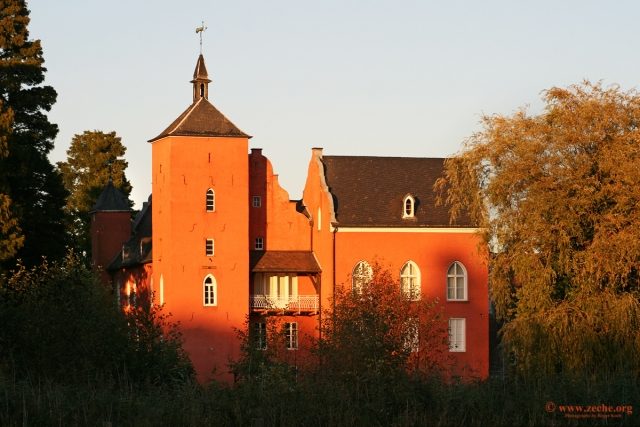
Bloemersheim Castle

Cultural Events
To be privately owned

Bloemersheim Castle is a moated castle near Neukirchen-Vluyn, one of the most impressive complexes in the district of Wesel. Leyenburg Castle is nearby.

The complex, dating from the late Middle Ages, was acquired in 1802 by Friedrich Heinrich von der Leyen, a silk producer from Krefeld, from Friedrich August von Pelden (called Cloudt). It remains to this day the ancestral seat of the Barons von der Leyen and the seat of an estate administration (with economically significant fruit sales and forestry operations).

The castle (courtyard and garden) is only accessible during rare cultural events, but the rear side facing the castle pond can be well viewed from a popular cycle path.

A Blomertshof estate was first mentioned in a document in 1406 as a sub-fief of Haus Gastendonk. The owners until 1510 were at that time the Lords of Baldrich. Members of this house were judges and bailiffs in Gelderland, as the castle grounds partly belonged to the Duchy of Geldern. Around 1560, the property came into the possession of the Lords of Hoennepel, called von der Impel, through the marriage of the heiress from the Baldrich family, and remained in the possession of this family for over 150 years. In 1667, the castle complex was transferred as a fief to the then Droste of the County of Moers, Baron von Pelden, called Cloudt, as he had married the heiress from the von der Impel family. The main seat of the von Pelden family at that time was Lauersfort Castle, and Bloemersheim was predominantly used by them as a hunting lodge.

When the first original moated castle with an outbuilding and subsequent main castle, which was originally only accessible via 2 drawbridges, was built, is not precisely known. The border between the Duchy of Geldern and the County of Moers ran right through the castle grounds and the kitchen in the main building. Only under the Prussians in 1724 was the border changed so that the entire area thereafter belonged to the Principality of Moers.

The castle was also a refuge where farmers living in the vicinity fled during wartime. It was frequently attacked and severely damaged. For example, the "first Cloudt" had to rebuild the destroyed outer bailey. During this construction phase, the moats between the outer and main bailey were filled in and leveled. Towards the end of the 18th century, around 1790, the castle was plundered and devastated by the French. The impoverished last heirs from the Cloudt family could neither renovate nor maintain the property, and it fell into disrepair. In 1802, the Cloudts sold the entire property for 17,000 thalers to the von der Leyen family. They developed the castle and the associated park into the current castle complex.

Take Mobile History with you

You are reading this text for free. Premium adds what matters on the road: descriptions read aloud, sites found through your camera, whole regions taken offline.

  • Every description, including the ~17,700 Premium sites
  • Audio guide: have descriptions read to you on location
  • AR finder: see sites through your camera, with distance and bearing
  • Unlimited saved sites

14 days free, then from €2.99 a month. Cancel anytime.

Source: Wikipedia · Licence: CC BY-SA 4.0 · Image: http://www.zeche.org/

This description draws on the facts documented in the linked Wikipedia article; Wikipedia content is licensed under CC BY-SA 4.0. Wording and editing: Mobile History.

Location: 51.4428, 6.5142