Museum
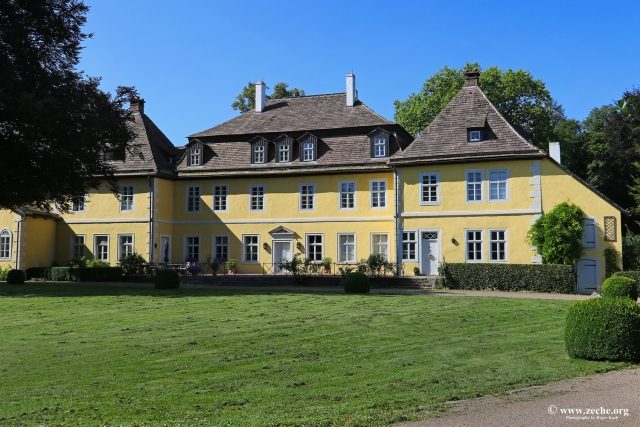
Bökerhof Castle

The Bökerhof is located in the East Westphalian village of Bökendorf (city of Brakel, district of Höxter) in North Rhine-Westphalia.
The Bökerhof is one of the family seats of Baron von Haxthausen, as are the Abbenburg estate and Haus Vörden. The von Haxthausen family was one of the four noble pillars of the Principality of Paderborn, and at the beginning of the 14th century, the named estates were granted to them by the Prince-Bishop of Paderborn.
The Estate+
Baron Caspar Moritz von Haxthausen commissioned the Hildesheim court architect Anton Went with the planning and construction of the Bökerhof between 1768 and 1771. The two-story manor house was built on the ruins of a 15th-century water system. To the side, the building extends into two tower-like extensions. The roofs are covered with Solling sandstone slabs, typical for the region. In 2009, the entire roof was re-covered with Solling sandstone slabs in accordance with monument preservation standards.
The Bökerhof is surrounded by an extensive garden area of approximately three hectares. Some old beeches, chestnuts, spruces, and elms, as well as a magnificent plane tree on the castle meadow, still bear witness to the historical period of the estate's creation. The rear park of the house was surrounded by a path formed from hornbeams. The branches of its beeches were regularly pruned to a height of over two meters, allowing a dense, impressive canopy to grow.
Even today, this historical unique feature is largely preserved as an "arbor walk" and can be traversed. Already at the beginning of the 19th century, it inspired well-known personalities such as Annette von Droste-Hülshoff and the Brothers Grimm. A watercolor by Annette von Droste-Hülshoff from 1820 documents the enchanting romantic view of the rear of the Bökerhof, even then.
As a special feature of garden design, a sweeping axis extended from the Bökerhof as its central point. Even today, the southwestern straight line gives the Bökerhof a special view of the vastness and beauty of the landscape. It impressively stretches across the castle meadow, an ascending slope with a lime tree avenue and a Stations of the Cross, all the way to a large wooden cross standing in the forest. The eastern axis is unfortunately only hinted at, in the form of an avenue at the approach to the Bökerhof.
The first inhabitant of the estate was the builder's son, Werner Adolph von Haxthausen. In the 1990s, the interior and exterior areas of the Bökerhof were fundamentally renovated, and the original condition was restored according to old plans and in compliance with monument preservation.
Bökendorf Romantic Circle+
In the 19th century, the Bökerhof manor house was the center of the "Bökendorf Romantic Circle" (1810 – 1834) with the sisters Jenny and Annette von Droste-Hülshoff, the brothers Jacob and Wilhelm Grimm, Clemens Brentano, and Josef Görres.
The creators of this literarily ambitious circle were primarily the brothers Werner and August von Haxthausen, but their sisters Anna, Ludowine, and Ferdinandine also belonged to this community.
The poets Heinrich Straube, August von Arnswaldt, August Heinrich Hoffmann von Fallersleben, and Luise Hensel joined this circle around 1820.
The Brothers Grimm collected fairy tales, legends, and folk songs in East Westphalia. Annette von Droste-Hülshoff learned about an authentic criminal case from the Bökendorf area at the end of the 18th century through stories at the Bökerhof and from the notes of her uncle August Franz von Haxthausen, the "History of an Algerian Slave" (1808), which she processed literarily in her novella "The Jew's Beech" (1842).
The Bökerhof, and thus Bökendorf, were the starting points for long-standing personal-literary relationships.
The Bökerhof Museum+
The Bökerhof manor house currently houses a literature museum that is not accessible to the public. Here, visitors gained an insight into the living conditions of the Biedermeier period, among other things. The heart of the museum is the historic hall, which has been restored to its original state according to old traditions.
Various exhibits related to the Romantic Circle are available in the collection. During the cultural summer, events such as readings, concerts, and exhibitions took place in an environment that had already inspired Annette von Droste-Hülshoff and the Brothers Grimm.
A special exhibit is the magnificent collegiate calendar of the Principality of Paderborn from 1747. Another is the square piano by the Münster piano maker Melchior Quante from around 1800, on which Annette von Droste-Hülshoff also gave a public concert in 1820.
Take Mobile History with you
You are reading this text for free. Premium adds what matters on the road: descriptions read aloud, sites found through your camera, whole regions taken offline.
- Every description, including the ~17,700 Premium sites
- Audio guide: have descriptions read to you on location
- AR finder: see sites through your camera, with distance and bearing
- Unlimited saved sites
14 days free, then from €2.99 a month. Cancel anytime.
Location: 51.7723, 9.2140