CastleWunstorf-Bokeloh

Bokeloh Castle

Bokeloh Castle

To be privately owned

Bokeloh Castle, also known as Veste Bokeloh in the sense of a fortified house, was a castle complex built in the 13th century by Bishop Ludolf of Minden in Bokeloh, Lower Saxony. In the 15th century, the Counts of Schaumburg established the seat of the Bokeloh office there. After the dissolution of the office in 1819, most of the buildings were demolished.

The former castle complex is located as a lowland castle at the southwestern end of Bokeloh in the extensive lowlands of the Westaue. The castle site and the outer bailey area are slightly elevated. Both were surrounded by moats, the depressions of which are still recognizable.

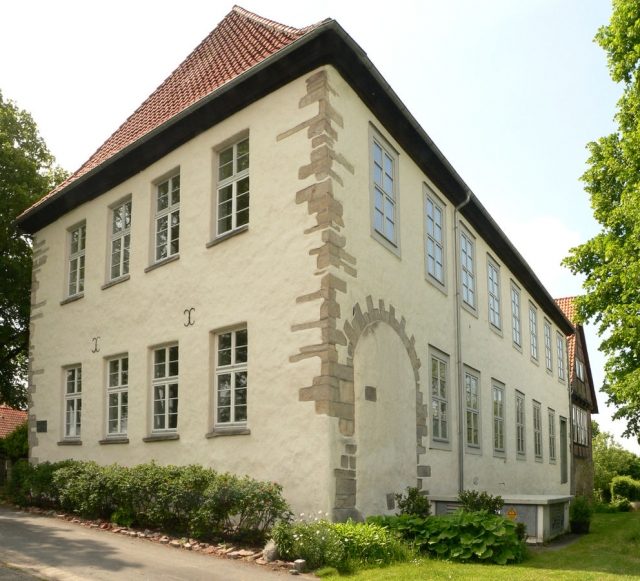
Pictorial representations of the castle in Bokeloh have not survived. A drawing from 1681 shows the castle complex as a loose collection of buildings with a freestanding castle tower. At that time, it was already an official residence. The foundations of a square tower were found during construction work in the 19th century. The current buildings appear as a three-winged complex, whose constructions date back to the 16th century and stand on medieval foundations and a cellar vault.

Upon the dissolution of the Bokeloh office in 1819, several buildings were demolished, such as the office building, the farm building, the horse stable, the pigsty, the carriage sheds, the drying house, and a barn. Only the main office building and an outbuilding remained untouched. The head forester took up his official residence in the main office building. The outbuilding was used by officials of the Blumenau office working in Bokeloh, and partly as storage space for grain. In the 1900s, the castle buildings underwent renovations and extensions were added.

Whether the building material of the castle, as described in written traditions, came from Tienberg was investigated in 1976. This was done through comparative studies of the distinctive red sandstone by the Lower Saxony State Office for Soil Research. The stones could be attributed to the Middle Bunter Sandstone based on their petrographic composition. It was considered probable that the stones came from Tienberg, as similar rocks are only found in the Bodenwerder area and transport from there is unlikely.

Bishop Wilhelm I of Minden erected the castle in Bokeloh in 1242. His successor Johann continued the fortification of the castle and, according to the Minden Bishop's Chronicles, had a castle tower built. In the Bishop's Chronicles, the castle is mentioned as "Castrum Novum" and first documented as castrum Boklo in 1317. The castle played an important territorial role in the mid-13th century with regard to the Counts of Roden in the Wunstorf area. The castle was not a pure bishop's castle, as two burgmannen of the Count of Roden resided there. In return, the Count had granted the Bishop of Minden the right to quarry stones for the construction of the castle at Tienberg, located north of Bokeloh, and to fell timber in the forest. It is presumed that the partnership between the Bishop of Minden and the Count of Roden was based on forming a coalition against the Count of Schaumburg and his plans for clearing the Dülwald forest. The reason for the construction of the castle in Bokeloh is also suspected to be the protection of the bishop's possessions around Idensen with the Sigwardskirche.

In the 14th century, Bishop Ludwig of Minden gave the castle to the Dukes of Brunswick and Lüneburg as a pledge. Later, other pledge owners followed until the castle came into the possession of the Counts of Schaumburg.

Take Mobile History with you

You are reading this text for free. Premium adds what matters on the road: descriptions read aloud, sites found through your camera, whole regions taken offline.

  • Every description, including the ~17,700 Premium sites
  • Audio guide: have descriptions read to you on location
  • AR finder: see sites through your camera, with distance and bearing
  • Unlimited saved sites

14 days free, then from €2.99 a month. Cancel anytime.

Source: Wikipedia · Licence: CC BY-SA 4.0 · Image: http://de.wikipedia.org/wiki/Schloss_Bokeloh#mediaviewer/Datei:Schloss_Bokeloh_Seitenansicht_Garten.jpg

This description draws on the facts documented in the linked Wikipedia article; Wikipedia content is licensed under CC BY-SA 4.0. Wording and editing: Mobile History.

Location: 52.4106, 9.3731