Public library
Museum
Cultural Events
Bonndorf Castle

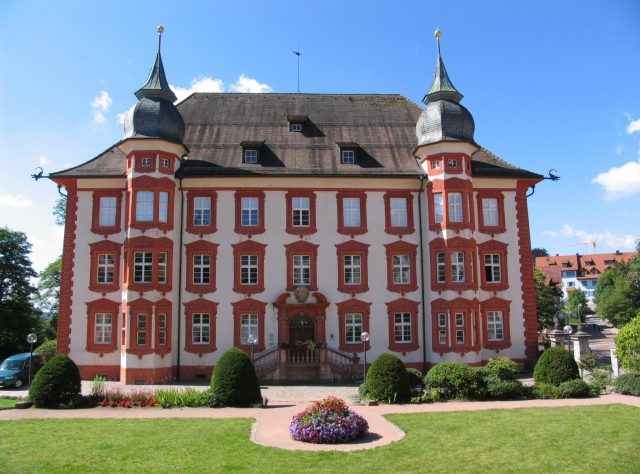
Bonndorf Castle is a castle in the town of Bonndorf in the Black Forest in the Waldshut district.
At the site of the current castle building, there was formerly a predecessor building, a "Sässhaus" presumably belonging to the Lords of Wolfurt from Wolfurt in Vorarlberg (where their ancestral castle Wolfurt still stands), which had been destroyed by a chimney fire. The Wolfurts owned Tannegg Castle and the Lordship of Birkendorf. In 1402, they founded the Paulinerkloster Bonndorf and staffed it with Pauliners from the Paulinerkloster Tannheim. After the Wolfurts, this predecessor building came into the possession of the Falkensteins, and via Knight Hans von Rechberg to the Counts of Lupfen. With the death of Heinrich von Lupfen, the family died out, and the County of Bonndorf was to fall to Conrad von Pappenheim. However, because he prematurely appropriated it, the Emperor punished him, and the lordship initially went to Karl von Zollern and Baron Peter von Mörsberg, but was revoked from them as early as 1598. Due to the resulting complications, Maximilian von Pappenheim, his son, later felt compelled to sell extensive property (Blumenegg, Gutenburg, Bettmaringen, Birkendorf, Grafenhausen, and the Vogtland of Berau) to St. Blasien Abbey. The Mörsberg family descends from the Morimont line. In 1686, Ulrich von Mörsberg was the last of his lineage.
New Construction and Renovation
The current castle was presumably initially built as a moated castle in the Renaissance style by Peter von Mörsberg († around 1594) and his son Joachim Christoph von Mörsberg. The construction costs of the building, erected between 1592 and 1595, were so high that Joachim von Mörsberg was forced to sell it in 1612. St. Blasien Abbey acquired the Lordship of Bonndorf for 150,000 guilders. Abbot Blasius III had the estate converted into a Baroque country castle between 1723 and 1727, adding two towers, a portal, and a grand staircase. Under Abbot Martin II, the hall on the upper floor was decorated with stucco work.
A small castle chapel, St. Nicholas Chapel, belonged to the castle. It was built in 1727 from sandstone and later relocated to the city garden.
Current Use
After extensive renovations, the castle now serves as a venue for concerts and exhibitions, houses the city library, and is a local history museum.
Take Mobile History with you
You are reading this text for free. Premium adds what matters on the road: descriptions read aloud, sites found through your camera, whole regions taken offline.
- Every description, including the ~17,700 Premium sites
- Audio guide: have descriptions read to you on location
- AR finder: see sites through your camera, with distance and bearing
- Unlimited saved sites
14 days free, then from €2.99 a month. Cancel anytime.
Source: Wikipedia · Licence: CC BY-SA 4.0
This description draws on the facts documented in the linked Wikipedia article; Wikipedia content is licensed under CC BY-SA 4.0. Wording and editing: Mobile History.
Location: 47.8187, 8.3416