Volkwang music school
Register office
Cultural center
Restaurant
Borbeck Castle

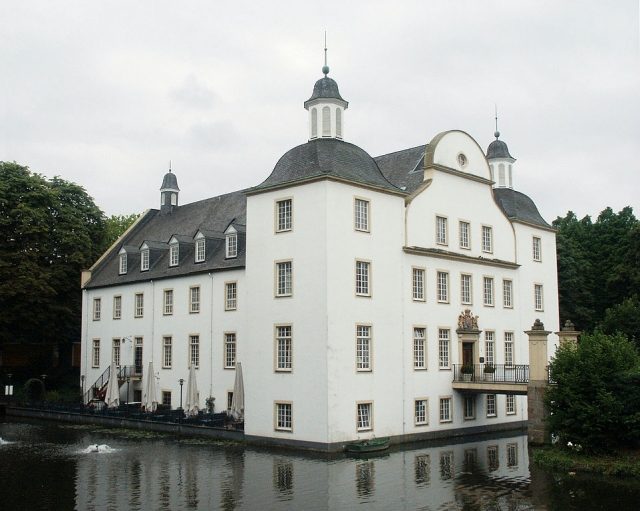
Borbeck Castle is a Baroque moated castle in the Borbeck district of Essen. Since the 14th century, it was the preferred residence of the Princess-Abbesses of Essen and received its current external appearance in the 18th century. Since the 1980s, it has been used as a venue for further education and cultural events.
The castle complex in Borbeck consists of a main house and an elongated economic building, which is located northeast of the main building. The two castle buildings are surrounded by a 42-hectare castle park in the English landscape style.
Buildings
The three-story main building is surrounded by a six to nine-meter wide moat, which flows north into a castle pond. It owes its current, sober appearance to renovation and extension work in the first half of the 18th century. The northern part of the light-plastered rectangular building, with its two square corner towers and the curved gable, still dates from the Renaissance period, but was later altered in Baroque forms. The rubble stone masonry of its core building rises on a 16x18 meter footprint and was erected in the mid-17th century. To its south, a five-window-axis extension was added, the construction of which probably began in 1744. The building's gable roof has a row of dormer windows on both roof slopes. At the southern end of its ridge stands a roof turret with a small bell. At both corners of the north facade rise four-story corner towers, topped by a curved hood with an octagonal lantern. Both the towers and the building are emphasized by corner quoins, which are now hidden under the plaster. A 13-meter long stone bridge leads to the main portal. It dates from the 19th century and replaced a wooden bridge, whose central pillars on both sides, made of ashlar, were reused. Above the castle entrance is the coat of arms of Franziska Christine von Pfalz-Sulzbach, held by two lions, with the inscription below:
“BY GOD'S GRACE FRANZISCA CHRISTINA COUNTESS PALATINE BY THE RHINE AND OF THE HOLY ROMAN EMPIRE PRINCESS AND ABBESS OF THE IMPERIAL FREE SECULAR ABBEYS OF ESSEN AND THORN IN BAVARIA DUCHESS OF GÜLICH CLEVE AND BERG PRINCESS OF MOERS COUNTESS OF VELDENZ SPONHEIM THE MARK AND RAVENSBERG LADY OF RAVENSTEIN BREYSIG RELLINGHAVSEN HUCKARDE ANNO 1744”.
Northwest of the manor house stands a Neoclassical plastered building with a castle-like character. Built in 1842 on the site of an old outer bailey, it always served economic purposes despite its stately appearance. Its central section has three stories, topped by a hip roof. The center of its nine axes is particularly emphasized by a crowning triangular gable. This displays Renaissance-era stone heads, which originate from Horst Castle. To the north and south, lower side wings with two stories adjoin the central section.
The northwestern corner of the north wing is marked by a rubble stone tower with a base measuring 5.90x5.90 meters. It is a relic of the former medieval outer bailey from the 14th/15th century and is one of the oldest architectural testimonies in Borbeck. It is presumed that it once had more than the three stories preserved today. Originally, its lower section probably had loopholes on all four sides. While its cellar previously served as a prison, the upper floor housed a guardroom with windows. One of these had a Gothic pointed arch shape, which is now covered by the wooden cladding on the outside.
Castle Park
Borbeck Castle Park is considered one of the oldest park facilities in the Rhineland, as Abbess Elisabeth von Manderscheid-Blankenheim had the beech forest belonging to the castle, also known as Fürstinnenbusch, transformed into a forest park as early as the 16th century. Access to it is provided by a wrought-iron gate dating from the end of the 17th century, which originally came from Hugenpoet Castle. After standing at the main entrance of the castle complex from 1846, it received its current location at the park entrance in the 1940s. The city coat of arms of Essen was incorporated into the upper part of the gate.
The castle park is designed as an English landscape garden and dates from the time when Maria Kunigunde von Sachsen presided over the Essen Abbey as abbess. In her time, it still had water features, aviaries, a fake tomb, an artificial ruin, and a small island in a swan pond. Today, the source of the Borbecke, which feeds the moat and castle pond via a narrow stream, is still accessible via winding paths. In the eastern part of the freely accessible park lies the Dubois Arena, an open-air amphitheater-style arena, which is now used for numerous events.
Beginnings
Borbeck Castle dates back to a Frankish manor of the Essen convent called Bort(h)beki, first mentioned in the 9th century in a tithe roll of the convent. It was further documented in 1227 due to a dispute between its then owner, Knight Hermann von Borbecke, and Princess-Abbess Adelheid von Wildenberg, who, with the support of the Imperial Bailiff, Adolf von Gymnich, ultimately prevailed in this conflict.
During the 13th century, the abbey gradually established territorial rule, leading to a desire for spatial separation of the Princess-Abbesses' residence from the buildings used for spiritual purposes, thereby expressing their secular claim to power. For this reason, Abbess Berta von Arnsberg purchased the apparently mortgaged Borbeck manor from the knights Hermann and Wennemar von Altendorf in 1288, intending to have the predecessor of the current castle built there. It remains unclear whether this motte was built on the foundations of the old manor or merely on its land.
Borbeck becomes a Residence
From the beginning of the 14th century, Borbeck became the preferred residence of the Princess-Abbesses. In 1372, it was first referred to as a castrum, which suggests that it was already a fortified house or castle at that time. Abbess Elisabeth von Nassau, in the aforementioned year, with the consent of Emperor Charles IV, moved the Free Court to Borbeck.
The castle complex subsequently often served as a refuge for the Essen canonesses; for example, in 1426, during an internal dispute within the abbey over the succession of Margarete von der Mark-Arensberg. The abbess had resigned her office, and with the support of the male canons, Margarethe von Limburg was appointed abbess. However, this happened against the votes of the other ten canonesses, who were essentially the only ones who had the right to elect a new abbess. Their favorite, Elisabeth Stecke-von Beeck, fled with her followers to the castle complex in Borbeck and was besieged there by men of the Limburg family. However, with the support of Elisabeth's family, the Limburgers were driven away. A two-year feud followed before the papal legate could mediate between the warring parties, and Elisabeth von Beeck was confirmed as abbess by the Pope.
From the 15th century, a mint is documented at the former castle. Abbess Sophia von Gleichen began to have her own coins minted, the so-called "Borbeck Gulden" and "Borbeck Groschen". In 1493, the gatehouse and stables of the complex burned down during a raid.
During the Eighty Years' War, Borbeck was largely destroyed by Spanish troops in 1590. However, the buildings were restored by Princess-Abbess Elisabeth von Manderscheid-Blankenheim by 1594 and even expanded into a summer residence.
Heyday and Secularization
In 1665, Abbess Anna Salome von Salm-Reifferscheidt moved her residence entirely from Essen to Borbeck after having the main house rebuilt in the Renaissance style on old foundations around 1650. At the same time, she created a first artistically designed garden west of the manor house with terraced rock gardens, walking paths, and walnut and fruit orchards.
Borbeck Castle owes its current appearance to renovation work carried out by Abbess Franziska Christine von Pfalz-Sulzbach between 1744 and 1762. She had the building extended to the south. The large castle park was also laid out under her direction. The Baroque garden with water features had strictly symmetrical beds and cascade systems flowing axially towards the castle.
The last Princess-Abbess of Essen, Maria Kunigunde von Sachsen, still planned a complete reconstruction of her residence, but this plan was never executed, as the territory of the abbey was annexed by Prussia in 1802. This also marked the end of this sovereign enclave on Prussian territory. After the secularization in 1803, the Prussian State and Domain Chamber sold Borbeck Castle in 1804 to the Counts von der Recke-Volmarstein.
In 1826, Imperial Baron Clemens von Fürstenberg acquired the complex. He had its old outer bailey, consisting of servants' quarters and farm buildings, demolished, and between 1839 and 1842, had a new, Neoclassical building along with a stable erected by the Essen architect Heinrich Theodor Freyse in place of the old servants' and farm buildings, integrating a medieval square tower into the new construction. Until the renovation under the Barons von Fürstenberg, it served, among other things, as a watchtower and prison. Subsequently, it was used as a beer cellar and archive. Clemens' son, Friedrich Leopold von Fürstenberg, had the moat system of the former outer bailey leveled in 1865, so that no traces of it are visible today.
When the von Fürstenberg family moved their residence entirely to Hugenpoet, whose castle had also been owned by the family since 1831, in 1879, the rooms of Borbeck Castle were no longer used.
20th Century
In 1920, the castle park was made accessible for a fee. During the Second World War, several small bunker systems were built in what is now the castle park area, which are still visible in the bushes today. Their entrances, however, are concreted shut. The castle buildings survived the war years unscathed.
The city of Essen acquired the complex from the Fürstenbergs in 1941 to use it as office space for the city administration after renovation and restoration in the 1950s and 1960s. With the exception of the vaulted cellar and some decorative interior elements, which came from Horst Castle, the historical building substance of the interior was lost during these construction measures.
With the relocation of the municipal departments to a new administrative building in the 1970s, the upper floor of the castle and its annex building remained unused for a long time. The planning concept "a castle for citizens" presented by the city of Essen in 1979 included, among other things, the provision of group and function rooms in addition to gastronomic operations, which were to be available to the youth music school in the mornings and to local associations in the evenings. In addition, small guest apartments were set up for artists. For example, the Essen lyricist Wilfried S. Bienek lived in one such apartment from 1982 to 1984, and in 1993, the musician Markus Zaja took up residence in the castle as a scholarship holder of the city of Essen. Furthermore, an elderly day care center, exhibition rooms and workshops for artists, as well as laboratory spaces and demonstration rooms for film and photo amateurs were planned in the economic building. The planning focused on the creation of a local cultural working group that was to take over the management on its own. In the early 1980s, an initiative was then founded to use the castle buildings as a community center. However, despite three years of preparatory work, the concept was not implemented, and the city of Essen itself remained the operator of the complex.
After the buildings were listed as historical monuments in February 1985, the entire castle grounds were also designated as an archaeological monument in December 1998, as structural remains of the predecessor buildings are suspected underground.
Current Use+
Since 1983, Borbeck Castle has served as a cultural and meeting place for the citizens of Essen. In addition to the Borbeck registry office, which maintains a wedding room in the castle, and the Folkwang Music School, it also houses part of the municipal adult education center. The former economic building is regularly used for exhibitions and craft VHS courses. In addition, concerts and lectures take place in the castle.
In the basement, there is a restaurant called "Zur Münze" (To the Coin), in reference to the old tradition of coin minting at Borbeck Castle, which regularly hosts gastronomic events in the castle's grand hall.
Since the completion of extensive renovation work between 2004 and 2006, the permanent exhibition "Borbeck Castle and the Princess-Abbesses" has been on display in the moated castle. It offers an insight into the almost 1000-year history of the Essen convent. An oil painting by Heinrich Foelix from 1772, depicting the last Abbess Maria Kunigunde, was auctioned at Sotheby's and now hangs in the castle's tower room. Furniture, dining services, tapestries, and a chess set from the 17th and 18th centuries are also housed there.
Take Mobile History with you
You are reading this text for free. Premium adds what matters on the road: descriptions read aloud, sites found through your camera, whole regions taken offline.
- Every description, including the ~17,700 Premium sites
- Audio guide: have descriptions read to you on location
- AR finder: see sites through your camera, with distance and bearing
- Unlimited saved sites
14 days free, then from €2.99 a month. Cancel anytime.
Source: Wikipedia · Licence: CC BY-SA 4.0 · Image: http://commons.wikimedia.org/wiki/File:SchlossBorbeck01.jpg
This description draws on the facts documented in the linked Wikipedia article; Wikipedia content is licensed under CC BY-SA 4.0. Wording and editing: Mobile History.
Location: 51.4683, 6.9422