CastleBrackenheim

Brackenheim Castle

Brackenheim Castle

District court
Theater

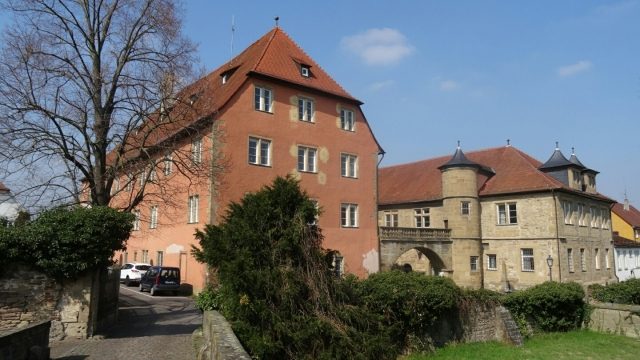
Brackenheim Castle is a castle in Brackenheim in the Heilbronn district in northern Baden-Württemberg. The complex was probably built in the High Middle Ages by the Lords of Magenheim in connection with the development of the town, and came into the possession of the House of Württemberg in the 14th century. The castle received its present appearance mainly through construction measures in the 16th and late 17th centuries. Württemberg used the castle as a dower house, although none of the widows favored with its possession ever lived in the complex in the 17th and 18th centuries. Later, the complex became the seat of the Oberamt Brackenheim and the Brackenheim district until its dissolution in 1938. Today, Brackenheim Castle houses, among other things, the Brackenheim District Court and a theater, and parts of the complex are also used for residential purposes.

Early History

The expansion of the town of Brackenheim into a city in the 13th century goes back to the Lords of Magenheim, who may also have had a seat in an old castle evidenced by the place name Burg. The existing town was systematically expanded and almost rectangularly walled, and a new castle was built in the southwestern corner of the town, from which the present Brackenheim Castle originates.

In the 14th century, Brackenheim and thus also the castle in the town came to Württemberg. As early as 1380, the complex was assigned to the wife of Count Eberhard III, Antonia Visconti, as a dower house. In 1492, the complex was first referred to as a castle. Under Duke Christoph, a comprehensive reconstruction of the castle took place between 1550 and 1565. The old castle was largely demolished in 1552 to erect new buildings on its foundations. Only an old keep remained from the castle, which was demolished in 1822. The new building of the 16th century was carried out by master builder Martin Berwart and was larger than the old castle, as several plots of land had been acquired and built over towards the town. A three-winged, almost rectangular complex was created with a three-story wing in the southwest and a two-story building in the east, which were connected in the north by a lower transverse building with two wooden galleries, while a wall enclosed the inner courtyard in the south. In the immediate vicinity of the castle and at various points within the town were several farmsteads belonging to the castle. The wing in the southwest became the seat of the respective Württemberg chief bailiffs.

Dower House of Barbara Sophia of Brandenburg

At the wedding of Duke Johann Friedrich with Barbara Sophia of Brandenburg in 1609, she was assured Brackenheim Castle as a dower house and the town and office of Brackenheim for her provision. In 1630, two years after Johann Friedrich's death, Barbara Sophie claimed the dower house and had it extensively renovated in the following years by the master builder Caspar Kretzmayer, without ever living there again. However, it was thanks to the construction measures initiated by the House of Württemberg and various efforts by the Duchess Dowager to secure her income from the office of Brackenheim that Brackenheim escaped relatively lightly in the turmoil of the Thirty Years' War. Barbara Sophia died in Strasbourg in 1636. From 1640, the castle was temporarily the seat of the widow of Duke Administrator Julius Friedrich.

Dower House of Maria Dorothea Sophie of Oettingen

At the wedding of Duke Eberhard III with Maria Dorothea Sophia of Oettingen in 1656, the bride was assured the castle, town, and office of Brackenheim as a dower house. In 1670, the complex was inhabited by the Württemberg chief bailiff Friedrich Ludwig von Janowitz and was severely damaged by a large fire. After the fire, there were initial considerations to rebuild the complex only partially due to lack of money and to assign another building to the chief bailiff as a residence. Finally, it was decided to proceed with a successive reconstruction. After the death of Eberhard III in 1674, the construction measures were accelerated, as the ducal councilors urged that his widow Maria Dorothea Sophia could move into the dower house quickly. From 1675, she directed the reconstruction from Kirchheim unter Teck and, contrary to the original plans for rebuilding the castle in its old form, introduced numerous special requests such as the expansion of the Bandhaus into a chapel, the establishment of a pharmacy, the relocation of the horse stable, the construction of portals and bridges, etc., thereby significantly influencing the present design of the castle. The construction work on the castle lasted over a decade. The extended east wing was then referred to as the New Castle, while the opposite wing was called the Old Castle. Maria Dorothea Sophie never moved into the building, as she remained in Kirchheim after the outbreak of the Palatinate War of Succession before fleeing to Regensburg and dying in Nürtingen in 1698.

Dower House of Marie Therese de La Contry

In the 18th century, the New Castle became the residence of the respective chief bailiffs, while the Old Castle was inhabited by the respective cellarmen and house tailors. After the death of Duke Administrator Carl Rudolf in 1742, on the advice of Privy Councilor Bernhard Bilfinger, the plan arose to convert three rooms in Brackenheim Castle for the accommodation of his life partner Marie Therese de La Contry, instead of the original testamentary provision for her with a dower house to be acquired. Three rooms were indeed prepared and various other renovations were carried out at the castle, but Carl Rudolf's widow died in 1748 before she had moved into the premises.

In the first half of the 18th century, the castle press, adjacent to the castle, was also built. The press, built in 1731, originally contained three press trees. As the performance of the press fell short of expectations, the number of press trees was reduced to two, and the storage space for grain was enlarged. In 1834, the press operation was discontinued, and in 1852/53, the building was sold privately and shortly thereafter converted into a residential building. Theodor Heuss was born in 1884 in a rented apartment on the upper floor of the building. The building was demolished in 1950 and replaced by a new cooperative press.

Oberamt Seat

In the course of the changes in the Württemberg administrative structure, the Oberamt Brackenheim was established in the middle of the 18th century, with the castle becoming its seat and remaining so until the dissolution of the administrative district, called Kreis Brackenheim from 1934, in 1938. Later, parts of the city administration and a police station were located in the castle. Today, the complex houses the Brackenheim District Court and a theater, and parts of the buildings are also used for residential purposes.

Take Mobile History with you

You are reading this text for free. Premium adds what matters on the road: descriptions read aloud, sites found through your camera, whole regions taken offline.

  • Every description, including the ~17,700 Premium sites
  • Audio guide: have descriptions read to you on location
  • AR finder: see sites through your camera, with distance and bearing
  • Unlimited saved sites

14 days free, then from €2.99 a month. Cancel anytime.

Source: Wikipedia · Licence: CC BY-SA 4.0 · Image: Jörg Heldt

This description draws on the facts documented in the linked Wikipedia article; Wikipedia content is licensed under CC BY-SA 4.0. Wording and editing: Mobile History.

Location: 49.0772, 9.0653