CastleBad Bramstedt

Bramstedt Castle

Bramstedt Castle

Cultural center

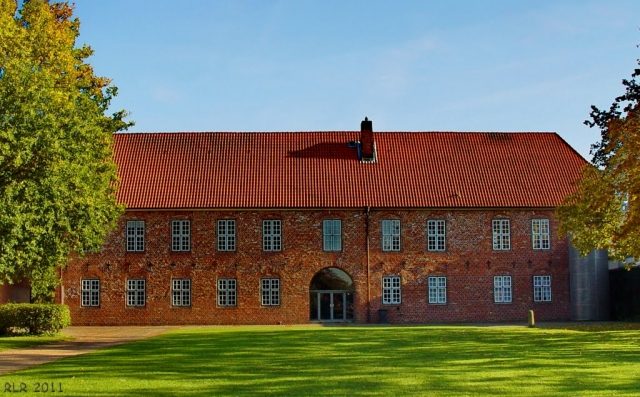
Bramstedter Schloss in Bad Bramstedt, Schleswig-Holstein, originated from the noble estate of the same name. The main building of the castle was demolished in the 18th century, and since then the name has been transferred to the former gatehouse of the estate, which was converted into a residential building in the Rococo style in the 18th century. The building now serves as the town's cultural center.

The Bramstedt estate developed from a medieval manorial lordship; the town received the rights of a noble estate in 1540. A peculiarity was that the estate was not originally owned by one of the Holstein nobility, but emerged from the possession of the great farmer Dirk Vaget and later came into the hands of an employee of the Danish king named Caspar Fuchs. Another peculiarity was that not all the lands of the village belonged to the estate. The property was distributed like a patchwork around Bramstedt and was cultivated not only by the lord of the manor and his serfs, but also by free, so-called "Amtsbauern" (official farmers). This led to repeated conflicts between the parties in the history of the estate. Caspar Fuchs was followed by Gerhard Steding as the next owner, after whom the estate also became known as Stedingshof. In 1628, a fire destroyed the buildings of the farm complex.

In 1631, the estate was sold to the Danish King Christian IV, who gifted the property to his mistress Wiebke Kruse in 1633 as a provisionary estate. A small castle was built for the king's beloved, and the current gatehouse also dates from this period. Whether and how often Wiebke Kruse stayed here is not historically confirmed. After her death, the estate passed as an inheritance to her daughter Elisabeth Sofie Christiansdatter and through her to her husband and heir Claus von Ahlefeldt. Ownership subsequently changed several times through sales or inheritances. The Ahlefeldts were followed by, among others, the Counts of Kielmannsegg. Under them, an attempt was made to force the free farmers of Bramstedt to perform corvée labor on the estate, against which they bought themselves out by forming a guild.

In the middle of the 17th century, the estate passed to the Stolberg family, under whom the old small castle and the buildings of the farmyard were largely demolished, and instead the gate building was converted into a residential house. The Stolbergs sold the estate in 1797 to the poet-jurist Friedrich Ludwig Wilhelm Meyer, who lived there until his death. Until the dissolution of the estate in the 19th century, the owners changed several times again, then the gatehouse, as the remnant of the former complex, came into the possession of the town of Bad Bramstedt.

Today, the gatehouse serves the city administration as a city archive and as a cultural center, where regular concerts and cabaret evenings are held.

Bramstedter Schloss+

The destroyed old castle

The actual Bramstedter Schloss was located west of the gatehouse on the other side of the Hudau, which flows through the former farmyard in a north-south direction. It was a small castle built around 1635 for Wiebke Kruse, and its front had a width of approximately thirteen meters. The more precise form of the building has not been preserved; only a few cadastral maps of the area exist from the time until its demolition in 1751. No traces of the castle remain; residential houses now stand at its location a few meters west of the Hudau. Between the castle and the gatehouse to the east was a farmyard with barns and stables, which were already removed under the Stolberg counts in the 18th century. The former farmyard now forms the garden of the gatehouse.

The current castle: the former gatehouse

The former gatehouse delimited the castle grounds from the former village center of Bramstedt; it is located directly on the Bleeck, the village's main square, which resembles a village green. The gatehouse is a cuboid, wide brick building, erected around 1647 in the forms of the late Nordic Renaissance. After the demolition of the castle in the 18th century, parts of the furnishings were installed in the gatehouse, and the building, once used for agricultural purposes, was converted into a residential house; since then, it has also been referred to as Schloss Bramstedt. In contrast to the strict and largely unarticulated facades, the interiors were richly decorated in the Rococo style by the Italian stucco artist C. D. Martini, and a baroque staircase was installed. The ornate furnishings of the living rooms have largely been preserved to the present day.

Take Mobile History with you

You are reading this text for free. Premium adds what matters on the road: descriptions read aloud, sites found through your camera, whole regions taken offline.

  • Every description, including the ~17,700 Premium sites
  • Audio guide: have descriptions read to you on location
  • AR finder: see sites through your camera, with distance and bearing
  • Unlimited saved sites

14 days free, then from €2.99 a month. Cancel anytime.

Source: Wikipedia · Licence: CC BY-SA 4.0 · Image: Rainer Gindele

This description draws on the facts documented in the linked Wikipedia article; Wikipedia content is licensed under CC BY-SA 4.0. Wording and editing: Mobile History.

Location: 53.9180, 9.8817