CastleRanis - Brandenstein

Brandenstein Castle
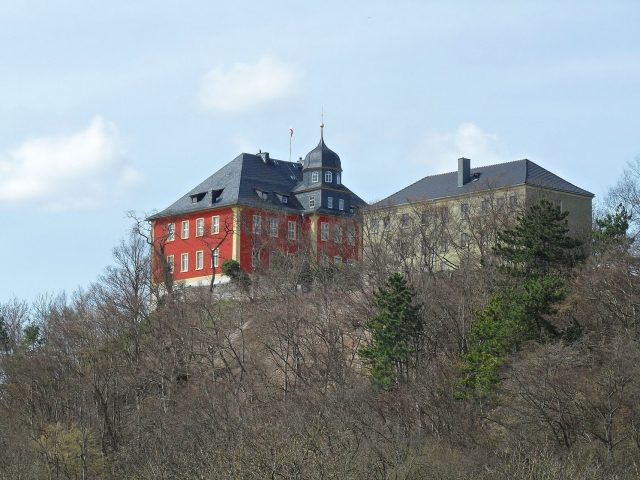
Brandenstein Castle

Museum
Restaurant

Brandenstein Castle, also known as Burg Brandenstein, stands on a Zechstein reef in the Brandenstein district of the town of Ranis in the Saale-Orla district in Thuringia.

The castle was the ancestral seat of the noble family of knights and later lords of Brandenstein, first mentioned in a document in 1289. They held Brandenstein Castle as a fief from the Wettins at least since 1351. However, they also possessed Schwarzburg, Orlamünde, and Lobdeburg fiefs, but mostly appeared as Wettin followers and councillors and played a relatively significant role as such.

The Brandensteins were nobles who could live quite well with a vassal relationship to the Wettins in the long term, especially if the latter provided them with military protection and relieved them of the payment of the not inconsiderable imperial taxes.

In 1584, the castle came into the possession of the Lords of Breitenbauch for 16,000 Thalers. During the Thirty Years' War, for the first time in 1634, Brandenstein Castle was besieged by Croatian troops. The castle was probably severely damaged during this difficult time and was mentioned as "the desolate house" of Brandenstein. Thus, from 1698 to 1705, it was converted into a palace in the High Baroque style by District Administrator Christoph Adam von Breitenbauch. He had the remains of the old castle removed and designed a castle courtyard on the east side. A round garden pavilion, whose foundations are still preserved, is verifiable. He had the outer bailey rebuilt from stones of the ruin of Burg Stein.

The castle remained in the possession of the von Breitenbauch family, who had renamed themselves Breitenbuch in 1910, until their expropriation and expulsion by the communists in 1945. Until 1955, Brandenstein Castle served as a workers' dormitory and the Leni Fleischer party school of the Maxhütte steelworks and the Hermsdorf Ceramic Works (KWH). From 1955 to 1988, the castle was a youth hostel with approximately 18,000 overnight stays per year. After 1988, the castle stood empty and was left to decay.

In 2000, the building was bought by the Thuringian family Holger Kahl, and since then, the house has been gradually renovated and reconstructed. The family uses parts of the first floor as a living area. On the second floor is the so-called Sonnensaal (Sun Hall), which can be used for various events. Since 2007, there has been a small castle café in the basement of the castle with a courtyard and a west terrace for guests. As part of a seminar project, a small exhibition room was created on the upper floor of the building, which documents part of the castle's history with artifacts and has been open to visitors since September 2009.

Take Mobile History with you

You are reading this text for free. Premium adds what matters on the road: descriptions read aloud, sites found through your camera, whole regions taken offline.

  • Every description, including the ~17,700 Premium sites
  • Audio guide: have descriptions read to you on location
  • AR finder: see sites through your camera, with distance and bearing
  • Unlimited saved sites

14 days free, then from €2.99 a month. Cancel anytime.

Source: Wikipedia · Licence: CC BY-SA 4.0 · Image: Uwe Klimpke

This description draws on the facts documented in the linked Wikipedia article; Wikipedia content is licensed under CC BY-SA 4.0. Wording and editing: Mobile History.

Location: 50.6694, 11.5558