CastleGußwerk-Brandhof

Brandhof Castle

Brandhof Castle

To be privately owned

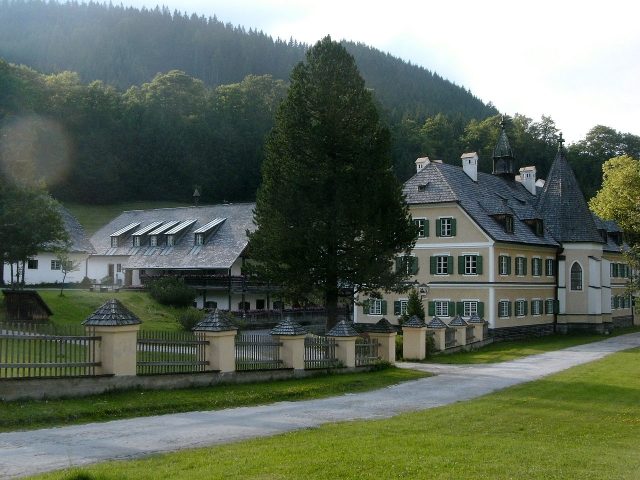
The Brandhof (also "Schloss Brandhof") is a very old farm at the foot of the Seebergsattel on the Mariazell road in the municipality of Gußwerk in the district of Bruck-Mürzzuschlag in Styria. It is a protected monument.

The Brandhof, owned by St. Lambrecht Abbey, was an ancient, isolated farm. It stood exactly on the border between the lordships of Mariazell and Aflenz. The farm itself was still in Mariazell territory, but most of the agricultural land was in the area of the Aflenz lordship. Around 1390, a certain Prantner was the tenant of the estate, whose name passed to the farm. The owner of the Brandhof was obliged to provide post-horse services over the 1254 m high Seebergsattel at the end of the 15th century. Archduke Johann, the younger brother of Emperor Franz II (I), acquired the farm in 1818 at an auction, where he sent Johann Hippmann as a straw man. The Archduke intended to establish a model estate for alpine cattle breeding here. For this purpose, he had a stable for 37 cows built, but for financial reasons, he initially made few changes to the modest residential house. When he inherited 200,000 guilders from Albert of Saxony-Teschen, he was able to carry out further plans. In the following six years, he had the estate expanded into a magnificent hunting lodge, largely according to his own plans. Through purchases, the property was significantly enlarged. Shortly after the acquisition, he had the farm registered as "Freigut Brandhofen" in the land register. In the newly built chapel in the castle, Archduke Johann married Anna Plochl, the daughter of the postmaster of Aussee. His brother only agreed to the marriage many years later. In 1834, Anna Plochl was granted the noble title "Freifrau von Brandhofen". Archduke Johann particularly enjoyed staying at Brandhof during the hunting season. It served him and his hunting guests as a base for chamois hunting in the Hochschwab area. His alpine garden with rare mountain plants from Europe and Asia was widely famous. In 1962, some farm buildings caught fire, but the hunting lodge was saved. It is still owned by his descendants, the Counts of Meran, today.

Architecture and Furnishings+

The complex consists of the actual manor house (the hunting lodge) and some farm buildings in a rural style. The residential house is an elongated rectangular building, which is provided with a high and steep hipped roof to protect against the abundant snowfalls common in this area. The attic is developed. Above the center of the building is a neo-Gothic roof turret with a clock and bell. Below it, the octagonal neo-Gothic chapel projects significantly from the facade. Above it is a small church tower. In it is a Gothic wooden statue of the Madonna with the Child Jesus, created around 1450 and repainted in the Baroque period. It originally came from Thernberg Castle, which was also owned by Archduke Johann until 1822, but was transferred by him to the Brandhof. The rest of the furnishings in the chapel are neo-Gothic. In the design of the interiors, less emphasis was placed on representation than on a Biedermeier living atmosphere. The windows in the large dining room were designed by Ludwig Ferdinand Schnorr von Carolsfeld and Matthäus Loder and executed as stained glass by Anton Kothgasser after 1828. They depict various possessions of the Archduke and historical events from his life. Schnorr von Carolsfeld was also responsible for the entire interior design of the building. The console figures and coats of arms of the beamed ceiling were created by Daniel Böhm - they refer to the history of the Habsburgs. The "Jägerzimmer" (hunter's room) is paneled with Swiss pine wood. Later, Archduke Johann set up a private hunting museum here. The designs for the stained glass windows there came from Jakob Gauermann, which were implemented by Gottlob Samuel Mohn in 1820/21.

Take Mobile History with you

You are reading this text for free. Premium adds what matters on the road: descriptions read aloud, sites found through your camera, whole regions taken offline.

  • Every description, including the ~17,700 Premium sites
  • Audio guide: have descriptions read to you on location
  • AR finder: see sites through your camera, with distance and bearing
  • Unlimited saved sites

14 days free, then from €2.99 a month. Cancel anytime.

Source: Wikipedia · Licence: CC BY-SA 4.0 · Image: http://commons.wikimedia.org/wiki/File:Schloss_Brandhof.jpg?uselang=de

This description draws on the facts documented in the linked Wikipedia article; Wikipedia content is licensed under CC BY-SA 4.0. Wording and editing: Mobile History.

Location: 47.6334, 15.3012