Cultural Events
Museum
Broich Castle

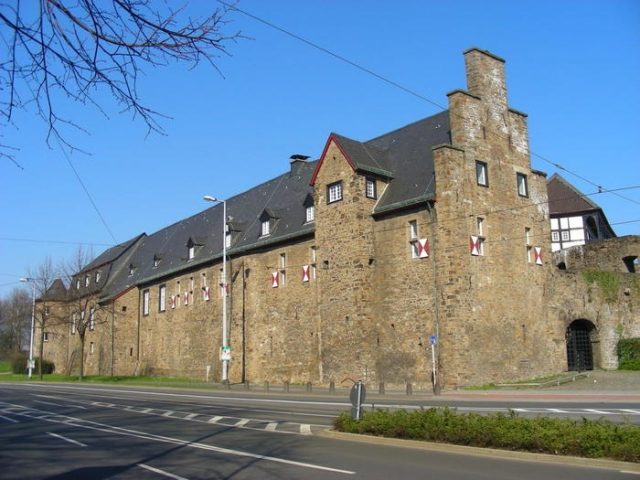
Broich Castle is located in the district of Broich in the city of Mülheim an der Ruhr, on the left bank of the Ruhr river near the city center. The fortification lies on the historic Ruhr ford of the old Hellweg and is, in parts, the oldest preserved early medieval defensive structure of the late Carolingian period north of the Alps.
9th to 11th Century
In 883, Vikings conquered Duisburg and established their winter camp there. Probably for this reason, the East Frankish Duke Henry had a fortified military camp built in Broich in the winter of 883/884: The original complex was built on an 11 m high spur above the Ruhr, probably as a barrier castle to secure the river and the Hellweg, which crossed the Ruhr via a ford here. An oval ring wall enclosed numerous multi-room, even two-story buildings. However, there were no kitchens, storerooms, or wells yet, suggesting a plan for only short-term use. In April 884, Henry and his army drove the Vikings out of Duisburg. But after the threat from the Vikings was no longer present, the complex was abandoned.
In his annals, Flodoard of Reims reports on a meeting that took place in 923 between King Henry I of East Francia and Robert I on the lower course of the fluvium Ruram. Some authors infer the existence of a fortified complex up to this point.
The abandoned castle was rebuilt and expanded by the noble lords of Broich towards the end of the 11th century. In 1093, the Broich family, along with the lords of Mülheim and Dümpten, are demonstrably mentioned in writing for the first time as witnesses to a count's court.
12th and 13th Century
Philipp I von Heinsberg, Archbishop of Cologne, acquired Broich Castle in 1188 from the brothers Theodorich and Erwin Bruke for 400 Mark. This is the first documented mention of the complex. However, no actual transfer of ownership occurred. The bishop's intention was to secure so-called "Offenhäuser" (open houses, i.e., castles that could be used by the liege lord in times of war).
From the end of the 12th century, the complex gradually developed into a fortress through renovations and new constructions. The ring wall was rebuilt, increased to 1.50 m in thickness and 9 m in height. The northern part became a Zwinger (outer bailey). A massive, 17.40 m high keep was erected. The renewed fortification was so effective that in 1240 it withstood the siege and attack of the Archbishop of Cologne, Konrad von Hochstaden. The occasion was the territorial wars of the Archbishop with Count Wilhelm IV of Jülich and Duke Henry IV of Limburg. Due to Duke Henry's simultaneous position as Count of Berg, his vassals, the Lords of Broich, were involved in this conflict.
14th and 15th Century
With the last Lord of Broich, Dietrich V, the original male line died out, and his eldest daughter Lukardis, married to Count Dietrich IV of Limburg, inherited the Lordship of Broich in 1372. Between 1380 and 1400, a two-story Gothic palas, or rather a hall building, with striking stepped gables, was built into the southern, partly demolished defensive wall.
Since Count Heinrich von Limburg-Broich led several feuds against the Archbishop of Cologne Dietrich II von Moers, the castle was besieged several times from 1437 to 1439. Finally, in 1443, the Archbishop of Cologne, Duke Gerhard von Jülich-Berg with their allies and troops of the Bishop of Liège Johann VIII von Heinsberg and Elector Frederick II of Saxony, besieged the castle from September 2nd to 19th. Observers reported an army of up to 22,000 men. Eventually, the castle was shelled. The mighty keep and the southwest tower went up in flames and burned out. The ring wall was severely damaged and the residential buildings were uninhabitable. The castle was captured for the first time in its history. The victors declared themselves willing to rebuild and fortify the castle. The damages were repaired by 1444 with 6,000 Rhenish gold guilders. During the repair, the keep was demolished, but a planned stone bridge over the Ruhr was not built.
16th Century
Because Count Johann von Limburg zu Broich had no descendants, in 1505 he adopted his sister Maria's daughter, Irmgard von Sayn, and married her in the same year to Wirich V von Daun-Falkenstein. In 1508, Johann gifted the couple the Lordship of Broich and his half of the County of Limburg.
Due to Wirich von Daun's larger retinue, several renovations and new constructions were carried out. The castle gate in the northwest tower was closed, and a larger entrance was broken into the western ring wall. A two-story building was erected between the northwest tower and the castle courtyard wall. Three half-timbered houses were built within the castle ring. A two-story residential building was constructed between the northwest tower and the castle courtyard wall. Near the palas, another two-story stone building was leaned against the southern castle courtyard wall. However, a strengthening of the fortifications did not occur.
Since 1584, Broich suffered severely from constant Spanish and state troop movements and quartering due to the Truchsessian Troubles and the Eighty Years' War.
Finally, on October 5, 1598, by order of Admiral Francisco de Mendoza, an army of 5000 Spaniards with several cannons advanced on Broich Castle. Lord of the castle Count Wirich VI von Daun-Falkenstein insisted on his neutrality in vain. After heavy shelling by the Spaniards, Count Wirich had to capitulate the next morning. The castle had suffered considerable damage; a breach was shot into the castle wall between the corner tower and Scheifhacke. On October 11, Count Wirich was struck down and stabbed near the castle by his two Spanish guards.
17th Century
The damage to the heavily destroyed castle was only repaired decades later, between 1644 and 1648, by Count Wilhelm Wirich von Daun-Falkenstein. The residential buildings were rebuilt and supplemented. On two stone, two-story residential houses of the ring complex, he had a half-timbered floor with a wooden gallery built above the gate: the present Hochschloss (upper castle). Above the entrance of the Hochschloss is the coat of arms of Wilhelm Wirich von Daun-Falkenstein, which, with the year 1648, indicates the completion of the renovation work. The following inscription can be read there:
Wilhelm Wyrich Von Daun Count Of Falkenstein And Limburg Lord
Of Oberstein Broich And Reipolskirchen etc. Anno 1648
In the castle courtyard, a two-story castle wing with an attached octagonal stair tower was built, using the Gothic palas and the 16th-century residential building. Two additional wings were erected on the northern and western castle courtyard walls. To the south, a large garden was created, with the castle gate being moved 80 meters outwards. Wilhelm Wirich had a flat-vaulted crypt built for his family under the chapel in the palas. Northwest of the castle, a tower-like outer bailey with a moat was built, which was demolished as a ruin in the 19th century.
Wilhelm Wirich died in 1682. Since his only heir, Carl Alexander, was shot dead by Count Moritz von Limburg-Styrum on October 7, 1659, the inheritance passed to his daughter Christine Luise. She had been married to Count Emich Christian von Leiningen-Dagsburg since July 17, 1664.
Not much was done for maintenance anymore. The castle now served only as the official residence of the rent master.
18th Century
It was not until Christine Luise's granddaughter, Maria Luise Albertine, Countess of Leiningen-Dagsburg, that interest in the property revived. She now stayed more often on the Ruhr and planned to have the castle restored and expanded by the Palatine Chief Architect Nicolas de Pigage. In 1789, however, they were content with a partial reconstruction of the west wing with the "glass palace" and the renewal of the stair tower in early Classicist style. The northern wing was demolished. Above the entrance portal of the west wing, the following inscription can be read, commemorating the construction:
This building was erected
in 1789 by
Maria Luise Albertine
Widowed Landgravine of Hesse-Darmstadt
Born Countess of Leiningen, Dachsburg and Broich
Renewed 1967-1974
In 1787 and 1791, the Countess took her two young granddaughters Luise and Friederike von Mecklenburg-Strelitz, later Queens of Prussia and Hanover respectively, to Broich. Due to their great closeness to the people and warmth, the two princesses quickly became very popular with the population.
19th and 20th Century
During Napoleon's rule on the Rhine and Ruhr from 1806 to 1813, the Lordship of Broich was also dissolved. After a two-year transitional period, Broich was annexed by Prussia in 1815 by decision of the Congress of Vienna.
The buildings quickly fell into disrepair. In 1830, the last owner, Prince Georg Karl von Hessen-Darmstadt, died.
In 1857, the rent administrator Bilger and his son-in-law, the banker Eduard Stöcker, bought the castle for 335,000 Thalers. They repaired major damage to the buildings, demolished the half-timbered structures of the core complex, and built a two-story Classicist villa there, leaning against the Hochschloss.
In the 19th and 20th centuries, the complex lost significant structural substance due to railway and road construction.
In 1938, the castle became the property of the city of Mülheim. During World War II and in the post-war period, it then visibly deteriorated. In 1952, at least the hall building received a new roof.
Between 1967 and 1974, extensive excavations and restorations were carried out on the complex on behalf of the Landschaftsverband Rheinland and under the direction of Professor Günther Binding. The foundations of the late Carolingian complex, as well as those of later centuries, were uncovered.
In 1975, Broich Castle was ceremoniously reopened.
21st Century
After large quarry stones detached from the ring wall in September 2009, the complex has been undergoing renovation since 2010.
Current Use+
The representative halls of Broich Castle are now used for city receptions and civil weddings. Like the rustic Tecklenburg Chambers, the Knight's Hall, the Fireplace Room, and the Coat of Arms Room can also be rented for private celebrations or corporate events. The attic also houses the headquarters of Mülheimer Stadtmarketing und Tourismus GmbH. The Hochschloss houses the Historical Museum of the Mülheim History Association, which provides insights into several centuries of Mülheim history with excavation finds, models, and a "Luise Room."
Castle Rock and Burgfolk Festival
Since 2000, the Castle Rock Festival, initially a one-day event and since 2009 a two-day event, has taken place in the inner courtyard of the newer part of the castle. In 2002, it was expanded to include the Burgfolk Festival, also initially a one-day event and since 2010 a two-day event. These festivals are organized with the support of the city of Mülheim.
The music bands performing at the festival come from the rock and modern folk music genres. Many of the bands are very popular in their circles. Hundreds of music fans attend every year, preferably from the so-called "Black Scene" of the Ruhr area. Castle Rock has been sold out several months before the event every year since 2003. 1,200 Gothic fans attended the thirteenth event in 2012.
Take Mobile History with you
You are reading this text for free. Premium adds what matters on the road: descriptions read aloud, sites found through your camera, whole regions taken offline.
- Every description, including the ~17,700 Premium sites
- Audio guide: have descriptions read to you on location
- AR finder: see sites through your camera, with distance and bearing
- Unlimited saved sites
14 days free, then from €2.99 a month. Cancel anytime.
Source: Wikipedia · Licence: CC BY-SA 4.0 · Image: http://www.wehrbauten.de/thread.php?threadid=630
This description draws on the facts documented in the linked Wikipedia article; Wikipedia content is licensed under CC BY-SA 4.0. Wording and editing: Mobile History.
Location: 51.4271, 6.8713