CastleBruchsal

Bruchsal Castle

Bruchsal Castle

Museum

Bruchsal Palace in the Baden-Württemberg city of Bruchsal was the residence of the Prince-Bishops of Speyer (as a replacement for the bishop's palace destroyed in the War of the Palatine Succession).

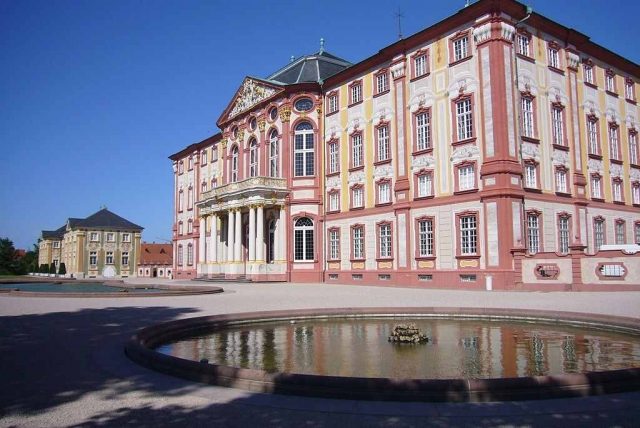
Bruchsal Palace, in the Baroque style, was built starting in 1720 at the request of Prince-Bishop Damian Hugo Philipp von Schönborn-Buchheim from Lossburg sandstone. At its core, it is a three-wing complex, based on plans by the Mainz chief building director Maximilian von Welsch. After several plan changes, the central staircase was built by Balthasar Neumann, who had taken over construction management in 1731. It is generally considered one of the most successful solutions for a Baroque staircase. His ingenious design provides for a two-flight staircase, surmounted by the dome hall, in the heart of the Corps de Logis, leading to the two grand halls of the palace. The Prince's Hall is the grand hall facing the city. The Marble or Emperor's Hall faces the garden. The Marble Hall belongs to the architectural and programmatic center of the spiritual residence.

In addition to Neumann, the Lombard painter Giovanni Francesco Marchini began his work in the palace. Between 1731 and 1736, he painted the frescoes of the Intrada, the gloomy grotto, and the garden hall. The facade painting of the Corps de Logis and the orangery buildings also come from Marchini's hand. The trompe l'oeil architecture of painted wall projections is of outstanding perfection.

The Rococo-style interior decoration was mainly created under Hugo Damian's successor Franz Christoph von Hutten zum Stolzenberg. The frescoes impressively depict the past, present, and future of the Prince-Bishopric of Speyer in the language of mythology. The stucco work was completed only in 1755 by Johann Michael Feuchtmayer, and the frescoes by Johannes Zick.

Between 1900 and 1909, the long-lost, colored facade design was restored by Fritz Hirsch as a pioneering act of modern monument preservation. The palace complex comprises numerous building parts, including the Damianstor and the court church. In the last days of World War II, the palace was severely hit during the air raids on the city on March 1, 1945, and burned out; however, the substance of the staircase largely survived the destruction, unlike the dome. The central building (Corps de Logis) was reconstructed as a museum until the 1970s after lengthy discussions about whether and how to rebuild it, while the church wing was designed in a modern style.

Current Use+

Bruchsal Palace is open for visits. The palace houses the German Museum of Music Automata and the Museum of the City of Bruchsal. It is one of the state-owned monuments and is managed by the "State Palaces and Gardens of Baden-Württemberg" institution. The Bruchsal District Court is also located in buildings belonging to the palace.

Take Mobile History with you

You are reading this text for free. Premium adds what matters on the road: descriptions read aloud, sites found through your camera, whole regions taken offline.

  • Every description, including the ~17,700 Premium sites
  • Audio guide: have descriptions read to you on location
  • AR finder: see sites through your camera, with distance and bearing
  • Unlimited saved sites

14 days free, then from €2.99 a month. Cancel anytime.

Source: Wikipedia · Licence: CC BY-SA 4.0 · Image: http://commons.wikimedia.org/wiki/File:Schloss_Bruchsal01.JPG?uselang=de

This description draws on the facts documented in the linked Wikipedia article; Wikipedia content is licensed under CC BY-SA 4.0. Wording and editing: Mobile History.

Location: 49.1288, 8.5981