The Castle can be visited
Museum
Bückeburg Castle

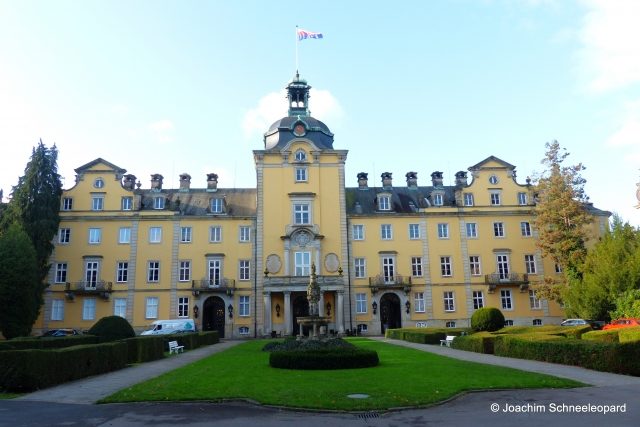
Bückeburg Castle is a castle in Bückeburg and the ancestral seat of the House of Schaumburg-Lippe, the princely house that ruled the state of Schaumburg-Lippe until 1918.
Middle Ages and Early Modern Period
The founding of Bückeburg as a precursor to the castle can be traced back to 1304, when it was first mentioned in a document. In the early 14th century, Count Adolf VI of Schauenburg and Holstein-Pinneberg built the moated castle of Bückeburg to monitor the important trade route Hellweg from there. It was named after the Old Bückeburg in nearby Obernkirchen, the castle of the Counts of Bukkigau, which had already fallen into disrepair around 1181. Initially, the fortification consisted only of a defensive tower and outbuildings, around which a small settlement developed over time.
In 1365, the small town of Bukkiborg was granted market rights, and around 1396, Otto I of Schaumburg appointed a clergyman to his newly built chapel. In 1492, the castle had only 13 rooms, but by 1527, under Johann IV, it had developed into a fortified complex with moats, ramparts, and bastions.
From 1560, Otto IV of Schaumburg had the original moated castle transformed into a representative four-winged castle complex in the Weser Renaissance style in just four years. Parts of the old building fabric were integrated into the new building. Heinrich Schrader and Jacob Kölling were responsible as master builders. The west and north wings were connected by the so-called Trumpeter's Gallery, an open gallery on the courtyard side.
Renaissance
Otto's son Ernst of Holstein-Schaumburg, who ruled from 1601 to 1622 and was elevated to prince in 1619, made Bückeburg his residence in 1607. He granted it city rights, had new streets laid out, fortifications and buildings erected, including the town church with its early Baroque facade from 1615. On the market square, he had the outer castle portal with a flanking administrative building, the Princely Court Chamber, which still exists today, and the ballroom built. Ernst transformed the garden laid out under his father into a typical, quite representative Renaissance garden. In 1622, the large stable was built as the last of the major constructions. The castle chapel received an early Baroque wooden decoration and was completely painted in the Mannerist style. The delicate wooden decoration of the castle chapel was made by the two Hildesheim sculptors Ebbert the Younger and Jonas Wulff.
One day after Ernst's death, foreign mercenaries stood in the city, and the calamity of the Thirty Years' War raged, which is why construction activities only resumed from 1695. After the Counts of Holstein-Schaumburg died out in the male line with Otto V in 1640, the castle and parts of the County of Schaumburg passed to Count Philipp, who founded the Schaumburg-Lippe line. He had the walls of the castle chapel completely whitewashed due to his Reformed faith, which caused the art historically highly significant fresco paintings to disappear under the paint for centuries.
Baroque
From 1728 to 1748, Albrecht Wolfgang zu Schaumburg-Lippe ruled in Schaumburg. During this time, Voltaire made several visits to Bückeburg, where he received the first inspiration for his famous novel Candide (the castle of Baron Thunder-ten-tronckh in Westphalia). In 1732, the north and south wings of the main building burned down in a few hours but were rebuilt within a year by levying a fire tax. At the same time, the inner castle moat was filled with the debris, thus enlarging the small space within the rampart.
Albrecht-Wolfgang envisioned a more generous reconstruction with an additional wing, but the tax revenues only allowed for the rebuilding of the destroyed east and south wings. The new style, now Baroque, still characterizes the external appearance of the castle today. The Count also had a Baroque garden laid out in place of the Renaissance garden, but the garden splendor only lasted until 1748.
From 1748 to 1777, Wilhelm zu Schaumburg-Lippe ruled. As a military strategist, he also had his father's castle garden provided with ramparts and moats, after the garden sculptures had previously been moved to the garden of Baum Castle. Under his successor Philipp Ernst (1777–1787), however, the castle garden was again transformed into a park with an attached large fruit tree nursery. His wife Juliane had part of the garden transformed into an English landscape garden. From 1820, large ponds were created in the so-called Hofwiesen south of the castle, in which carp were kept until 20 years ago. These ponds are now a valuable biotope for amphibians and waterfowl.
Historicism
It was not until 1860, under Prince Adolf Georg, that the castle rooms were renovated; among them the Golden Hall – formerly the White Chamber – which was equipped between 1863 and 1867 with, among other things, the red silk wallpapers that are still preserved today. The castle chapel was also thoroughly restored from 1879 to 1885. During the installation of the large organ, the pulpit wall, which until then had been directly attached to the back wall, had to be moved almost three meters into the room. The fresco paintings, which had been whitewashed in 1648, were also completely uncovered again, providing a deep insight into the formal language of Mannerism.
Major changes took place between 1893 and 1896, when the tower received a new wing extension. This extension corresponds to the plans Albrecht Wolfgang already had in 1732, namely to move the tower to the center of the castle by means of an extension. The main part of the extension is occupied by the Great Ballroom (9 meters high, 12 meters wide, and almost 24 meters long). In the basement, a modern large kitchen was installed with the latest technology, which could cater for 250 people. At the same time, the chancellery buildings and the old kitchen, which were still built under Otto IV, were demolished. The castle forecourt received an almost closed development with two semicircular cavalier houses and an associated formal garden.
From 1911 to 1915, Prince Adolf had a mausoleum built on the edge of the castle park as a burial place for the princely house. The architect was the Berlin professor Paul Otto August Baumgarten. At a height of 25 meters, there is the largest gold mosaic dome in Europe with an area of 500 m². This massive building with its own park is still the burial place of the princely family.
Current Use+
Bückeburg Castle has been continuously inhabited since its construction; originally by the Counts of Holstein-Schaumburg and from 1640 by members of the comital, later princely, family of Schaumburg-Lippe. Today, Alexander Prince zu Schaumburg-Lippe lives in the castle.
Since 1925, individual rooms have been open to visitors, including the castle chapel, the Golden Hall, and the Great Ballroom. Since May 2004, the Bückeburg Court Riding School has been located in the stables, where the equestrian art of European epochs from the 11th to the 17th centuries is demonstrated and cultivated. Bückeburg Castle is also a venue for various festivals and exhibitions, for example, the annual "Landpartie" in early summer, the "Christmas Magic" which takes place on the first two Advent weekends each year, the Schaumburg Country Fair "Ährensache" annually on the first weekend of September, or the medieval market "Mittelalterlich Spectaculum" in July. Oldtimer rallies such as the "Schaumburg Classics," in which the castle is included as a station, also attract great public interest. For some time now, civil weddings have been possible in the Baroque music room, and the castle chapel can now also be used by wedding couples of various Christian denominations.
On January 21, 2011, the completed 1:60 precision model of the castle was installed in the Marble Hall, from where castle tours will begin in the future. A cafe-restaurant is located in the rooms of the historic kitchen. There, guests can gain an authentic insight into the former stately grand kitchen based on old menus, photos, and original room furnishings. The Bückeburg State Archives are located in a side wing.
The freely accessible castle park has an area of over 80 hectares and surrounds the castle on all sides. One can find some globally rare tree species, such as Süntel beeches, swamp cypresses, or an almost 25-meter-high redwood tree behind the mausoleum.
Every autumn, the master classes of the International Music Academy for Soloists are held at Bückeburg Castle.
Take Mobile History with you
You are reading this text for free. Premium adds what matters on the road: descriptions read aloud, sites found through your camera, whole regions taken offline.
- Every description, including the ~17,700 Premium sites
- Audio guide: have descriptions read to you on location
- AR finder: see sites through your camera, with distance and bearing
- Unlimited saved sites
14 days free, then from €2.99 a month. Cancel anytime.
Source: Wikipedia · Licence: CC BY-SA 4.0 · Image: Joachim Schneeleopard
This description draws on the facts documented in the linked Wikipedia article; Wikipedia content is licensed under CC BY-SA 4.0. Wording and editing: Mobile History.
Location: 52.2589, 9.0436