CastleBüren

Büren Castle

Büren Castle

Administration department

The castle houses the district administration of the Office of Büren: the Government Governor's Office, the judicial authorities of Judicial District III Aarberg-Büren-Erlach, a prison, and a branch of the District Land Registry Office III and the Debt Enforcement and Bankruptcy Office.

In Büren, Bern succeeded the Counts of Neuchâtel in 1393. The old seat of the bailiffs, called Schultheissen, was located in the Seitengasse. In 1620, Bern bought four burgher houses between Hauptgasse and Aare at the western city entrance and had a large new castle built in their place by 1625. The aim of the undertaking was to appear representatively as a state entity at the then state border, at the Aare crossing, on the Aare, which was important as a transport route, and on Switzerland's ancient and most important East-West route. The building, occupied in 1624, has served the district administration ever since.

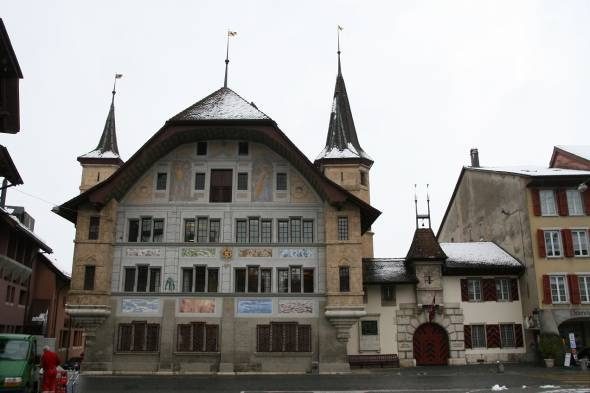
In accordance with its purpose, the new building was representative. At the widened, plaza-like mouth of the Kreuzgasse, it was erected with its gable facing the street, instead of the usual eaves-facing position. This makes the building appear larger and more powerful. The three-and-a-half-story, heavily windowed facade is topped by a large rounded roof, which is pierced on the sides by representative stone bay windows. An independent gatehouse in Renaissance forms with a machicolation and turrets leads into the courtyard; on the eaves side, a mighty stair tower provides access to the entire house via a transverse corridor.

The image of the castle is dominated by the cycle of paintings on the main and side facades of the castle, executed in 1623, recently restored and contemporaneously supplemented, by the universal artist Joseph Plepp. Integrated into the painted trompe l'oeil architecture of a palace facade, it displays an extensive iconographic program of Bern's Good Government, which is compared to that of Rome in its republican era. At the center is a "fruitful" Bernese coat of arms, above it the allegory of Mars/Victoria and Pax, protected by Pallas Athena, below it four seasons and the four elements.

On the western eaves side, a gigantic mural with the sacrificial death of Marcus Curtius to save the city of Rome, the largest facade painting in the Canton of Bern, adorns the triumphal arch. In the midst of the Thirty Years' War, which devastated entire regions just a few hours' ride from the state border, Bern demonstrated that its state system thrives in peace and strength, that gods, elements, and seasons are favorable to it, but that it requires the spirit of sacrifice of its citizens for the common good.

Take Mobile History with you

You are reading this text for free. Premium adds what matters on the road: descriptions read aloud, sites found through your camera, whole regions taken offline.

  • Every description, including the ~17,700 Premium sites
  • Audio guide: have descriptions read to you on location
  • AR finder: see sites through your camera, with distance and bearing
  • Unlimited saved sites

14 days free, then from €2.99 a month. Cancel anytime.

Source: Wikipedia · Licence: CC BY-SA 4.0

This description draws on the facts documented in the linked Wikipedia article; Wikipedia content is licensed under CC BY-SA 4.0. Wording and editing: Mobile History.

Location: 47.1401, 7.3714