CastleMayen - Sankt Johann

Bürresheim Castle
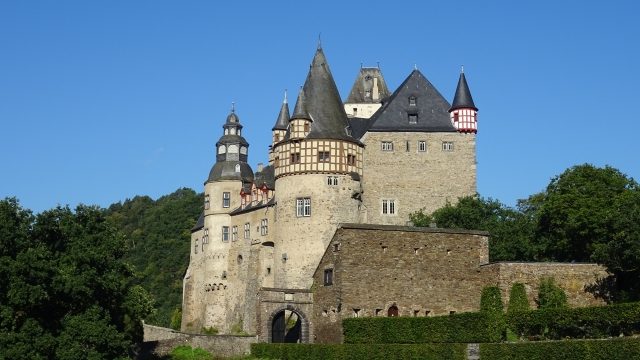
Bürresheim Castle

The Castle can be visited

Bürresheim Castle is located northwest of Mayen on a rock spur in the Nettetal valley. It belongs to the municipality of Sankt Johann (near Mayen). Together with Eltz Castle and Lissingen Castle, it is the only complex in the Eifel that was never conquered or destroyed and was able to survive the wars of the 17th and 18th centuries as well as the social upheavals of the French Revolution unscathed.

Due to its unique location in the border area of the possessions of Electoral Cologne and Electoral Trier, these archbishoprics significantly influenced the history of the castle.

Inhabitants and Owners+

Built in the 12th century, Bürresheim, with its then owners, the noble free lords Eberhard and Mettfried "de Burgenesem", was first mentioned in 1157. Eberhard's son Philipp sold his share to the Archbishop of Cologne Philipp I von Heinsberg shortly before 1189, only to receive it back from him as a fief. The Archbishopric of Trier also recognized the importance of the complex and acquired the other half of the then castle under Archbishop Heinrich II von Finstingen.

In 1359, the bailiffs of Leutesdorf took over the Cologne fief from the last representative of the von Bürresheim family, while the Trier part went to the Lords of Schöneck. Bürresheim thus became a Ganerbenburg (castle owned by multiple families) in the 14th century. The von Schöneck family did not remain owners for long, because already in 1473 Kuno von Schöneck and his son sold their part of the castle and lordship of Bürresheim to Gerlach von Breidbach, whose son Johann was also able to acquire a part of the Leutesdorf fief in 1477. The remaining castle share of the bailiffs came into the possession of Emmerich von Lahnstein at the beginning of the 16th century.

From 1572 onwards, disputes over ownership arose concerning that Lahnstein property, which could not be settled even by a lawsuit before the Imperial Chamber Court. It was not until 1659 that the parties reached an agreement through a settlement, and the von Breidbach family became the sole owner of the castle complex. From then on, the family bore the name "von Breidbach-Bürresheim" and was even elevated to the status of Imperial Barons in 1691. Their most famous representative was Emmerich Joseph von Breidbach-Bürresheim, Elector and Archbishop of Mainz from 1763 to 1774. At the time of the Barons von Breidbach-Bürresheim, the immediate imperial lordship of Bürresheim included, in addition to the castle, the villages of Sankt Johann, Rieden, and Waldesch, the hamlet of Nitz, and the Bürresheim mills.

In 1796, the lineage died out with the death of the last male heir, Franz Ludwig Freiherr von Breitbach-Bürresheim, the senior official in Koblenz and Ehrenbreitstein, who died while fleeing from French troops. Bürresheim Castle was inherited by a grandson of the sister of the last Breidbach at Bürresheim, Count Klemens Wenzeslaus von Renesse, whose descendants continued to live at Bürresheim Castle. In 1921, it also came into the possession of the comital family von Westerholt through inheritance. Due to unfortunate circumstances, only 17 years later, they were forced to sell Bürresheim Castle, including its complete furnishings, to the Provincial Association of the Prussian Rhine Province. The castle remained in their possession until it came under the care of the "State Castle Administration of Rhineland-Palatinate" in 1948, which handed it over to its successor organization "Castles, Palaces, Antiquities of Rhineland-Palatinate" in 1998.

Architecture+

The complex, which appears as a closed whole, only acquired its present form from the 15th century onwards. Previously, it consisted of two completely independent, unconnected, and differently sized sub-complexes, which only shared the Romanesque keep from the 12th century.

Bürresheim Castle was once secured by curtain walls and two neck ditches. The latter are now filled in, and only a few remnants of the curtain walls remain.

Keep

The almost square keep is the oldest building of the castle complex. Formerly only accessible through a high entrance, it is now accessible via a baroque open staircase built in the 17th century. It was probably raised in the 15th century and housed the gatekeeper's dwelling on the fifth floor.

Cologne Castle

This part was named after its builder, Archbishop Philipp I von Heinsberg, who had the buildings erected in the west of the present complex in 1339. It consisted of a spacious outer bailey, of which only remnants of the curtain wall remain today, and the late Gothic core castle. Access was from the northwest via a drawbridge.

The core castle consisted of a double-tower gate, which also served as a shield wall, and an adjoining hall building. Its cellar floor was - as was customary at the time - designed as a barrel vault. The ground floor consisted of a single large hall with a small, separate chapel room.

After the expansion of the Trier Castle from 1659, the Cologne Castle was only used as a farmyard and finally left to decay. Today it only remains as a ruin.

Trier Castle

The oldest preserved building of the Trier Castle dates back to the bailiffs of Leutesdorf, who built a residential house on the border with the Cologne Castle in the second half of the 14th century. All other buildings in their currently preserved form were built under the Lords of Breidbach.

Gerhard and Johann von Breidbach had a three-story residential building adjoining the curtain wall and a round tower with four-meter-thick walls built in the southeast after 1473. Only later did the latter receive its now distinctive half-timbered upper floor. The late medieval residential building, on the other hand, illustrates very well how simply people lived around 1490. Each floor contains a single large hall with oak pillars, beamed ceilings, and huge fireplaces. Only in later centuries were cozy rooms partitioned off.

After the von Breidbachs became sole owners of the castle complex in 1659, extensive extensions and conversions into a baroque residential castle began. Anna Magdalena von Metzenhausen, the widow of Wolf Heinrich von Breidbach, had a large south wing built between the round tower and the Leutesdorf bailiff's house, and between 1698 and 1700, Georg Rheinhard von Breidbach closed the last structural gap between the keep and the Gothic residential building with the so-called chapel building. Unusual here was that the builder had the chapel installed not on the ground floor, as was customary at the time, but on the first floor.

Already in 1683, a French terraced garden in the Baroque style was created on the southwest side of the castle, which was reconstructed in its present form in 1952.

Visit+

While the ruin of the Cologne Castle is not open to visitors, parts of the Trier Castle can be visited as part of a guided tour.

The fact that Bürresheim was in the hands of a single noble family for a long time gives the castle its remarkable, unique interior, which includes pieces from the late Gothic period to Historicism. Numerous portraits show members and relatives of the owner family and princes of past times. Thus, a unique testimony to Rhenish aristocratic and residential culture has been preserved to this day.

Among others, King Ludwig I of Bavaria and Emperor Wilhelm II visited Bürresheim Castle.

Filming Location+

A short exterior shot of the castle can be seen in Indiana Jones and the Last Crusade. In the film, it represents the fictional Castle Brunwald on the German-Austrian border, where Professor Henry Jones senior is held captive. Among other things, it can also be seen in the children's film The Prince and the Pauper as the king's castle, from which the prince and the pauper flee. Furthermore, a commercial for "4711 Echt Kölnisch Wasser" showed the baroque garden and the castle in the background, and in May 2009, filming for the WDR fairy tale film Rumpelstiltskin took place here.

Take Mobile History with you

You are reading this text for free. Premium adds what matters on the road: descriptions read aloud, sites found through your camera, whole regions taken offline.

  • Every description, including the ~17,700 Premium sites
  • Audio guide: have descriptions read to you on location
  • AR finder: see sites through your camera, with distance and bearing
  • Unlimited saved sites

14 days free, then from €2.99 a month. Cancel anytime.

Source: Wikipedia · Licence: CC BY-SA 4.0 · Image: Jörg Heldt

This description draws on the facts documented in the linked Wikipedia article; Wikipedia content is licensed under CC BY-SA 4.0. Wording and editing: Mobile History.

Location: 50.3528, 7.1795