CastleBulle

Bulle Castle

Bulle Castle

Administration department

Although it was never directly under Savoyard rule, Bulle Castle provides an excellent example of the architecture of castles as planned by the Counts of Savoy in the 13th century, especially Pierre II.

Bulle belonged to the Bishop of Lausanne, the spiritual ruler of the region since the beginning of the Middle Ages, and its church marked the center of a very large and ancient parish. The last King of Upper Burgundy, Rudolph III, transferred temporary power over parochial Bulle to the bishop. Located in the center of the Sarine Valley at the crossroads of several connecting routes, this village had a particularly significant importance due to its exceptional location.

The church, erected on a plain in a sheltered location, was soon surrounded by an initial agglomeration that did not hesitate to hold markets. In the 12th century, this was the cause of a disagreement between the bishop and the Count of Gruyères. Finally, the bishop seized the market rights, and the count renounced organizing his own markets in 1195-96. One of the most important events in Bulle's history was the construction of a larger village and fortifications at the beginning of the 13th century, which was undoubtedly undertaken to strengthen the defense of the site, which was always exposed to attacks from the Counts of Gruyères. Only the original layout of this medieval village persisted, a rectangular core that can still be found today in the city center of Bulle.

Even when the city was the victim of destructive fires in 1447 and 1805, it retained this layout, characterized by two longitudinal streets. North of the rectangle, 400 meters long and 140 to 150 meters wide, stands the church, and to the south, the castle.

Archaeological research indicates that the city of Bulle was founded under the episcopate of Boniface (1231-1239) and later canonized. As for the construction of the castle, the question remains open. The one who became Count Pierre II was initially destined for an ecclesiastical career; from 1229 to 1231, he was procurator of the Bishop of Lausanne. In this capacity, he acquired a certain influence over Bishop Boniface, who, coming from Cologne, was not well acquainted with the Vaud diocese. Savoyard coats of arms, uncovered in the doorframe of a window during renovation work, prove that the Count's family was involved in the construction of the castle in one way or another. After 1239, this would no longer have been possible, because a dispute that arose between the bishop and the counts in connection with Boniface's succession divided the bishop and the House of Savoy for decades, and even after this dispute, the bishop remained the absolute ruler over Bulle for a long time.

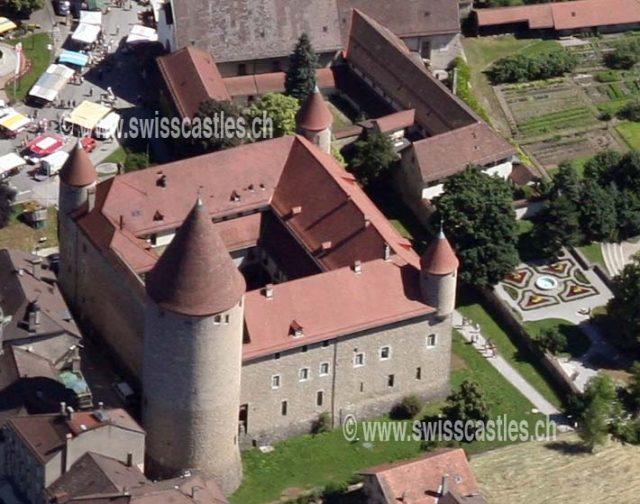
Its construction probably followed a single pattern. It is a typical work of Savoyard architecture, a quadrangle flanked by round towers. The one in the southwest is a massive watchtower 13.5 meters in diameter and 33 meters high; on the ground floor, its walls reach a thickness of 2.16 meters. Smaller are the towers of the other three corners, which were placed overhanging the upper part of the walls. Without the large circular tower, the footprint of this work forms almost a square of 41 by 44 meters. The north sides – where the entrance is – the south and the east are formed by three massive buildings; a no less solid enclosure wall ensures the connection to the west.

In its substance, Bulle Castle has hardly changed. Fortunately, it was spared from the two great fires. Its exterior, on the other hand, has undergone transformations through renovation work carried out in the 18th century: its floors were shifted, new windows were installed, and the moat was filled.

During the last centuries of the Middle Ages, the bishops entrusted the administration of their property in Bulle to a castellan. The city did not suffer from the Burgundian Wars, because, following the Gruyères example, it signed a treaty with Fribourg in January 1476. In 1536, during the conquest of Vaud by the Bernese, the bishop, who had fled Lausanne, called on Bulle to place itself again under the protection of Fribourg. It was then incorporated into Fribourg territory. However, the bishop did not formally renounce his rights until 1614. Until 1798, the castle served as the seat for the Fribourg bailiffs; since the 19th century, it has housed the prefecture of the Gruyères district.

Take Mobile History with you

You are reading this text for free. Premium adds what matters on the road: descriptions read aloud, sites found through your camera, whole regions taken offline.

  • Every description, including the ~17,700 Premium sites
  • Audio guide: have descriptions read to you on location
  • AR finder: see sites through your camera, with distance and bearing
  • Unlimited saved sites

14 days free, then from €2.99 a month. Cancel anytime.

Source: Wikipedia · Licence: CC BY-SA 4.0

This description draws on the facts documented in the linked Wikipedia article; Wikipedia content is licensed under CC BY-SA 4.0. Wording and editing: Mobile History.

Location: 46.6174, 7.0579