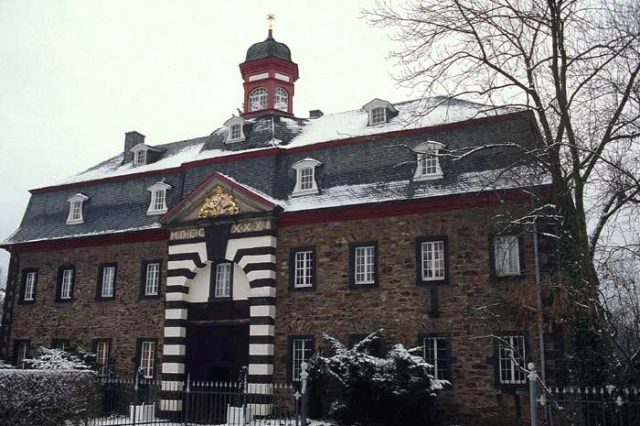
CastleBurgbrohl

Burgbrohl Castle

Burgbrohl Castle

Hotel

Burgbrohl Castle is located above the municipality of Burgbrohl in the Ahrweiler district in Rhineland-Palatinate.

Burgbrohl first appears in documents in the Middle Ages, when Volcoldus von Brule was mentioned in 1093 and 1112 as a witness in the founding charter of Laach Abbey by Count Palatine Heinrich II. It is possible that the Lords of Brule, as officials of the imperial count, had a fortified court on the castle hill and monitored the strategic point where the paths in the valley crossed.

Its importance must have increased, as a document from 1289 already speaks of a castle. In 1338, "the Lords of Brohl, with tower, gate, outer bailey with the court in the valley and around the castle, pledged it as a fief to Margrave Wilhelm of Jülich." The feudal activity lasted until the complete reorganization by the French in 1794. In 1471, Elsa von Brohl granted the Elector of Trier, Johann II, a right of access to Brohl Castle for his lifetime. Since Elsa von Brohl was the last of her lineage, the inheritance was divided among the families Winneburg, Eltz, and Braunsberg according to her will. The resulting disputes dragged on for almost 100 years until, around 1560, the Braunsberg family took possession of the castle, and on March 3, 1563, Wilhelm von Braunsberg was again enfeoffed with the lordship by Duke Wilhelm of Jülich.

When French troops temporarily occupied Western Germany at the end of the 17th century, Burgbrohl Castle was destroyed by fire during their retreat, along with the castles of Olbrück, Rheineck, and Sinzig, on the night of May 1, 1689. The reconstruction of the castle and the marriage of Kasper Franz von Bourscheidt to Isabella Countess von Schaesberg at the beginning of the 18th century led to a flourishing period for the lordship. The castle was rebuilt relatively quickly in 1709/10, and in 1731, a new steward's office was built.

At the beginning of the 19th century, Ferdinand von Bourscheid had the rocky hill enclosed by retaining walls. Parklands and gardens were laid out on the now flat area. On March 6, 1836, Johann Ludwig von Bourscheid died, and with him, the lineage became extinct. The lordship was sold to Fr. G. Weckbecker from Münstermaifeld for the sum of 150,000 Reichstalers. In the same year, P. Menn from Koblenz acquired the estate, which he sold in 1838 to a Major Decker. The latter, in turn, handed it over in 1845 to Rector a. D. Johann Jakob Ewich, whose son Dr. Karl Otto Jakob Ewich – a doctor, surgeon, and obstetrician, as he introduces himself in his 1852 publication "Der Führer am Laacher See und durch das Brohltal" – "felt prompted to establish a spa house (Burgbrohl Castle) after good experiences with the healing effects of 'Heilbronn' and also the castle spring" (see also: Efforts for a Heilbronn spa near Brohl).

A lithograph by H. v. Dirks, Saarlouis 1852, "Schloß und Dorf Burgbrohl" shows the inscription "Curhaus" on the side of the western wing facing the village. The pensioner Bernhard Grünwald acquired the castle from the Ewich heirs. Presumably in 1889, the architect Joseph Steinbach wrote in the second edition of his guide to Laacher See: it was probably high time, after all the vicissitudes, that the beautiful property came back into proven, provident hands. After taking possession, the new buyer immediately set about bringing the beautiful castle building, which had been designed according to a magnificent plan but was not completed, to a worthy conclusion, which he seems to have succeeded in with the assistance of the editor of our guide as the supervising architect. The eastern wing received an extension on the south side in 1879 with a magnificent portal, with an entrance hall, veranda, and a large grand staircase. Further building plans were not realized.

Subsequently, the property changed hands several times and served, among other things, as a monastery for a men's order for a time until the 1960s.

In 1985, the Austrian artist Gottfried Helnwein acquired the castle and began restoring the dilapidated buildings and park. He lived and worked here with his family until 1997, when he left Germany and moved to Ireland. During this period, he restored and reconstructed the castle and the garden according to old plans. In 2006, he sold Burgbrohl Castle for 3.9 million Euros to a Viennese businessman and art collector, Alexander Schütz. In 2009, the castle was bought by the entrepreneurial couple Weber for 5 million Euros and converted into a castle hotel.

Take Mobile History with you

You are reading this text for free. Premium adds what matters on the road: descriptions read aloud, sites found through your camera, whole regions taken offline.

  • Every description, including the ~17,700 Premium sites
  • Audio guide: have descriptions read to you on location
  • AR finder: see sites through your camera, with distance and bearing
  • Unlimited saved sites

14 days free, then from €2.99 a month. Cancel anytime.

Source: Wikipedia · Licence: CC BY-SA 4.0 · Image: http://de.wikipedia.org/wiki/Datei:Burgbrohl.jpg

This description draws on the facts documented in the linked Wikipedia article; Wikipedia content is licensed under CC BY-SA 4.0. Wording and editing: Mobile History.

Location: 50.4559, 7.2737