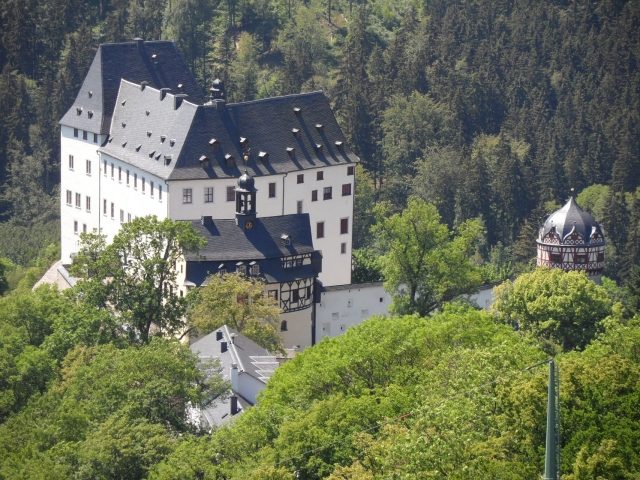
CastleBurgk

Burgk Castle

Burgk Castle

Museum

Burgk Castle is a former castle of the Princes Reuss. It is located on a rock plateau above the Burgkhammer dam.

Already in the Middle Ages, a castle was built by the Vögte of Gera (ancestors of the Reuss family) at this strategically favorable location. After a temporary sale to the Teutonic Knights, it returned to the Geraer Vögte (later Lords), and after their extinction, it fell to the Greiz Reuss family. Within this older line of the House of Reuss, Burgk was temporarily a separate dominion, though it only included a few villages. Noteworthy is the letter of protection issued to the dominion by Wallenstein in 1632, which was acquired for a considerable sum of money. In the 17th and 18th centuries, the complex was significantly rebuilt, in particular, a park was created, which definitively transformed the character of the building into a pleasure palace. From 1768, it served as a residence for the princely house of Reuss older line (Greiz). Only after the Second World War, through expropriation, did it come into state ownership and was made accessible to the public in the early 1950s.

Complex+

The very well-preserved castle still has the character of a fortress with many medieval details. The original palas is completely preserved, as are the keep and both stone bridges leading to the inner ring and the palas, respectively. Both bridges were formerly drawbridges. A customs tariff board is displayed under the Amtshaus at the outer bridge.

When the second gatehouse was demolished in 1739, a chamber with a dog was found. Presumably, this dog was walled in alive there as a building sacrifice (offering) about 400 years earlier. Today, this mummified dog can be seen behind a glass pane in the entrance area. The castle chapel and the kitchen are in very good condition. Particularly noteworthy is the very well-preserved kitchen chimney. At the western end of the complex stands the Red Tower with a half-timbered cap in the late Renaissance style. Also worth special mention is the access to the Red Tower, which leads over a walkable and covered battlement, from which three further, partly superimposed battlements branch off, located within the wall. In the center of the park, laid out in the French style in the mid-18th century south of the castle, is the late Baroque/Classical pavilion known as Sophienlust.

Rooms+

Concerts are regularly held in the Knights' Hall of the castle. In addition, the baroque state room with a bed alcove and the living rooms in Rococo style, partly influenced by 18th-century Chinoiserie, offer a good insight into the life of German princes. An extensive collection of weapons and trophies in the hunting room indicates the use of the complex as a hunting lodge. A special feature of the castle chapel is the organ by Gottfried Silbermann, consecrated in 1743.

Take Mobile History with you

You are reading this text for free. Premium adds what matters on the road: descriptions read aloud, sites found through your camera, whole regions taken offline.

  • Every description, including the ~17,700 Premium sites
  • Audio guide: have descriptions read to you on location
  • AR finder: see sites through your camera, with distance and bearing
  • Unlimited saved sites

14 days free, then from €2.99 a month. Cancel anytime.

Source: Wikipedia · Licence: CC BY-SA 4.0 · Image: Uwe Klimpke

This description draws on the facts documented in the linked Wikipedia article; Wikipedia content is licensed under CC BY-SA 4.0. Wording and editing: Mobile History.

Location: 50.5535, 11.7157