CastleHiddenhausen

Castle Bustedt (Hiddenhausen)

Castle Bustedt (Hiddenhausen)

Register office

Biological center
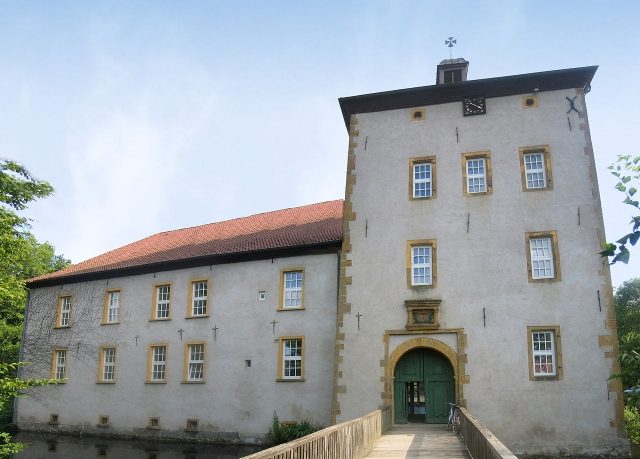
Gut Bustedt is a knight's estate in the northwest of Hiddenhausen, Herford district. Gut Bustedt is home to the Biology Centre Gut Bustedt.

The estate was built in 1415 by Knight Heinrich Ledebur as a moated castle on the property of the Herford convent. Since the lands belonged to the convent, this led to a feud between Ledebur and the Herford abbess. After losing the feud, Ledebur was forced to leave the estate in 1419 at the instigation of the Herford abbess. The original castle was demolished by the abbess and rebuilt, became a pawn object and was then long associated with the Drosten of the County of Ravensberg, above all the Nagel family, who held Bustedt as a fief for over 100 years. The castle was then also for a long time the seat of the Enger office. The castle thus de facto fell to the Counts of Ravensberg. From 1649, the castle was converted into a moated castle by Rittmeister Wolf-Ernst Eller, confidant of the Great Elector of Brandenburg and commander of the Sparrenburg. The County of Ravensberg had meanwhile fallen to Brandenburg-Prussia and Eller received the castle from the Prussians as a reward for his betrayal of the city of Herford to the Swedes in the Thirty Years' War. In 1964, Gut Bustedt, which until then had been owned by the Eller family, later Eller-Eberstein, came into the possession of the Hiddenhausen office.

Buildings+

The estate is laid out on two islands, defining the outer and main bailey. On the main bailey stands the manor house with a residential tower, which was built between 1649 and 1662. On the outer bailey, which can be reached via a baroque bridge, there were a cow shed and a farm building until the 19th century. The moats of the estate are fed by the Brandbach stream. When the Hiddenhausen office bought the estate, the agricultural areas of the estate were sold and in 1982 a biology centre finally moved into the estate. In a training centre, school classes can "immerse themselves in the world of biology" here. In addition, couples can get married at the estate.

Park+

In the second half of the 18th century, the house moat was partially filled in and initially utility gardens were laid out on the enlarged island. Around 1820, ornamental garden elements were added to the garden. Since 1982, training gardens, including a farmhouse garden, have been created around the estate by the Biology Centre for biology lessons for students.

District Bustedt+

Bustedt is also the name of the Bünde district, but the estate is no longer located within its territory. However, Bustedt belonged to the Hiddenhausen office as an independent municipality until 1968. In the regional reform of 1969, the area of Gut Bustedt was separated from Bustedt and remained with the newly created municipality of Hiddenhausen.

Take Mobile History with you

You are reading this text for free. Premium adds what matters on the road: descriptions read aloud, sites found through your camera, whole regions taken offline.

  • Every description, including the ~17,700 Premium sites
  • Audio guide: have descriptions read to you on location
  • AR finder: see sites through your camera, with distance and bearing
  • Unlimited saved sites

14 days free, then from €2.99 a month. Cancel anytime.

Source: Wikipedia · Licence: CC BY-SA 4.0

This description draws on the facts documented in the linked Wikipedia article; Wikipedia content is licensed under CC BY-SA 4.0. Wording and editing: Mobile History.

Location: 52.1684, 8.6056