The Castle can be visited
Charlottenhof Castle

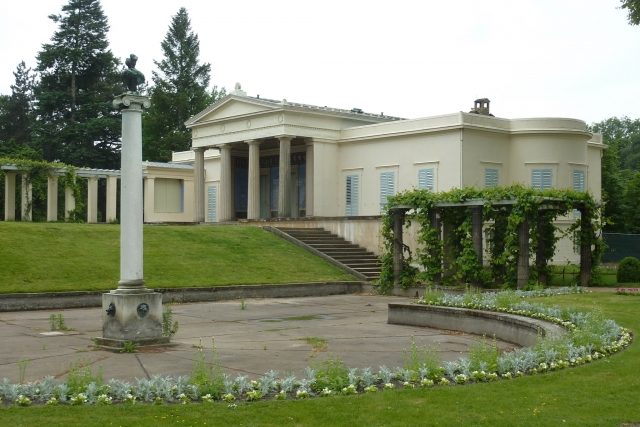
Charlottenhof Palace was the summer residence of Crown Prince Friedrich Wilhelm (1795-1861), from 1840 King Friedrich Wilhelm IV of Prussia. It is located southwest of Sanssouci Palace, Potsdam, and is managed by the Prussian Palaces and Gardens Foundation Berlin-Brandenburg.
The grounds of Charlottenhof Park, with changing buildings, date back to the 18th century. After several changes of ownership, Friedrich Wilhelm III (1770-1840) bought the area, which bordered Sanssouci Park to the south, and gave it to his son Crown Prince Friedrich Wilhelm and his wife Elisabeth Ludovika of Bavaria for Christmas 1825.
The Crown Prince commissioned the architect Karl Friedrich Schinkel to convert an existing manor house on these grounds. The conversion was carried out between 1826 and 1829 with modest means. Schinkel, supported by his pupil Ludwig Persius, built a small palace in the Neoclassical style, modeled after Roman villas, on the foundations of the old house.
The artistically gifted Crown Prince participated in the design of the palace and park with his own design drawings. He himself called his summer palace "Siam", understood at the time as "the land of the free", and jokingly referred to himself as "Siam-house-architect".
Officially, the palace and park were named Charlottenhof. The namesake was Maria Charlotte von Gentzkow, the wife of a chamberlain and owner of the estate from 1790 to 1794.
Architectural Interior Design+
Inside, the furnishings of the ten rooms are largely still original. The furniture was mostly designed by Schinkel himself and is characterized by simple, cultivated bourgeois elegance.
Remarkable is the different thematization of each room in terms of material and color, which goes so far that even the doors are treated quite differently on each side. The most original room in the palace is the Tent Room, designed in the style of Roman general's tents. The ceiling and walls are covered with blue and white striped paper wallpaper. The curtains and canopy-like drapes and the covers of the camp beds have the same pattern. The room served as a bedroom for ladies-in-waiting and guests.
Blue and white is also found on all the palace's window shutters and is an allusion to the Bavarian origin of Crown Princess Elisabeth.
Between 1835-40, the Tent Room housed the researcher and world traveler Alexander von Humboldt during the summer months, who was staying in Potsdam at the invitation of Crown Prince Friedrich Wilhelm.
Charlottenhof Park+
The garden architect Hermann Sello, with the collaboration of Peter Joseph Lenné, was commissioned with the design of Charlottenhof Park. The park is considered a milestone in garden history because it was the first to incorporate extensive geometric sections, then called "Italian", into the landscape framework. At least these sections go back to the personal designs of the Italy-enthusiastic Crown Prince.
The park was skillfully connected with the old Sanssouci Park from the time of Frederick the Great.
The originally flat and in places swampy terrain was transformed into an English landscape garden, whose main elements are trees, meadows, and water. Irrigation was carried out with water from the Havel, for which a water pipeline and a separate engine house were built. Erwin Albert Barth later captured the engine house, the pond system, and bridges in the park in drawings.
From 1836, the Hippodrome was built west of the palace building, surrounded by a small forest. In 1840, a pheasantry was laid out behind it according to plans by Friedrich Ludwig Persius. The area around the pheasantry was given a forest-like character by Lenné. The paths in this area are suitable for quiet and contemplative walks.
Between 1960 and 1980, the equestrian statue of Frederick the Great stood in the middle of the Hippodrome.
Take Mobile History with you
You are reading this text for free. Premium adds what matters on the road: descriptions read aloud, sites found through your camera, whole regions taken offline.
- Every description, including the ~17,700 Premium sites
- Audio guide: have descriptions read to you on location
- AR finder: see sites through your camera, with distance and bearing
- Unlimited saved sites
14 days free, then from €2.99 a month. Cancel anytime.
Source: Wikipedia · Licence: CC BY-SA 4.0 · Image: Joachim Schneeleopard
This description draws on the facts documented in the linked Wikipedia article; Wikipedia content is licensed under CC BY-SA 4.0. Wording and editing: Mobile History.
Location: 52.3956, 13.0256