To be privately owned
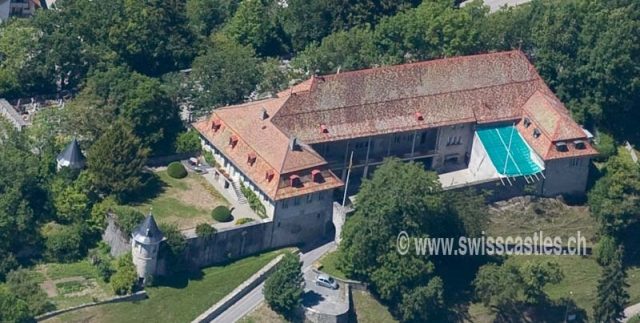
Châtel-Saint-Denis Castle

It is remarkable from a strategic point of view that the position of what became the Old Castle was hardly suitable for the movement that ensured the prosperity of the new city. Amédée V of Savoy chose a location that was open to access and transit roads. The acquisition of ownership was ratified on April 18, 1297. A castellan was chosen, and the construction of the castle began at the same time as that of the city. The accounts for the years 1297 and 1298 document expenses of one hundred Lausanne pounds transferred to masons for the watchtower. Other works were undertaken on site.
Old engravings show a majestic building, which notably includes the quadrangular watchtower in the northeast. On May 15, 1758, a rampant fire spread not far from the shingled roof of the tower. The timberwork fell into the halls of the lower floors, and despite the dedication of numerous volunteers, this architectural element was lost.
With a special status, the city had its own authorities. The Counts of Savoy delegated their directors – the castellan – who shared his jurisdiction with the municipal power.
The function of the castellan was neither hereditary nor permanent, which explains his long succession from 1297 to 1384, the year of the sale of the lordship. The list, reviewed by Canon Philipona, is impressive: Jean Luyset in 1297, Druet des Portes in 1298, Pierre des Portes in 1300, Rudolph von Bons in 1318, Wilhelm von Châtillon in 1330, Humbert de Chapelle in 1342, Pierre von Saillon in 1348, Mermet von Corbière in 1350, Thomasset Fabre in 1356, Nicolet von Lussinges in 1360, Jacquet de Châtel (from the Fruence family) in 1365, Thomas Bisy in 1378, and Pierre von Pont in 1382.
In 1384, Pierre von Cly of Challant, Lord of Aymonville in the Aosta Valley, acquired the lordship of the castle. Yblet von Challant succeeded him in 1385.
In 1393, Francois von Challant sold the lordship to a family member, Amédée von Challant, before marrying Margerite von Bossonnens, the widow of Francois de la Sarraz.
Amédée's heirs made bad deals and had to borrow in Fribourg. In 1444, they could only cede the lordship of the castle to a Savoyard knight, Francois Bonivard. It seems they could not repay their debt, because in 1461 the Fribourgers forcibly reclaimed the lordship of the castle. However, Bonivard, a subordinate holder, sued, and a judgment was rendered in his favor on April 5, 1462, and he became owner of his estate again.
In 1464, Bonivard sold the castle to Francois, a Count of Gruyères, who owned it for a few months before reselling it to Francois von Menthon, who was followed by Antoine in 1478, then Georges von Menthon in 1494. On April 15, 1508, there was a brief reappearance of a Gruyères, Jean, until June 26 of the same year, when Georges von Menthon again became the lord of the place.
Fribourg re-appropriated the castle in 1513, to hand it over to Savoy in 1518. The latter appointed a castellan, Bernardin Musy. Fribourg took possession again in 1536 during the conquest of its side of Vaud. Consequently, the castle became the seat of the bailiffs and later that of the prefects and various civil servants.
Take Mobile History with you
You are reading this text for free. Premium adds what matters on the road: descriptions read aloud, sites found through your camera, whole regions taken offline.
- Every description, including the ~17,700 Premium sites
- Audio guide: have descriptions read to you on location
- AR finder: see sites through your camera, with distance and bearing
- Unlimited saved sites
14 days free, then from €2.99 a month. Cancel anytime.
Source: Wikipedia · Licence: CC BY-SA 4.0
This description draws on the facts documented in the linked Wikipedia article; Wikipedia content is licensed under CC BY-SA 4.0. Wording and editing: Mobile History.
Location: 46.5295, 6.9017