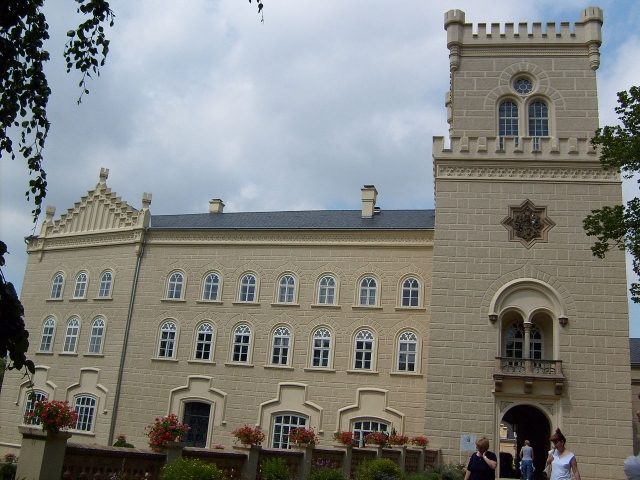
CastleChyše

Chyše Castle

Chyše Castle

To be privately owned

Chyše Castle is an ancient place, the history of which begins in the 12th century. The original stronghold was first mentioned in 1169, nonetheless, it had to be built much earlier because it is denoted as the home of Odolen, the son of Střez, who accompanied King Vladislav II (also denoted as Vladislaus II of Bohemia) on his expedition to Milan in 1158. Odolen is considered as the forefather of the influential family of Pětipeský of Chyše.

The stronghold was later rebuilt into a castle, but you will not find it there. Instead, you will find the present-day Castle, which is the result of the reconstruction of a Renaissance castle in Gothic Revival style. The author of this last reconstruction is Ignác Ullmann who worked for the contemporary owners of the chateau, the family of Lažanský of Buková, from the 1850s.

The famous Czech writer, Karel Čapek, was temporarily hired by the family as a private tutor and he stayed at the Castle in 1917. After the war ended in 1945, the German owners were expropriated and distributed (or murdered) by the Czechs. These crimes were legalized by the Beneš decrees. The description of the Castle later appeared in one of Čapek's works – in his novel Krakatit.

The Castle was ultimately returned to its pre-war owners who have almost completed all renovation work and opened the stylish Castle interiors, Castle cellars, a medieval bastion, a Baroque well, as well as an exhibition dedicated to Karel Čapek to the public.

A Castle brewery is a part of the Castle complex, built between 1839 and 1841. Brewing in Chyše has a long tradition dating as far back as the 1580’s. In 2007, production of high-quality Castle beer was renewed after 74 years. A stylish restaurant and a traditional alehouse are open to visitors in the historical interiors of the Castle brewery.

Chateau Park

The extensive reconstruction and renovation of the Castle also embraced the careful revitalization of the adjoining unique Castle park covering an area of 9 hectares, as well as the rehabilitation of its water management.

From an artistic and historical point of view, the Castle park may be considered as a good example of landscape architecture of the mid 19th century, which ingeniously utilised the articulated terrain to deploy almost all forms of contemporary garden architecture, combining them in perfect harmony.

Taking advantage of the broken terrain, the Castle park is divided into two parts with a distinctly different architectonic layout and greenery. The first part, dominated by the Castle, winds and spreads along a brook, which forms a shallow valley. Below the Castle, the brook winds along a small hill, on which the castle had once stood, and it flows into a small pond that creates a mirror reflection of the Castle.

Take Mobile History with you

You are reading this text for free. Premium adds what matters on the road: descriptions read aloud, sites found through your camera, whole regions taken offline.

  • Every description, including the ~17,700 Premium sites
  • Audio guide: have descriptions read to you on location
  • AR finder: see sites through your camera, with distance and bearing
  • Unlimited saved sites

14 days free, then from €2.99 a month. Cancel anytime.

Source: Wikipedia · Licence: CC BY-SA 4.0 · Image: http://commons.wikimedia.org/wiki/File:Chy%C5%A1e-Castle2.jpg

This description draws on the facts documented in the linked Wikipedia article; Wikipedia content is licensed under CC BY-SA 4.0. Wording and editing: Mobile History.

Location: 50.1056, 13.2465