Uninhabited
Crossen Castle

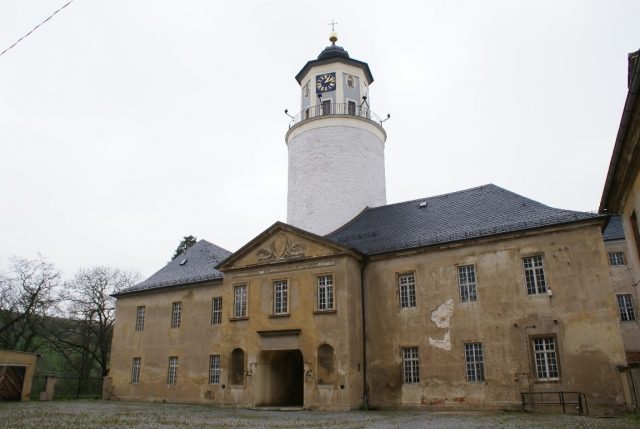
Crossen Castle is a Baroque castle complex in Crossen an der Elster in eastern Thuringia. It is located on a mountain spur above the valley of the White Elster. Crossen Castle is known for its magnificent Baroque hall, decorated with Italian illusionistic paintings. Currently (as of March 2008), the castle is empty and not accessible to the public. The owners are two Irish investors.
Complex+
The castle is located northwest of Crossen's village center on a hill. It comprises the four-winged main building in the east, which integrates the keep and encloses the inner castle courtyard. In the south wing of the main building is the Baroque ballroom, which extends over two floors. West of this complex is the outer castle courtyard, which is flanked in the east by the main building, in the west by the former farm building, and in the north and south by two symmetrical cavalier houses. Between the southern cavalier house and the farm building is the entrance to the castle complex. In the 1960s, a boarding school building was erected behind the farm building, which is now also part of the complex. The castle is surrounded by the largely preserved castle wall. Between it and the main house lies the overgrown castle garden. South of the castle hill is the former castle park with another outbuilding. Part of the lower castle garden was converted into Crossen's sports field in 1949.
Predecessor Castle
A first castle in Crossen was built as early as the 10th century to protect the trade routes between Gera and Zeitz and between Bad Sulza/Camburg and Gera (wine and salt road). It was first mentioned in a document in 995 when Emperor Otto III transferred it to the Diocese of Zeitz. This first castle complex was abandoned around 1150. Whether it stood in the same place as the current castle cannot be proven.
The second castle complex on the hill was first mentioned in a document on January 27, 1272. It served as the administrative seat of the castellan for the surrounding villages and was also a court. Little is known about the castle today, except that it was damaged in the Hussite Wars in 1452. A local chronicle of Crossen describes it as a narrow castle surrounded by high walls. Two other towers and a castle chapel also belonged to this complex. Today, only the keep and parts of the ring wall remain of this predecessor building.
Conversion to a Renaissance Castle
After the Reformation, the complex passed from the Diocese of Naumburg-Zeitz into the possession of the Wettins. The Saxon Elector August commissioned Wolf Ernst von Wolframsdorf in 1585 with the administration of the Crossen office, who then had the castle converted into a Renaissance-style castle. This castle existed for only a good 100 years, which is why even less is known about it today than about the previous castle.
The Baroque Castle
The Leipzig merchant and commercial councilor David Fleischer, originally from the Ore Mountains, acquired the ensemble in 1700. From then on, he called himself David von Fletscher and had the old castle demolished and the current complex built in the Baroque style between 1701 and 1712. Only the keep remained. In 1712, von Fletscher had the two-story Baroque ballroom installed in a mezzanine in the south wing. For this, he brought the Italian master Giovanni Francesco Marchini from Como to Crossen. Previously, he had also worked on buildings such as Bruchsal Castle in Baden and St. Martin's Church in Bamberg. Marchini decorated the hall with opulent illusionistic paintings that feigned a rich architectural articulation of the hall. The ballroom is considered a masterpiece of the Baroque in Thuringia; it is also the only preserved illusionistic total work of art in the state. The motifs primarily include scenes from ancient mythology and images of gods.
Crossen Castle in the Possession of the von Flemming Family
In 1724, Field Marshal Jacob Heinrich von Flemming, from the Pomeranian noble family von Flemming, acquired the castle from the bankruptcy estate of the highly indebted court and justice councilor Thomas August von Fletscher. The family owned it for the next 200 years and carried out no major alterations, so that the castle was still purely Baroque in 1925. Until 1777, the von Flemming family did not often inhabit the castle, but it was subsequently renovated and the coat of arms decorations that exist today were applied to the facades. Now, family members such as Johann Heinrich Joseph Georg von Flemming or Karl von Flemming lived permanently in the Baroque complex. The former had the castle furnished with valuable stucco ceilings and wallpapers, as well as magnificent inventory. The music room, the new farm building, and the two cavalier houses around the outer castle courtyard were also built under his commission. This was followed in the 1780s by the redesign of the outdoor area. A vineyard was laid out there. In addition, hops and noble fruit trees were cultivated in the castle garden.
Count Edmund von Flemming further embellished the castle. He acquired two tower clocks and donated a new organ for the castle church, which he had built by an organ builder in Frankfurt/Oder. In 1892, he had a new iron water pipe laid and a well built for the upper mountain residents. The writer Elisabeth von Heyking was the last of the von Flemming family to inhabit the castle until her death in 1925. Her husband Edmund was an envoy of the German Reich in China and installed Chinese fabric wallpapers brought from there in the castle.
History between 1925 and 1990
The heir to the castle was Edmund von Bockum-Dolffs, who sold all the furniture, stoves, and wallpapers of the castle and left the complex to decay. The roof of the castle church began to deteriorate from 1930, leading to the loss of Marchini's ceiling paintings there. In 1938, the castle church finally collapsed.
On May 13, 1937, Rudolf Zersch, the owner of the Köstritzer Schwarzbierbrauerei, bought the castle at a forced auction for 30,000 Reichsmark and had it restored. During World War II, Wehrmacht soldiers were quartered in the castle. Afterwards, it initially served as a refugee camp. Apartments for displaced persons were also set up in the outbuildings. Later, there were plans to demolish the castle, but this was prevented by Professor Jefimow from Zeitz. He ensured that a school was housed in the castle in 1953, which existed until 1991 and trained about 330 teachers annually. In the 1960s, the dilapidated stables were demolished and replaced by a boarding school dormitory.
The Castle after Reunification
In 1992, the building passed into the possession of the Landesentwicklungsgesellschaft Thüringen (Thuringian State Development Company), which had various repair works carried out. Among other things, the keep, the roof, and the heating system were renewed. In the 1990s, castle festivals of the Heinrich-Schütz-Akademie Bad Köstritz were repeatedly held at Crossen Castle.
On November 24, 2006, the company intended to sell the property at an auction in Erfurt. The minimum bid was 850,000 Euros, although the market value of the castle was estimated at almost 2.5 million Euros. Nevertheless, no buyer was found. The municipalities, the community of Crossen and the administrative community Heideland-Elstertal, also did not want to buy the complex, which is why it remained in the possession of the Landesentwicklungsgesellschaft. The architectural firm Siebert prepared an expert opinion at that time, according to which about five million Euros would have to be invested for a repair of the castle and up to ten million Euros for a comprehensive renovation. In June 2007, the castle was again offered for auction at an auction in Berlin. It was then purchased by the specially founded company Hurlson GmbH for the unsatisfactory price of only 205,000 Euros for the LEG (the LEG had previously invested state funds amounting to 2.5 million Euros in the castle). Hurlson GmbH was founded by the two investors John Robinson and Eftim Hurly from Ireland. The municipalities (the community of Crossen, the VG Heideland-Elstertal, the Saale-Holzland district, and the state of Thuringia) would have had a right of first refusal, which they did not exercise, making the auction to Hurlson GmbH legally binding. They cited lack of funds as the reason. In September 2007, the keys were handed over to the new owners, who have not yet presented a usage concept for the castle. The castle grounds are no longer accessible to the public; the buildings themselves are in a steadily deteriorating condition.
In spring 2012, Dr. Wolfgang Maruschky from Crossen took the initiative to found an association of friends and patrons of Crossen Castle, which was to acquire, renovate, and transform the castle into an educational institution.
Take Mobile History with you
You are reading this text for free. Premium adds what matters on the road: descriptions read aloud, sites found through your camera, whole regions taken offline.
- Every description, including the ~17,700 Premium sites
- Audio guide: have descriptions read to you on location
- AR finder: see sites through your camera, with distance and bearing
- Unlimited saved sites
14 days free, then from €2.99 a month. Cancel anytime.
Source: Wikipedia · Licence: CC BY-SA 4.0 · Image: Roland Neubert, Halle (Saale)
This description draws on the facts documented in the linked Wikipedia article; Wikipedia content is licensed under CC BY-SA 4.0. Wording and editing: Mobile History.
Location: 50.9782, 11.9756