Uninhabited
Dammsmühle Castle

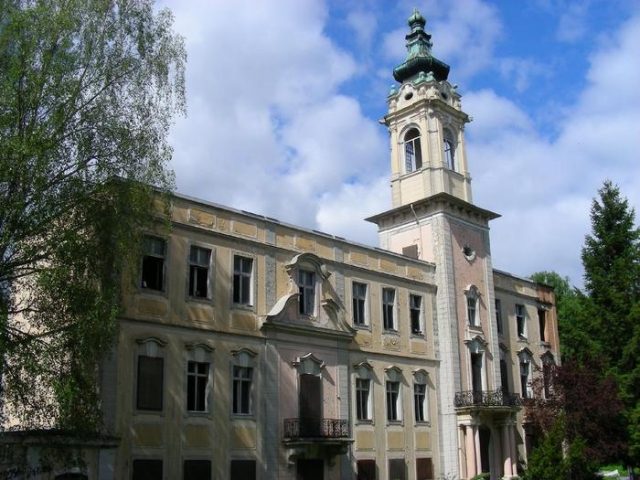
Dammsmühle Castle is a Neo-Baroque manor house with 28 hectares of surrounding land in the Barnim district of Brandenburg. It is located in the area of the village of Schönwalde in the municipality of Wandlitz.
At the site of today's Dammsmühle Castle, there was already a mill in the 16th century, which probably belonged to the Cistercian monastery of Lehnin, which had owned the lands of this area since the 14th/15th century. When a new mill was built in the mid-18th century, the builders came across millstones from that period, which bore traces of a fire. Around 1650, in place of the Cistercian mill, there was a hunting lodge built on behalf of the Great Elector Frederick William of Brandenburg.
The grounds of the former mill were acquired in 1755 by the Berlin leather manufacturer Peter Friedrich Damm, who had the sole right to supply the royal Prussian army with uniform parts made of chamois leather. He built the building of Dammsmühle Castle in 1768 as a two-story palace in a wooded area of Barnim, west of the village of Schönwalde near Lake Mühlenbeck. Queen Elisabeth Christine, the wife of Frederick the Great, is said to have stayed there several times. In keeping with the Rococo fashion, the castle had a theater hall on the upper floor. After Damm's death, the building fell into disrepair because there was no heir. At a forced auction in 1894, Lieutenant Adolf Wollank, son of the Berlin lawyer, landowner, and Pankow district administrator Adolf Friedrich Wollank, acquired the property and converted it into a manor. He had the building rebuilt in Neo-Baroque style by the architectural firm Erdmann & Spindler from Berlin, adding an extra floor, an extension, and a tower with an onion dome. On an artificial island in the mill pond, he had a building erected in the shape of a mosque, inside which was a large ballroom.
After Adolf Wollank's death on April 27, 1915, his brother Otto managed the castle, which was now named Dammsmühle after its builder. Adolf Wollank was buried on the castle grounds in the Hubertus Pavilion, which he commissioned, opposite the castle building. The pavilion no longer exists today. Wollankstraße in the Berlin district of Pankow is named after the Wollank family. The castle was sold in 1919 to the merchant Hermann Zirkel from Zehlendorf.
Ten years later, in 1929, the Briton Harry Goodwin Hart, then director of Unilever, acquired the property. After Hart and his Jewish wife had to leave Germany in 1938, he was dispossessed in 1940. The castle then came into the possession of Heinrich Himmler. During this time, prisoners from Sachsenhausen concentration camp were used for construction and maintenance work. Shortly before the end of the war, the commander of the Wehrmacht Army Group Vistula defending Berlin, Colonel General Gotthard Heinrici, set up his headquarters here.
After the end of the war in 1945, it was occupied by the Red Army. In 1959, the Ministry for State Security of the GDR took over the house and used it as a hunting lodge until 1989. After German reunification, the castle briefly served as a hotel.
In 1997, the heirs of Harry Goodwin Hart had the property returned to them, and they resold the estate. The castle building fell into disrepair due to years of vacancy.
In 2000, the area was used by a Berlin concert promoter until October 2003 for open-air concerts of various genres, which annually attracted approximately 30,000 concert-goers from across Germany, thereby increasing the area's recognition. The reason for the failure to implement a planned concept to develop Dammsmühle Castle into an established event and recreation venue was the inglorious circumstance that individual organs of the then municipality used this area for political re-election. The court proceedings initiated by the municipality in the fourth quarter of 2004 were dismissed in favor of the operator with clear submissions from the involved law firms due to "StGB" (German Criminal Code). However, the then operating company from 2000-2003 waived a renewed legal dispute under the StGB for reasons of expediency and withdrew from the Dammsmühle Castle area. The site was thus exposed to further decay, vandalism, and illegal waste dumping by residents from the surrounding area.
In 2008, the property went to Schlossgut Dammsmühle Management GmbH, which intended to develop the site into a cultural experience world with free public access. This company already concluded a long-term lease agreement with the private individual Gerd Matern in the following year. Matern then actually began a gradual redesign of the castle and the park. Since early summer 2009, numerous events have been organized on site, such as a castle beer garden brunch, a 3-lake run for everyone around the mill pond, a vintage car show with a rock concert, a ghost festival, etc. Furthermore, the revival of the bathing tradition, also in the castle rooms, the establishment of a gourmet restaurant, a nightclub, and a café in the former bowling alley were planned. However, the operating company has since ceased its activities.
Chronicle
Chronological sequence of the castle's history:
- 1650 Hunting lodge of the Great Elector at the site of today's castle
- 1746 Soldier Knape applies for the construction of a mill
- 1747 Miller Grüwel (Mönchmühle) receives permission to build instead of Knape
- 1753 Schönwalde is founded
- 1755 Manufacturer Damm acquires the "New Mill", built a few years earlier, from the indebted Grüwel
- 1776 After Damm's death, his widow remains the owner until 1802
- 1805 Dammsmühle falls victim to a fire
- 1812 Napoleon stays at Dammsmühle during the inspection of a new regiment at the Mühlenbeck manor
- 1824 Sale to the London merchant Heese
- 1832 New owner J.J.TH. Schaeffer
- 1840 Frederick William IV rejects an offer to buy; Dammsmühle falls into disrepair around 1890 Dammsmühle becomes an entertainment venue
- 1894 After purchase by Lieutenant Adolf Wollank, the manor receives its current basic form through the construction of a second house and the connection in the form of a tower; construction of a floating pavilion in oriental style
- 1910 Meeting of Wilhelm II with Tsar Nicholas II in Dammsmühle
- 1915 After Wollank's death, his brother Otto von Wollank manages Dammsmühle Castle
- 1919 Merchant Herrmann Zirkel acquires the property
- 1929 Dammsmühle becomes a film location: Ariel-Film GmbH shoots "Sein bester Freund" with lead actor Harry Piel
- 1929 The director of the British soap company Unilever, Harry Goodwin Hart, acquires the property
- 1938 Hart and his wife must leave Germany
- 1940 After the confiscation of the grounds as "enemy property" by the Nazi regime, it officially falls under the control of the Reichsführer SS, Heinrich Himmler. Whether he was ever on site is not known.
- 1943 Labor deployment of a total of 25 male prisoners between January 2 and July 3 in "Object 1091", which at that time was an external camp of Sachsenhausen concentration camp. According to reports from those affected, the external commando was considered a comparatively minor evil
- 1945 The Red Army occupies Dammsmühle; initially used as a hospital, the building later becomes a recreation home and casino for Soviet officers
- 1951 After handover to the German authorities, the property serves as an educational institution, recreation home, and pioneer camp
- 1958 Administrative authority of the Schönwalde municipal council over Dammsmühle
- 1959 The Stasi takes possession of the castle; it serves, among other things, as a guesthouse
- 1968 Major renovations to the castle until 1978: full floor with roof garden instead of the mansard roof; construction of underground bunkers on the grounds
- 1989 The Wende (fall of the Berlin Wall) ends the Stasi's presence at Dammsmühle
- 1991 Set for the WDR multi-part series "Haus am See" with Hildegard Knef, Anita Kupsch, Ursela Monn, among others
- 2008 After various interim uses and subsequent decay, Dammsmühle Castle is designed as a place for leisure activities. The operating company Dammsmühle Management GmbH later has to file for insolvency.
Take Mobile History with you
You are reading this text for free. Premium adds what matters on the road: descriptions read aloud, sites found through your camera, whole regions taken offline.
- Every description, including the ~17,700 Premium sites
- Audio guide: have descriptions read to you on location
- AR finder: see sites through your camera, with distance and bearing
- Unlimited saved sites
14 days free, then from €2.99 a month. Cancel anytime.
Source: Wikipedia · Licence: CC BY-SA 4.0 · Image: http://www.wehrbauten.de/thread.php?threadid=892
This description draws on the facts documented in the linked Wikipedia article; Wikipedia content is licensed under CC BY-SA 4.0. Wording and editing: Mobile History.
Location: 52.6938, 13.4075