The Castle can be visited
To be privately owned
CastleHaren - Dankern
Dankern Castle
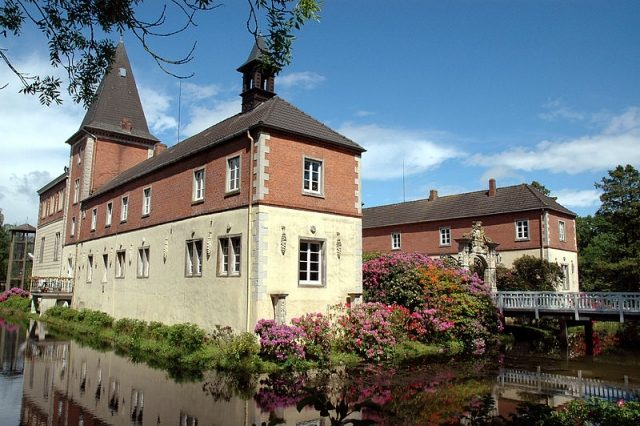
Dankern Castle is a Baroque moated castle in Haren, Emsland district, Lower Saxony.
Although details are largely unknown, it is certain that Dankern looks back on a history of more than 500 years. Not far from the present castle, on an area now forested, there are signs that an early medieval circular castle once stood here. Even today, this place is called 'de Borg' ("the castle"). When and by whom this complex was built is unknown.
The oldest, known by name, owners were the Lords of Beesten. In 1509, this family was listed as Lords of Dankern in the Münster Landtag matriculation. In the following years, Dankern passed as an inheritance into the hands of various families.
For centuries, the Emsland belonged to the Prince-Bishopric of Münster. As early as 1252, the then Prince-Bishop of Münster, Otto II, bought the counties in the Emsland from the last owner Jutta von Ravensberg, married to von Monjoie. Until 1803, after the Prince-Bishopric of Münster was secularized by the main resolution of the extraordinary Imperial Deputation, the sovereign was the respective Prince-Bishop of Münster.
The permanent representative of the sovereigns was the Droste, who carried out government affairs on behalf of the Prince-Bishop. The Droste's seat was initially the Paulsburg in Meppen, then Haus Nienhues, and finally Haus Altenkamp near Aschendorf.
Johann Heinrich Martels, Rentmeister from 1654 to 1696 and thus the second highest official after the Droste in the so-called Niederstift Münster, bought the Dankern estate in 1667 from its last owner Heinrich von Mandelsloh.
Castle Lords+
Martels Family
Johann Heinrich Martels, as Münster's chief war commissioner and diplomat in the service of Prince-Bishop Christoph Bernhard von Galen, had acquired considerable wealth. After taking office as Rentmeister, he acquired the Wesuwe estate in 1667 and the Lehrte estate a few years later. At the same time, Martels was able to lend 7000 Thalers for a tax debt of the Meppen office against interest and security from the regional estates.
Who designed the plans for the new manor house remains unclear to this day. The oral tradition that it is the work of the Münster master builder Gottfried Laurenz Pictorius is hardly tenable, especially since his first independent works were only created between 1686 and 1688. According to Dehio, an attribution to Ambrosius von Oelde is also questionable. The new Haus Dankern consists of the core castle, surrounded by a moat and standing on wooden piles in the water, and an outer bailey with farm buildings. Construction of the originally single-story, three-winged brick structure with sandstone elements began in 1680. The fourth side was closed in 1689 by a richly ornamented triumphal arch portal. The contemporary grille resembles chapel grilles in Paderborn Cathedral from 1687. The entire complex is characterized by Flemish High Baroque and is unusually richly equipped with figural and ornamental sandstone work for the region.
The Lords Martels worked in an exemplary manner by cultivating large areas of moor and heathland, as the foothills of the Bourtanger Moor reached the farmstead of the estate, and 40 new settlers were settled.
The grandson of the builder of Dankern, Johann Heinrich Martels, Rentmeister from 1729 to 1770, was ennobled for his services. Under his son, Johann Franz von Martels, Rentmeister from 1770 to 1800, there was a strong decline in the family's financial situation. He was married to Theodora von Dwingelo zu Lotten. She was considered extravagant and domineering and was so unpopular that the population refused her a burial place in Wesuwe. Her funeral procession had to turn back on the day of the burial, and her body was interred in the castle chapel at Dankern. According to legend, her soul haunted the castle at night and only found peace after her grave was relocated during later renovations.
The son and successor Georg Ludwig von Martels, married to Maria Ludwica von Voorst, complained in 1800 that "our family has been ruined and fallen into disrepair by years of discord and perpetual disunity. Inherited estates, indeed most of the entailed estate, have been fragmented or sold, and the entire Dankern estate faces ruin."
In 1827, the family won the lawsuit concerning the tax debt of 1666. The so-called Martelsche Schuld was last heard before the Imperial Chamber Court in Wetzlar. It was decided that the Martels family should be paid the sum of 30,146 Thalers by the Meppen office. However, the arbitration award reached the family at a time when even such a sum could no longer change their precarious financial situation. On May 22, 1832, Franz Ludwig von Martels sold the Dankern estate and the castle for 72,000 Thalers to Imperial Baron Johann Ignatz von Landsberg-Velen. The mediator of the sale was the Lathen notary Clemens August Behnes. As a result of this sale, most of the original furniture and almost all records of Dankern's history, including the building plans, were lost.
Families of the Barons von Landsberg and von Velen
The Westphalian families of the Barons von Landsberg zu Erwitte and the Barons von Velen had been closely connected with the Emsland for more than 200 years. As early as 1556, the era of the von Velen family as Droste of the Emsland began with Hermann von Velen. One of the most significant Droste, Dietrich von Velen (1611–1657), bought the very devastated Papenburg Castle with its lands in 1631. With great energy and the use of considerable financial resources, he built a canal to the Ems to transport the inexhaustible supply of peat abroad: "The swamps were drained, so that houses could be built and plots of land could be designated as green and arable land." This laid the foundation for the present city of Papenburg.
For over six generations, the von Velen family served the respective Prince-Bishops. With Hermann Anton, the last Droste of the family from 1725 to 1767, the family of the Barons von Velen died out. The heiress of the Velensche Fideikommiss and thus also of all Emsland possessions was his daughter Anna-Theresia. In 1756, she married Klemens-August Freiherr von Landsberg zu Erwitte.
In 1792, son Paul Joseph adopted the name Velen in addition to Landsberg and became the first Baron von Landsberg-Velen. Johann Ignaz Freiherr von Landsberg-Velen, married to Ludowica Gräfin von Westerholt und Gysenberg, bought the Dankern estate in 1832. He was elevated to the Prussian countship on October 15, 1840, which entitled the respective head of the family to bear this title.
In 1863, his son Friederich Ludolf took over the Dankern estate. Under him, significant extensions were made to the house from 1890 to 1894, which gave the castle its present appearance.
The building was raised by another floor, and towers were added at the two intersections of the wings with the main building. These additions were made in red brick, while the original brick building was plastered. These measures took away not a little of the complex's nobility and Baroque lightness; rather, the building now exuded a ponderous dignity corresponding to the taste of the time.
When Friederich Ludolf von Landsberg-Velen died in 1898, his property and count's title passed to his first son Maximilian according to the Landsberg Fideikommiss. His second son Friederich, married to Sophie Gräfin von Westerholt und Gysenberg, inherited Dankern Castle and continued the cultivation and reforestation there.
When Maximilian died in 1902 without a male heir, Friederich became lord of the Landsberg entailed estates in Westphalia. In 1920, he left Dankern to his second son Otto (1890–1974), married to Maria Gräfin Droste zu Vischering (1892–1984).
Large areas of heath were reclaimed and moors cultivated, most of which were reforested. Later, in 1972, Otto Freiherr von Landsberg-Velen had to witness how the entire forest, his life's work, was destroyed by a hurricane in one night.
Dankern was spared from the events of the Second World War. However, for almost three years, it became a second home for many citizens of Haren: Haren had been confiscated by the English military government for Polish repatriates, and thus all residents of Haren had to leave their homes within a few hours.
Current Use+
To secure the economic basis for the preservation of the castle, the Schloss Dankern holiday center was founded in the early 1970s by Otto's son Manfred Freiherr von Landsberg-Velen (1923–2010).
The idea was to enable families with children to have an affordable holiday. With the motto "Holidays with the child, by the child," the holiday center was successful from the start. A comprehensive holiday complex with now over 700 holiday homes and diverse play and sports facilities was created. Annually, over 125,000 guests spend their holidays here, with around 650,000 overnight stays. In addition, there are approximately 100,000 day guests.
The complex has been expanded several times and offers one of the largest playgrounds in Germany. Between giant swings and trampolines, there are two indoor play halls, giant slides, a water bob run, and a traditional pony riding facility for children up to 14. To comfortably use the area, there is a bicycle rental in an old pony stable and - especially for holiday guests - a supermarket.
At Dankernsee, outside the holiday park, there is a water ski facility, a surf school, and a diving school. On the back of the lake are several artificial sand beaches, including one for dogs, and an artificial sand dune. West of the lake there is a go-kart track and an airfield.
A regional excursion destination is also the Topas water park, which directly adjoins the holiday park. Likewise, former holiday homes in the park in direct proximity to the lake have now been released for sale.
Dankern Castle forms the spatially central point of the complex and has been fundamentally renovated in recent decades. For the funds spent on restoration, there were grants from the state of Lower Saxony, the Emsland district, and the city of Haren. Nevertheless, approximately 90 percent of the costs must be borne by the owner. The castle continues to be inhabited by the owner family and is only partially accessible to the public through guided tours (currently weekly on Tuesdays).
Take Mobile History with you
You are reading this text for free. Premium adds what matters on the road: descriptions read aloud, sites found through your camera, whole regions taken offline.
- Every description, including the ~17,700 Premium sites
- Audio guide: have descriptions read to you on location
- AR finder: see sites through your camera, with distance and bearing
- Unlimited saved sites
14 days free, then from €2.99 a month. Cancel anytime.
Location: 52.7952, 7.2005