Uninhabited
Dehrn Castle
Dehrn Castle is located near the village of Dehrn in the municipality of Runkel in the Limburg-Weilburg district in Hesse. Dehrn Castle is situated on a mountain spur above the Lahn river.
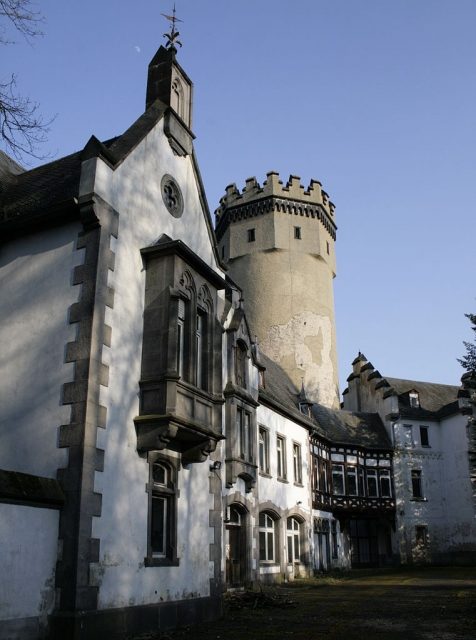
The most striking part of the castle is the round, 34 m high keep with an octagonal battlement storey. While the tower, with its walls up to three meters thick, probably dates from the 13th century, the octagonal battlement storey was added in the 19th century. The residential building, south of the keep, is still Gothic in its core (13th century). This part was rebuilt in the late Gothic style in the 16th century. East of the Gothic residential building is a residential building with a four-sided mansard roof. This was probably added in the early 19th century. The western parts of the building were erected in the Neo-Gothic style after 1845. The stepped gables are characteristic of these parts of the building.
South of the castle was an English landscape park with two bridges and a chapel. Only the foundations of the chapel remain.
Near the castle, two knight's residences have been preserved, which were essentially built in the late Gothic period.
In addition to its monument protection status, the castle has received protection status for wartime according to the Hague Convention.
In the 12th century, the castle was built by the Counts of Diez to secure the Lahn crossing and was garrisoned with knights. In 1197, a knight, Henricus Frio de Derne, appeared for the first time.
With the secession of the County of Weilnau from the County of Diez, the castle became common property of both lines. In 1317, the County of Weilnau pledged its share to Siegfried von Runkel, the provost of Gemünden Abbey. On July 31, 1367, a Friedrich Frei von Dehrn stabbed the son of Count Gerhard von Diez, the only male heir of the comital house, at Dehrn Castle; the house died out 20 years later with Gerhard's death. In 1485, the Frei von Dehrn had their freedom from taxes confirmed by the now ruling House of Nassau. This was enforced several times against the Counts of Runkel. In 1492, the Frei von Dehrn built an extension reaching to the tower for 300 guilders.
In the 16th century, castle-like alterations were made. With Franz Alexander Frei von Dehrn, the family of Frei von Dehrn died out in 1737. The castle fell to the Greiffenclau family and, after their extinction in 1814, to the related House of Sturmfeder von Oppenweiler. In 1818, the Limburg merchant Trombetta acquired the partly dilapidated castle and had it repaired, extended, and a park laid out. Through reconstruction and additions, the castle acquired its present appearance. In 1843/44, the castle came into the possession of the von Dungern family, who had further alterations made to the castle. Among other things, the access roads were renewed, the tower renovated and heightened. New farm buildings and a park enlarged the complex.
Shortly after the First World War, the von Dungern family lost their fortune, including Dehrn Castle. In 1925, the castle became the "Fürstenhof" hotel for a few months, then came into the possession of the Province of Hesse-Nassau, which converted it into a reformatory for male youths in 1925. In 1933, the lands belonging to the castle were privatized. From 1934, the main building served as a BDM camp, and the farm building as a children's convalescent home. With the beginning of the Second World War, the castle became a reserve hospital and from September 29, 1944, to March 16, it served as the headquarters of the German Air Force High Command West. In 1945, the fleeing Wehrmacht blew up the chapel in the park, where equipment was stored. In the 1950s or 1960s, the remains of the ruin were removed and a memorial stone for the burial site of the von Dungern family was erected. From April 1945 to August 20, the American occupation troops used the building.
From August 25, 1946, to June 1949, the farm building served as a home for girls who had lost their relatives in the war. From October 1, 1946, to July 1, 1951, the castle housed a home for the blind run by the Frankfurt Foundation for the Blind and Visually Impaired. The farm building was converted in July 1949, and the castle in October 1951, into a retirement home for 240 residents by the Hessian State Welfare Association. This phase ended in 1962, and the castle was renovated. From 1965 to 1982, it was the seat of a clinic of the State Welfare Association for speech and voice disorders with 84 beds, and from 1986 to 1994, an asylum seekers' home with up to 800 residents. By then, the State of Hesse had become the owner. Since 1999, the castle has largely stood empty. Several attempts to establish businesses there have failed. The historic complex is now in a neglected state.
Take Mobile History with you
You are reading this text for free. Premium adds what matters on the road: descriptions read aloud, sites found through your camera, whole regions taken offline.
- Every description, including the ~17,700 Premium sites
- Audio guide: have descriptions read to you on location
- AR finder: see sites through your camera, with distance and bearing
- Unlimited saved sites
14 days free, then from €2.99 a month. Cancel anytime.
Source: Wikipedia · Licence: CC BY-SA 4.0
This description draws on the facts documented in the linked Wikipedia article; Wikipedia content is licensed under CC BY-SA 4.0. Wording and editing: Mobile History.
Location: 50.4169, 8.0923