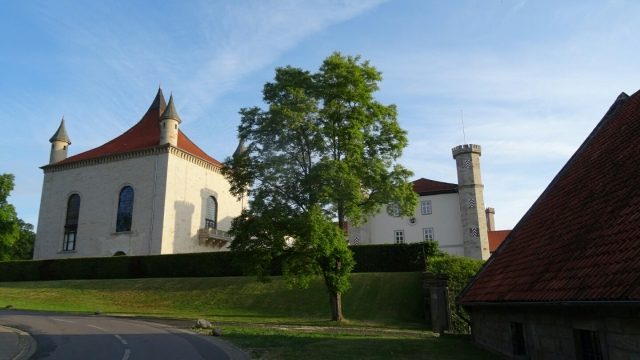
To be privately owned
Derneburg Castle
Originally, there was a manor house in Derneburg, which the brothers Hermann and Heinrich von Assel held as a fief from Burchard I von Loccum. In 1130, Hermann murdered his liege lord. Thereupon, in 1143, the brothers handed over Derneburg to the Diocese of Hildesheim as atonement, with the stipulation that a nunnery be founded. Due to a lack of financial means, this only came into being in 1213, when the convent of Augustinian nuns from Holle was relocated to Derneburg. Thus, the Augustinian Canonesses' Abbey of Derneburg was established in the castrum Sanctae virginis Derneburgense ("fortified house of the Holy Virgin of Derneburg").
In the following 10 years, the monastery expanded its possessions and added countless plots of land and tithes from the surrounding villages. Bishop Konrad II also handed over the main and baptismal church of St. Martin in Sottrum to the provost of the Derneburg monastery in 1223. A document concerning the incorporation of the Sottrum church into the monastery is not available. During an investigation at the Council of Basel in 1436, which was to examine the legality of this transfer to the monastery, documentary proof of the incorporation could not be provided, as, according to the monastery, the documents had been burned. However, the investigation must ultimately have been in favor of the monastery, as by the 16th century, all the assets of the Sottrum church were in the possession of the monastery.
At the beginning of the 14th century, the monastery became impoverished, and the monastic customs were increasingly disregarded by the sisters. In 1370, an excommunication occurred. In 1443, Abbot Heinrich Barnten from Marienrode Abbey unceremoniously had the monastery cleared of the disobedient nuns and handed over the religious institution to the Cistercians. They sent nuns from Wöltingerode Abbey to Derneburg.
In 1523, the monastic parish of St. Andreas placed itself under the protection of Erich I of Calenberg during the Hildesheim Diocesan Feud, because there were repeated plundering raids by Duke Heinrich II's cavalry. Derneburg Abbey - as an exclave of Calenberg - was therefore only reformed in 1543 by the church visitation of Margravine Elisabeth of Brandenburg, Princess of Calenberg-Göttingen.
With the Reformation in the 16th century, the monastery was converted into a Lutheran convent for noblewomen, which remained in the possession of the Dukes of Braunschweig until the 17th century. In 1643, after the restoration of the Diocese of Hildesheim in preparation for the Peace of Westphalia, the monastery was recatholicized and in 1651 was settled as a filiation by Cistercian monks from the Rhenish Abbey of Altenberg under Abbot Jodokus Rebroik. Due to repeated plundering and contributions during the Thirty Years' War, the buildings were dilapidated; the monks still found three old canonesses.
The Cistercians began a lively building activity, took measures to improve the landscape around the monastery site, and thus laid the foundation for Derneburg's still visible wealth. With their proven Cistercian hydraulic engineering, still recognizable today, they regulated the waters and reclaimed fields and pastures, which they effectively cultivated. They opened a sandstone quarry, where they obtained the building material for the farm buildings and the convent buildings, which were renewed in the 18th century. From 1735 to 1749, the Cistercians created the Baroque monastery church (master builder Johann Daniel Köppel) and the buildings of the domain. In 1803, the abbey was secularized.
Conversion to a Castle
Through secularization, the Prussians dissolved the monastery with 14 monks in 1803 and made it a Prussian state domain. Four years later, French troops occupied the estate and plundered it. In 1815, Derneburg, as part of the Prince-Bishopric of Hildesheim, fell to the Guelph Kingdom after the Congress of Vienna. King George III gifted the neglected former Derneburg monastery and its land to the Hanoverian minister Count Ernst zu Münster (1766–1839) in gratitude for his successful negotiations at the Congress. His son Georg Herbert converted the monastery building into a castle between 1846 and 1848. The buildings received an architectural design in the English Gothic Tudor style during the course of renovations and new constructions, which was unusual in Lower Saxony but corresponded to the imagination of the Count, who grew up in London.
With the help of the Hanoverian architect Georg Ludwig Friedrich Laves, an English landscape garden was created around the castle even under Count Ernst zu Münster, and the following facilities were built near the castle:
- "Tea Temple" (1830) (colloquially). A temple-like structure in ancient Greek style with Doric columns as a viewpoint for the Count, formerly with a fireplace room.
- Laves Bridge (1838). A pedestrian bridge over the Nette, reconstructed in 1992, featuring the "Laves beam," a fish-belly truss underneath. This construction allows for a slender bridge when spanning longer distances.
- Mausoleum (1839). Built as an Egyptian steep pyramid eleven meters high. Inside is the von Münster family tomb for the builder and numerous other family members.
- Tower ruin near Astenbeck, which was formerly part of the line of sight to the Tea Temple. Today, the line of sight is obscured by tree growth, but the tower can be seen from federal highway B 6.
Today
During World War II, the castle was a Wehrmacht hospital, and after the war, a hospital for the British Army of the Rhine. After the war, many displaced persons sought refuge in the castle, leading to the establishment of a refugee camp. Approximately 250 elderly people lived there for five years in a dedicated area for the elderly. This led to the creation of the St. Josef Home of Caritas, which was relocated to Hildesheim in 1952, as Count zu Münster, who had fled to England, demanded his castle rooms back.
In 1955, the state of Lower Saxony acquired the castle's land for the operation of the former neighboring castle domain. The castle remained in the possession of the Münster family, who, after five generations, sold it in 1975 through Peter Graf zu Münster to the artist Georg Baselitz. In 2006, the American broker and art collector Andrew J. Hall finally acquired the property. The castle is privately owned and not open to visitors. It is – after extensive renovation under the direction of architect Tammo Prinz – in good structural condition, as is the state-owned domain.
Take Mobile History with you
You are reading this text for free. Premium adds what matters on the road: descriptions read aloud, sites found through your camera, whole regions taken offline.
- Every description, including the ~17,700 Premium sites
- Audio guide: have descriptions read to you on location
- AR finder: see sites through your camera, with distance and bearing
- Unlimited saved sites
14 days free, then from €2.99 a month. Cancel anytime.
Location: 52.0957, 10.1320