To be privately owned
CastleDětenice
Dětenice Castle
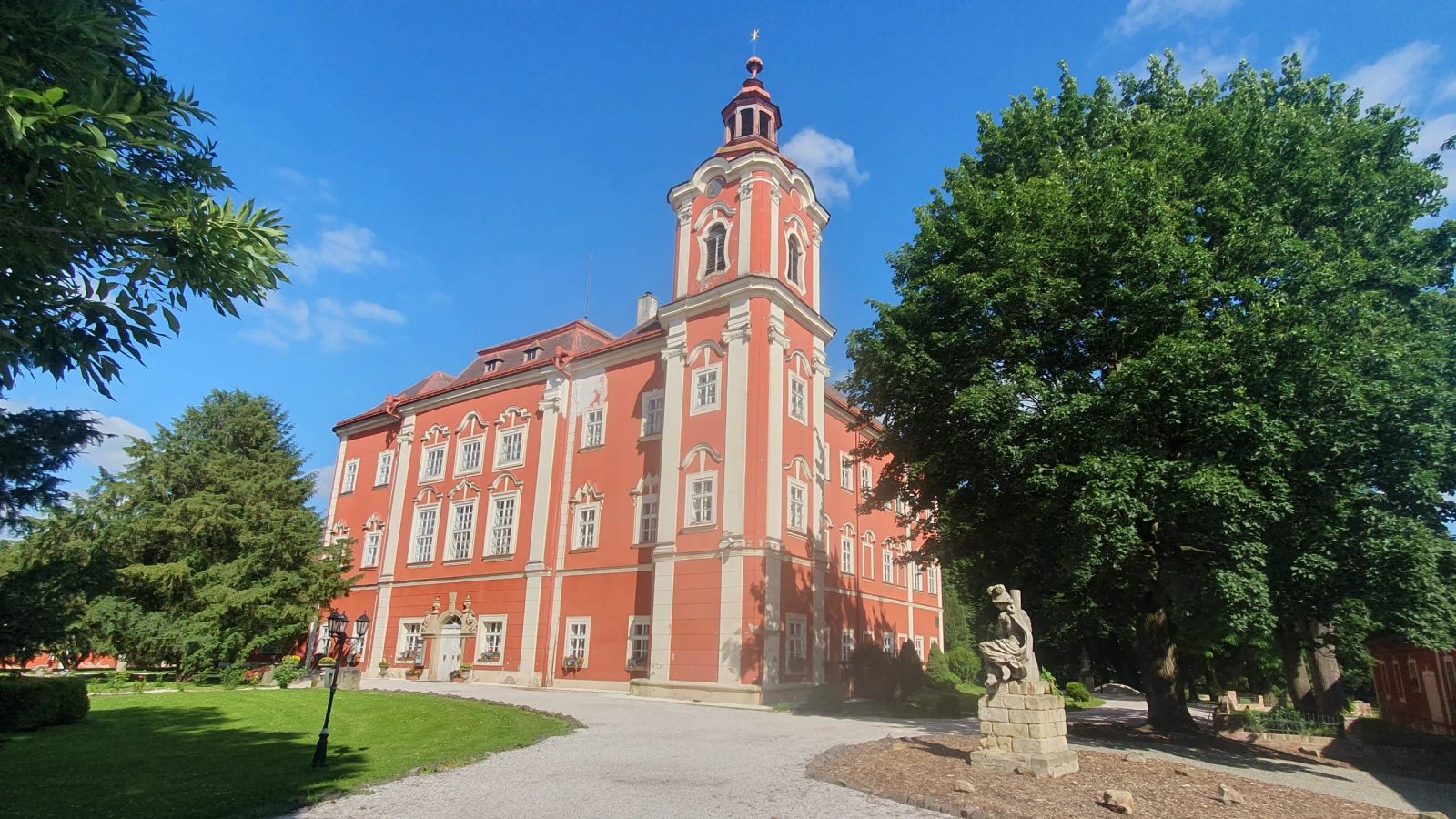
Dětenice Castle (German Jettenitz) is located south of the Bohemian Paradise in the Czech Republic.
History+
In 1295, Beneš von Hruštice, the ancestor of the Dětenice and Waldstein families, built a fortress on the site of the present-day castle. From 1503, Dětenice was owned by the Lords of Křinecký. Bohuslav Křinecký von Ronov converted the Gothic fortress into a Renaissance castle in 1587. After his death, his widow married Wenzel von Lobkowitz. She managed the castle with him until her son Jiří Křinecký von Ronov came of age and took over the regency. In 1619, he erected the tower, which has retained its original appearance to this day. After the Battle of White Mountain, the property was confiscated by Emperor Ferdinand II. Jiří Křinecký was to be executed, but managed to flee to Saxony in time. Albrecht von Wallenstein, who had owned the castle since 1622, exchanged it a few years later for other lands with the highest court master of the Bohemian Crown, Adam von Waldstein. His son Karl von Waldstein sold Dětenice to Jan Christoph von Waldstein. After him, his son Ladislav Octavian (1670–1717) reigned, who advocated for the re-Catholicization of the area. Octavian's daughter married the Count of Burg Kunburg and, after his death, Count Batthyány. The latter was the tutor of the future Emperor Joseph II and managed Dětenice from 1760. During the reign of Count Christian Clam-Gallas, the castle was converted into a late Baroque castle in 1762–1765 according to a design by the master builder Zacharias Fiegert. Christian's son Karl Clam-Gallas reigned in Dětenice from 1775–1783. He left the place after the death of his wife. The next owner was Baron Jakob Wimmer von Wimmersberg, a well-known Prague benefactor who had become rich during the Napoleonic Wars as the main supplier to the imperial army. Due to losses on the stock exchange, he lost all his possessions. The next owner from 1808 was Jan Philip Wesenberk von Ampringen, a prominent Austrian diplomat and Prime Minister of the Habsburg Monarchy. After the revolution of 1848, however, he had to flee. His grandson Philip Wesenberk had the estate further expanded in the following years. After being accused of high treason in 1873, he chose suicide by shooting in Vienna. As he was a Knight of Malta, he bequeathed the castle to the Order of Malta in his will. In recognition of his services, Emperor Franz Joseph I granted the princely title to the Maltese Grand Prior of Bohemia and Austria, Othenio Lichnovský, and his successors in 1881. Othenio initiated further structural changes to the castle. After his death, Prince Quido Thun-Hohenstein took over. Thereafter, Dětenice was managed by a Count of Hardegg (Hardegg). During his tenure, the Spanish Queen Maria Christina visited Dětenice. In 1903, the industrialist Adolf Bloch acquired Dětenice. His son Rudolf Bloch, however, lost all his fortune on the stock exchange. In 1927, the architect Emanuel Řehák acquired the property. He was a great patriot who promoted the region economically and made part of the castle accessible to the public. In 1948, the property was expropriated by the Czechoslovak State. A girls' school for horticulture was established in the castle and later a home for difficult-to-educate children. In 1998, the Ondráček couple acquired and reconstructed the castle. The interior furnishings do not come from the castle itself, but from a variety of castle depots as loans for furnishing a castle after the restoration of the castle buildings in the early 2000s.
Take Mobile History with you
You are reading this text for free. Premium adds what matters on the road: descriptions read aloud, sites found through your camera, whole regions taken offline.
- Every description, including the ~17,700 Premium sites
- Audio guide: have descriptions read to you on location
- AR finder: see sites through your camera, with distance and bearing
- Unlimited saved sites
14 days free, then from €2.99 a month. Cancel anytime.
Source: Wikipedia · Licence: CC BY-SA 4.0 · Image: Foto: Jörg Heldt (Community)
This description is a machine translation of an excerpt from the linked Wikipedia article. The source text was written by its authors, the translation is by Mobile History; like the original it is licensed under CC BY-SA 4.0.
Location: 50.3680, 15.1730