School
CastleHochstetten - Dhaun
Dhaun Castle
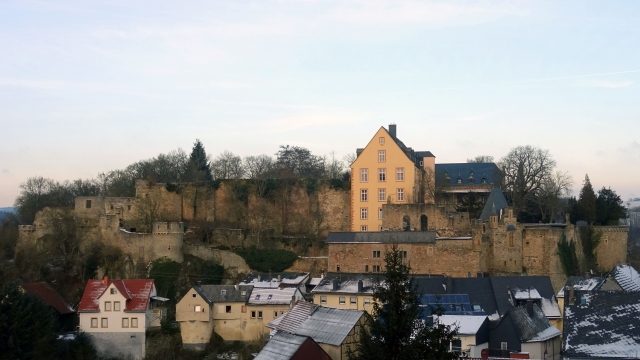
The castle ruin Dhaun, the largest complex of its kind in the Nahe Valley, stands high above the Kellenbach Valley in Rhineland-Palatinate. Originally a medieval castle, it was transformed into a baroque palace.
The origins of Dhaun Castle date back to the 12th century when it was built as a castle by the Counts of Nahegau. First documented as "castrum de Dune" in 1215, it was a fief of the Imperial Abbey of St. Maximin in Trier and served to protect the territory of the Wildgraves. In 1340, the castle was besieged during the Dhaun Feud by troops of Archbishop Balduin of Trier, who was in dispute with Lord Johann I of Dhaun. The Archbishop won the feud and was granted the right of access to the castle. After Johann's death in 1350 without male heirs, the complex passed to his nephew, Rheingraf Johann II vom Stein, marking the beginning of the era of the Dhaun Wild- and Rheingraves. In the 15th and 16th centuries, the castle was extensively expanded, including the construction of the barbican of the upper castle in 1526 and a three-story underground passage system. In 1729, the complex was converted into a baroque palace under Wild- and Rheingraf Karl von Dhaun, with the palas in the west becoming a residential palace and a horseshoe-shaped layout emerging. After Karl's death in 1733 and the conquest by French revolutionary troops in 1794, the castle was auctioned off in 1804, and its structural components were moved to Kauzenburg.
Source: Wikipedia · Licence: CC BY-SA 4.0 · Image: Jörg Heldt
This description draws on the facts documented in the linked Wikipedia article; Wikipedia content is licensed under CC BY-SA 4.0. Wording and editing: Mobile History.
Location: 49.8161, 7.4999