Cultural Events
To be privately owned
Dilborn Castle (Brüggen)

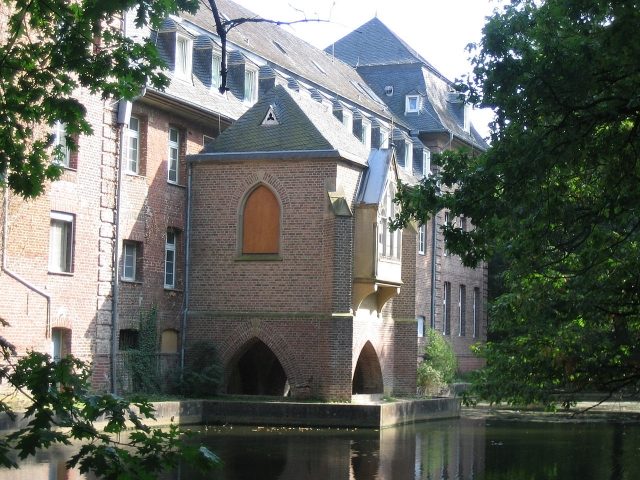
Dilborn Castle is a former moated castle on the banks of the Schwalm and belongs to the municipality of Brüggen on the left Lower Rhine in North Rhine-Westphalia.
The Beginnings
The predecessor of Dilborn moated castle was probably built around 1200 on a motte.
13th–18th Century
Dilborn (= "Source of Odilia") was, from the beginning of the 13th century, a fief of Duke Eduard of Geldern to the Lords Seger von Swalmen. It was first mentioned in a document in 1363 as this very fief.
Between 1583 and 1854, it remained in the hands of the related families von Elmpt and Geloes, who belonged to the Maasland-Rhenish nobility. After the construction of the east wing in 1583, all investments ceased for almost three centuries, regardless of changing owners. After the Geloes family, these were first the von Hoesch families, then the Imperial Counts von Hallberg in 1784. During their ownership, the long-lasting substance losses took their toll for the first time: the dilapidated east wing had to be demolished.
19th Century
After minor investments in the first third of the 19th century, an era of stabilization began for Dilborn in 1854 with the sale of the moated castle to Imperial Count Julius von Schaesberg. The Imperial Count had a neo-Gothic castle chapel built in the castle pond, the garden and park were completely redesigned, and a new farm building was also constructed south of the access road.
20th Century
However, when the Counts von Schaesberg had to pay for the reconstruction of their ancestral seat Krickenbeck and therefore sold Dilborn to the Imperial Counts von Westerholt in 1910, a new phase of neglected investments began. Dilborn was partly leased as an agricultural estate, partly rented to several parties for residential purposes. This allowed the couple Marie von Malachowski and Heinrich Nauen to live and paint at Dilborn from 1911 to 1931; they are among the most important representatives of Rhenish Expressionism. Later, Dilborn successively served as quarters for Westwall workers, as a camp for the female Reich Labour Service, and as a command post for a German Luftwaffe general. After that, Dilborn had become dilapidated in every respect.
Current Situation
Immediately after the Second World War, the Dernbach Sisters took over the paradisiacally located torso and bought the castle together with the grounds from the Counts von Westerholt in 1949. In several stages and with endless commitment, they converted the castle into a children's home, with the city of Mönchengladbach providing extensive assistance. In doing so, they encountered the sum of past sins so persistently that the south tower and the southern central section had to be demolished down to the foundations and replaced by a "picture-perfect" new building. The farm building also received a new purpose. In the first decades of the twentieth century, Dilborn was a "classic" orphanage and was mentioned in connection with the mistreatment of children within the framework of "Black Pedagogy". Meanwhile, "Schloss Dilborn - Die Jugendhilfe" (Dilborn Castle - Youth Welfare) continues the work begun more than half a century ago in a new legal form and with an updated social orientation in the moated castle located on the Schwalm and in a high forest.
At the end of 2007, Dilborn Castle was sold to the Swiss architect Auguste Triet, who lives in Düsseldorf and is now planning a renovation of the complex. Triet, managing director of the company TBP Generalplaner, intends to use part of the castle privately in the future, among other things, while the youth welfare part will also be renovated by Maria Hilf NRW gGmbH.
Since September 2006, the Niederrhein Theater has regularly performed in the castle's cultural hall. Every year, plays for children and adults are staged there, premiere at the castle, and then go on tour from here.
Take Mobile History with you
You are reading this text for free. Premium adds what matters on the road: descriptions read aloud, sites found through your camera, whole regions taken offline.
- Every description, including the ~17,700 Premium sites
- Audio guide: have descriptions read to you on location
- AR finder: see sites through your camera, with distance and bearing
- Unlimited saved sites
14 days free, then from €2.99 a month. Cancel anytime.
Source: Wikipedia · Licence: CC BY-SA 4.0
This description draws on the facts documented in the linked Wikipedia article; Wikipedia content is licensed under CC BY-SA 4.0. Wording and editing: Mobile History.
Location: 51.2347, 6.1789