To be privately owned
Drakenburg Castle
The medieval Drakenburg (Low German for Dragon Castle), which gave the town its name, was a castle complex located directly on the Weser. Almost nothing is known about its appearance. It was owned by the Counts of Wölpe, who resided here temporarily until they moved their seat to Neustadt am Rübenberge in the 13th century. After the extinction of the Wölpe line of counts in 1302, Drakenburg was owned by the Counts of Hoya. The castle was probably built in the 12th century. It was destroyed in the 14th century during the Mandelsloh Feud, probably in 1390. The extent to which the castle was rebuilt afterwards is unknown. The castle is mentioned in sources until about 1450. There is no clear evidence of the castle's continued existence after 1450. It is very unlikely that the castle still existed at the time of the Battle of Drakenburg in 1547. The few mentions of the castle in sources from 1390 to 1450 and its silent "disappearance" in any case argue against any particular significance after its destruction in the Mandelsloh Feud. The castle certainly no longer existed at the time of the Thirty Years' War. Its remains were carried away at an unknown time, probably by a Weser flood in the 17th century, along with the ground on which it stood. Its location can no longer be clearly pinpointed, as the corresponding area today belongs to the course of the Weser River.
In 1547, after the imperial siege of Bremen was broken off during the Schmalkaldic War, the Battle of Drakenburg took place. In this open field battle near Drakenburg on the Weser, the troops of Duke Erich II of Braunschweig-Lüneburg and those of the Schmalkaldic League under Count Albrecht von Mansfeld clashed.
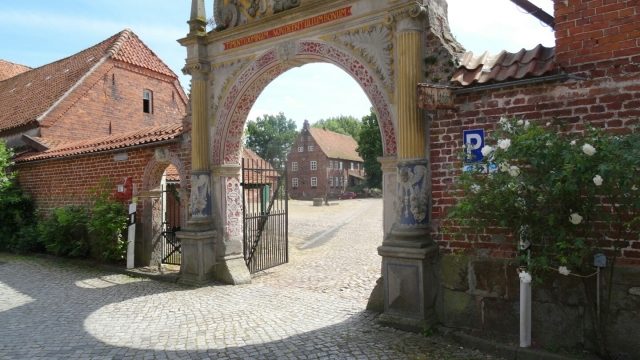
In addition to the medieval Drakenburg, there was a three-winged castle complex in the town, probably built by Heinrich von Rantzau, who had become lord of the largest manor in Drakenburg through his marriage to Christine von Halle. It was burned down in the Thirty Years' War in 1627, along with the town of Drakenburg, during Tilly's second siege of Nienburg by the Danish defenders of Nienburg. This was to prevent Tilly from being able to quarter in Drakenburg as he had during the first siege of Nienburg. However, this measure could not prevent the capture of Nienburg by the Imperial forces. The castle was affected by another fire in 1790. The Renaissance-style courtyard gate (Drakenburg's magnificent portal) and one wing of the main building have been preserved.
Take Mobile History with you
You are reading this text for free. Premium adds what matters on the road: descriptions read aloud, sites found through your camera, whole regions taken offline.
- Every description, including the ~17,700 Premium sites
- Audio guide: have descriptions read to you on location
- AR finder: see sites through your camera, with distance and bearing
- Unlimited saved sites
14 days free, then from €2.99 a month. Cancel anytime.
Location: 52.6861, 9.2100