Uninhabited
CastleDrogosze (Dönhoffstädt)
Drogosze Castle
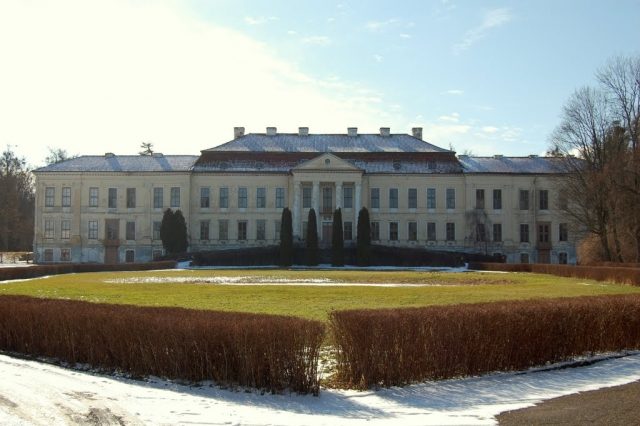
Dönhoff Castle, belonging to the Counts Dönhoff, was built for Bogislaw Friedrich von Dönhoff somewhat away from the old site on a slope after a fire destroyed the old Renaissance castle of Groß Wolfsdorf and was named "Dönhoffstädt". The design of the building came from the architects Jean de Bodt (1670–1745) and the master builder John von Collas (1678–1753), both Huguenots. It was built from 1710 to 1716 and then remained in the possession of the Dönhoffs until 1816. In the division of inheritance after the death of Count Stanislaus Dönhoff in 1816, his sisters divided the extensive family estate, with Angélique Dönhoff (1793–1863) receiving the Dönhoffstädt estate and castle. She later married Count Georg zu Dohna. In 1863, her niece Marianne Countess zu Stolberg-Wernigerode, née Baroness von Romberg (1821–1884), inherited the extensive Dönhofstädt estate, whose descendants resided there until 1945. Her son Count Udo zu Stolberg-Wernigerode (1840–1910) was President of the Reichstag. The castle had its own theatre in the western side wing, an extensive library, and a house chapel in the east wing, which underwent a neo-Gothic redesign in the 1830s. Behind the castle to the south extends an extensive landscape park, which dates back to Count Bogislav Dönhoff (1754–1809) and which also included a fallow deer enclosure (wildlife park). Remains of the baroque garden complex, in the form of some sandstone sculptures and vases, were preserved around the castle until 1945. Significant parts of the archive were evacuated by the Poles after 1945 and are now in the Olsztyn Archive (German: Allenstein). When the area was placed under Polish administration after the Second World War, an agricultural school was initially established in the building. Since the end of the People's Republic of Poland, the building has been unused. Plans to build a hotel have not yet been implemented.
Castle Chapel+
The church patron Count Bogislaw Friedrich von Dönhoff established a chapel in the eastern part of the castle in 1725. It was rectangular, built of fieldstones, and had no tower: the bells hung in the roof truss. The interior and its furnishings were kept very simple, in accordance with the taste of the builder and committed to the Reformed tradition. The ceiling was vaulted and partly decorated with stucco.
The Königsberg organ builder Johann Schwartz built a small house organ in 1734/24, which was installed in 1730. It had one manual with eight stops in bass and treble division and no pedal. In 1933, the Lübeck organ builder Karl Kemper brought the instrument from Dönhofstädt to the Hanseatic city – probably in exchange for a new organ. Initially, it was located in St. Catherine's Church, and in 1948 it was moved to St. Mary's Church, where it functioned as the so-called "Briefkapellenorgel" (Letter Chapel Organ) and, as a well-preserved baroque organ, still accompanies services today – especially between January and March in the Briefkapelle as a winter church. In 1818, the Reformed parish of Dönhofstädt joined the Old Prussian Union in the association of Lutheran and Reformed churches, but took longer to give up its previously cultivated independent life. In the 1830s, a redesign of the chapel began, in which Lutheran elements also came into play. On August 5, 1860, the altar, made in Rome from Carrara marble, was installed, accompanied by a marble bas-relief of the Entombment of Christ by August Wittig (1823–1893), who also designed the bas-reliefs of the Baptism and Resurrection of Christ in white marble. The altar marble relief is now in the St. John the Evangelist Church in Bartoszyce (German: Bartenstein). A carved pulpit was placed above the altar. In addition to the castle chapel, the memorial chapel for the former estate owners from 1884 is still preserved today, including marble sarcophagi by the Berlin sculptor Eduard Lürssen (1840–1891) for members of the von Dönhof family. After 1945, the castle chapel, like the castle itself, was put to other and also secular uses.
Take Mobile History with you
You are reading this text for free. Premium adds what matters on the road: descriptions read aloud, sites found through your camera, whole regions taken offline.
- Every description, including the ~17,700 Premium sites
- Audio guide: have descriptions read to you on location
- AR finder: see sites through your camera, with distance and bearing
- Unlimited saved sites
14 days free, then from €2.99 a month. Cancel anytime.
Source: Wikipedia · Licence: CC BY-SA 4.0 · Image: Maciek Wegrzyn
This description is a machine translation of an excerpt from the linked Wikipedia article. The source text was written by its authors, the translation is by Mobile History; like the original it is licensed under CC BY-SA 4.0.
Location: 54.2074, 21.2331