CastleMoorrege

Düneck Castle

Düneck Castle

Apartments

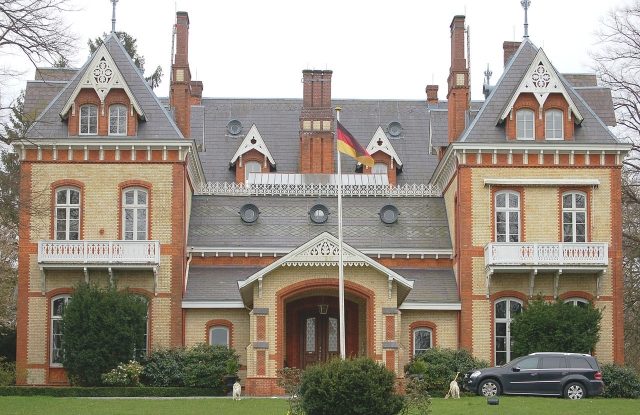
The castle-like building is located in an extensive park on Klinkerstraße in Moorrege. Although it is known as Schloss Düneck, it is not a castle. Rather, it was designed as a country house for the wealthy German-American Michael Lienau (1816–1893), who had it built in 1871. The architect was his brother Detlef Lienau (1818–1887), who was considered one of the most important American architects of his time.

The main and ancillary buildings, as well as the park, are registered in the monument book as cultural monuments of particular importance.

History of Origin+

Michael Lienau, originally from Uetersen, took over his father Jacob Lienau's wine trade and initially specialized in importing French wines. He eventually settled in New York and amassed a considerable fortune with his company Diedrichs and Lienau, founded there in 1841, and in the textile trade. Lienau was also entrusted with the management of several New York fire insurance companies and was president of the First National Bank of Jersey City. In his first marriage, he was married to Sarah Adeline Booraem, who came from a traditional American family from New Amsterdam; in his second marriage, to Sarah Francis Van Vorst, from one of the oldest and wealthiest families in New Jersey. Lienau returned to Germany with his second wife.

He planned to build his new domicile in the middle of a large park on the edge of the Pinnau lowlands. Sand drifts in the dune area, sparsely covered with stunted pines, made the creation of the park difficult. Lienau eventually had large parts of the area leveled and covered with heavy clay soil from the marsh.

Architecture+

Detlef Lienau, who studied at the Gewerbeschule founded by Dr. Klöden in Berlin in 1837, later studied at the Royal Building Academy in Munich. His 177 surviving hand drawings and ornament studies, which are in the archive of the Avery Library at Columbia University New York, suggest an intensive study of the styles that characterized Schinkel's Berlin. The talented architect always strived for purity and balance. In 1847, he received first prize for his Neo-Classicism-oriented design for the Altona Hospital, the construction of which, however, was only carried out from 1859 to 1861 and redesigned by the architect Winkler with a brick cladding. From 1842 to 1846, Detlef Lienau worked in the office of the French architect Henri Labrouste in Paris, whose most famous creations include the Bibliothèque Sainte Geneviève (Henri Labrouste, Wikipedia). In Paris, Detlef Lienau received decisive influences. In New York, where he followed his brother, he quickly became successful and built villas and country houses for numerous prominent Americans. His name was linked to the introduction of the French mansard roof from the Second Empire period. For his brother Michael, he designed a small "cottage" in New Jersey, whose covered entrance area anticipates the much more elaborate one of Düneck. Lienau's most famous building in the USA is the villa for the railway entrepreneur LeGrand Lockwood in South Norwalk (Connecticut), oriented in its exterior design to the French Renaissance style, and exuberantly luxurious inside. Detlef Lienau also designed the simple Lienau family house in Uetersen, which temporarily housed the wine trade. The original drawings for Schloss Düneck, the ancillary buildings, and the gate are in the archive of the Avery Library at Columbia University New York.

Schloss Düneck is an eight-axis building with two main floors and a high basement, built with yellow and red bricks. The slate roof is enlivened by numerous dormer windows with white decorative gables. The southeast side with the conservatory is generally simpler than the entrance side in the northwest. There, two side wings frame the representative entrance. Inside, a continuous hall connects. The side rooms of the first floor are accessible from a gallery. The ensemble is illuminated by a large, artfully framed skylight window.

Changing Uses+
  • Michael Lienau's death in 1893 was followed by business decline. The family sold the estate to the brickyard owner and shipowner Captain Johann Peter Baas, originally from Uetersen, who was related to the Tantau and Kedenburg families. Lienau and Baas were business partners. Together with Dr. Ludwig Mein and Klosterprobst v. Ahlefeldt, they founded the "Uetersener Dampfziegelei" (Uetersen Steam Brickyard), later "Uetersener Dampfziegelei J.P. Baas Nachfolger" (Uetersen Steam Brickyard J.P. Baas Successors). In 1874, Lienau, Baas, and Mayor Ernst Heinrich Meßtorf founded the "Uetersener Credit-Verein e.G.", since 1920 "Uetersener Bank eGmbH", since March 1941 "Volksbank Uetersen eGmbH".
  • Johann Peter Baas leased Schloss Düneck to the sanatorium doctor Dr. Erfurt, who used the house as a sanatorium for girls from wealthy families at risk of alcoholism. In 1905, Baas left Schloss Düneck to his daughter Emma Margarethe Baas and his son-in-law Dr. med. Eduard Schwab, who transformed Düneck into a psychiatric hospital. It had to be closed in 1908 after suicides occurred.
  • After that, Schloss Düneck had changing owners and stood empty and unused for many years. In 1923/24, the Landesbank Kiel acquired it at a compulsory auction.
  • In 1937, the Landesbank sold Schloss Düneck to Nordmark-Werke. The founders Julius Wolf and Alfred Voss, honorary consul of Hungary and owner of Hinrich Voss's margarine factories in Altona, moved with their families from Hamburg to Düneck in 1943. Annemarie Voss, Alfred Voss's widow, remained in Düneck like Julius Wolf and continued the margarine factories after his death. As local chairwoman of the DRK in Moorrege and as a member of the DRK presidium in Kiel, she dedicated herself to numerous charitable tasks.
  • When Nordmark-Werke, which had been taken over by BASF in 1968, submitted a demolition application in 1980, the Moorrege municipal council became active. They prevented the demolition by drawing up a development plan with a change freeze. They also successfully pursued monument protection.
  • After several years of negotiations, a private investor, Hans-Werner Rathjens, took over the property. He set up several condominiums and restored the building and park. The former Uetersen mayor Lothar Mosler advocated for the preservation and monument protection of the house.

Take Mobile History with you

You are reading this text for free. Premium adds what matters on the road: descriptions read aloud, sites found through your camera, whole regions taken offline.

  • Every description, including the ~17,700 Premium sites
  • Audio guide: have descriptions read to you on location
  • AR finder: see sites through your camera, with distance and bearing
  • Unlimited saved sites

14 days free, then from €2.99 a month. Cancel anytime.

Source: Wikipedia · Licence: CC BY-SA 4.0 · Image: http://de.wikipedia.org/wiki/Datei:Schlo%C3%9F_D%C3%BCneck_Vorn01.jpg

This description draws on the facts documented in the linked Wikipedia article; Wikipedia content is licensed under CC BY-SA 4.0. Wording and editing: Mobile History.

Location: 53.6736, 9.6657