To be privately owned
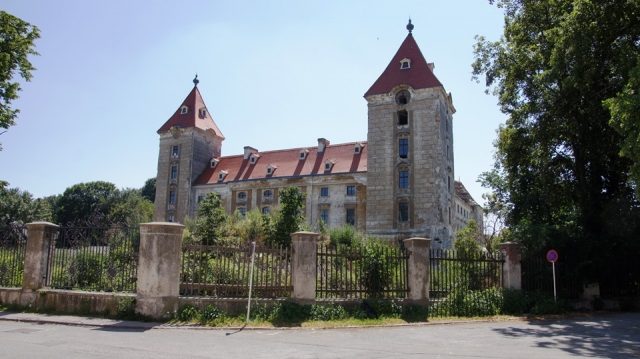
Ebenfurth Castle

Ebenfurth is likely one of the oldest castles in Austria. It is assumed that a fortified structure already existed on the site of the later castle at the beginning of the 12th century. Since a castle in Ebenfurth is only mentioned in documents in 1263, it was probably a "Festes Haus" (fortified house) before that.
The place "Ebenfurte" is first mentioned in documents in 1160. It was a fief of the Diocese of Passau. The ford was probably protected by a tower. This complex was in the feudal possession of the Feldsberg/Seefelder family in 1250. After the extinction of this family (1269), Ebenfurth passed into the ownership of the Pottendorfer family around 1270. In 1293, Chunrad von Pottendorf received permission from Duke Albrecht I to rebuild and expand the damaged castle.
It is possible that it had already been severely damaged in the Battle of Leitha in 1246 or only during the Hungarian wars. He created a small Romanesque moated castle. The Pottendorfer family kept Ebenfurth until their extinction towards the end of the 15th century, reinforcing the fortifications several times. In the conflicts between Emperor Frederick III and King Matthias Corvinus in 1485, Ebenfurth fell into the hands of the latter and was pledged. When King Matthias died in 1490, a Hungarian garrison remained in Ebenfurth, which had to be driven out by the imperial troops.
Since Jörg, the last Pottendorfer, had meanwhile died, Ebenfurth now became princely. The lordship was successively pledged to Stephan von Zips, Heinrich Prüschenk Graf von Hardegg (1495), Hans von Rappach, and the Lords of Stamp. In 1582, Ebenfurth came into the possession of the Unverzagt family, first as a pledge and then in 1589 by purchase. At the beginning of the 17th century, the high medieval castle was transformed into a Renaissance palace. The Baroque transformation took place in the first third of the 18th century by the Unverzagt family. From 1747 until the second half of the 20th century, Ebenfurth Castle belonged to the Suttner family.
In the last weeks of the Second World War, the castle temporarily served as a reception center for tens of thousands of refugees. Neglect and severe damage occurred under Russian administration from 1945 to 1955. The castle was subsequently left to decay. When Carl Suttner sold the already ruinous building to Dr. Liebleitner in 1979, the new owner could not stop the further decay. After the penultimate change of ownership (2000), with financial help from the state of Lower Austria, the huge roof landscape could be renovated. Since 2010, Dragana Mirković Bijelic and Anton Bijelic are the new owners, who have already begun the renovation of the castle.
Take Mobile History with you
You are reading this text for free. Premium adds what matters on the road: descriptions read aloud, sites found through your camera, whole regions taken offline.
- Every description, including the ~17,700 Premium sites
- Audio guide: have descriptions read to you on location
- AR finder: see sites through your camera, with distance and bearing
- Unlimited saved sites
14 days free, then from €2.99 a month. Cancel anytime.
Source: Wikipedia · Licence: CC BY-SA 4.0 · Image: http://www.wehrbauten.at/noe/niederoesterreich.html
This description draws on the facts documented in the linked Wikipedia article; Wikipedia content is licensed under CC BY-SA 4.0. Wording and editing: Mobile History.
Location: 47.8758, 16.3687