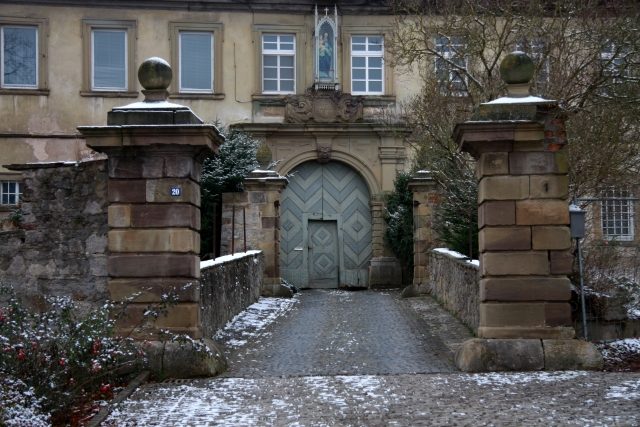
CastleEbenhausen

Ebenhausen Castle

Ebenhausen Castle

To be privately owned

The Hennebergers, as successors to the former Gau counts' offices, established their tithes* in Ebenhausen. Ebenhausen was a Hennebergian tithe from the beginning. Presumably, a castle complex was already built at the site of the present-day castle at that time. In 1315, Heinrich IV von Henneberg sold Ebenhausen Castle and town for 200 marks of silver to his cousin Heinrich V.

The walls and towers, built in the late medieval architectural style, clearly date from before 1400. A secret passage was also built during this period, which is still present today and leads out under the castle barn through the surrounding wall.

During the Peasants' War, all castles in the Ebenhausen district were destroyed. Ebenhausen Castle was also set on fire. During renovation work in the right part of the residential building wing, burn residues were found under the interior plaster of the facade wall. This part of the building clearly dates from this period due to its architectural style. The castle was renovated and rebuilt after the Peasants' War.

In a description of the possessions of the von Münster family from 1570, Ebenhausen Castle is listed, among others. The castle was sold to the Bishop of Würzburg in 1576.

In 1587, construction began on the castle barn, which still stands today. The building is three-storied and was built in the Gothic style. The construction costs amounted to 2312 guilders, 4 marks, and 23 pounds. The construction was completed in 1603. The builder was Prince-Bishop Julius Echter.

In 1641, the Swedes burned half of Ebenhausen down because they were shot at from the castle tower.

During the reign of Prince-Bishop Johann Philipp II von Greiffenklau (1699-1719), the southern part of the castle building was erected. The architect was probably Balthasar Neumann. The building wing, a two-story structure, was built in the Baroque style.

After the dissolution of the Prince-Bishopric of Franconia and the annexation of Franconia to the Kingdom of Bavaria in 1802, the Ebenhausen district was also dissolved. Ebenhausen was subordinated to the Euerdorf district court. The castle itself was now the property of the government of Lower Franconia. The administrator appointed by the government carried out his administrative activities until 1804 and resided in the castle. After that, the castle stood empty.

In a municipal directory from 1834, the castle served as a residence for the hunter Josef Haidt, who was employed at the Ebenhausen forestry office. After the dissolution of the forestry office, the castle stood empty again.

The empty castle was subsequently used as a source of building materials, and usable windows, doors, and other materials were stolen from the castle.

In 1847, Michael Schubert bought Ebenhausen Castle for 9000 guilders from the government of Lower Franconia. Since then, the castle has been used as an agricultural estate.

The Second World War also left its mark on Ebenhausen Castle. The castle barn and the horse stable on the Schubert family's estate received a total of seven shell hits. The damage was repaired in 1946, but traces are still visible today.

Take Mobile History with you

You are reading this text for free. Premium adds what matters on the road: descriptions read aloud, sites found through your camera, whole regions taken offline.

  • Every description, including the ~17,700 Premium sites
  • Audio guide: have descriptions read to you on location
  • AR finder: see sites through your camera, with distance and bearing
  • Unlimited saved sites

14 days free, then from €2.99 a month. Cancel anytime.

Source: Wikipedia · Licence: CC BY-SA 4.0

This description draws on the facts documented in the linked Wikipedia article; Wikipedia content is licensed under CC BY-SA 4.0. Wording and editing: Mobile History.

Location: 50.1264, 10.1315